
Composite Material Testing Services

Introduction to Composite Testing Services

Composite testing services play an important role in transforming high-performance materials from laboratories into real-world applications.  Testing ensures that these composites don’t break when it matters most, whether it’s the lightweight frame of an electric car or the protective gear used by sports. Composite testing verifies that these materials maintain their strength and durability promises by mimicking actual circumstances such as collisions, heat exposure, or repeated stress.

Incorporating composite materials results in lighter and more resilient products and components, two key parameters for enhancing competitiveness and differentiation. However, the more companies search for advanced material properties, the more variations we have available. As a result, it is becoming increasingly difficult to predict each material’s in-service behavior.

Importance of Composite Testing Services

Advanced composites are being used in a wide range of products, from sports, aerospace, to even marine applications. The requirement for thorough, reliable testing is growing along with the demand for composites. The tensile strength and compression of a composite, among other properties, can be measured using a variety of tests.

Almost any sector and application can benefit from the engineering of advanced composites. This is because there is an astoundingly large number of resin, reinforcement, and production technique combinations available. 

Composites used in the aerospace sector, for instance, are probably made using different materials and techniques than those used to make a boat’s hull. Likely, the particular laminate configuration under consideration has never been used before due to this customization; thus, it’s crucial to set design allowable so that system designers may proceed with these cutting-edge materials with confidence.

Advanced composites, in contrast to earlier composite materials, are composed of precisely aligned fibers embedded in a variety of matrix materials. Because of this, producing advanced composites can be more expensive and time-consuming, but the results are well worth the effort. By ensuring that all advanced composites can meet system specifications without the addition of extra materials, composite testing makes sure that the time and money invested in design and manufacturing are worthwhile.

Applications and Advantages of Composite Materials and Testing

Composite materials have exceptional benefits, such as their strength-to-weight ratio, which helps to enhance their fuel efficiency in automotive applications and the aerospace industry. The other benefits of composite materials testing include:

  • Enhanced strength and reliability.
  • Better strength bearing capacity.
  • Lightweight and improved performance.
  • Superior resistance to diverse environmental conditions. 
  • Remarkable flexibility and aesthetic design.

Advantages

Performance: Composite materials perform better than traditional materials; the composite material testing ensures higher performance. 

Cost and Manufacturing: Composite materials testing offers long-term cost-saving benefits.

List of Common Tests Under Composite Materials Testing

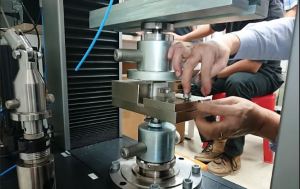
Tensile Tests in Composite Materials: Tensile testing is a mechanical testing method used to measure the mechanical properties of polymer matrix composite materials. It provides essential information about the strength, stiffness, and failure behavior of PMCs, which is important for designing and predicting their performance in various applications.

Compression Testing for Composite Materials: Compressive strength testing is a common method used to measure the compressive strength of composite materials. Compressive strength testing is an important aspect of material characterization for composite materials.

V-Notched Rail Shear Method: For figuring out the in-plane shear characteristics of composite materials, a common technique is the V-notched rail shear method. The evaluation is quick, affordable, and offers precise measurements that may be used to verify design calculations and finite element models.

Fatigue Tests: By delivering cyclic loading to a building or coupon, fatigue testing is a specialized type of mechanical testing. These tests can determine binding sites, produce data on fatigue life and fracture propagation, or show the safety of a structure subject to fatigue.

Compressive Strength Tests: Compressive strength testing is a common method used to measure the compressive strength of composite materials. Compressive strength testing is an important aspect of material characterization for composite materials.

Conclusion

Composite material testing is the most reliable and safest way to manufacture new and innovative, well-qualified materials for a wide breadth of industries. Since these processes can take an extensive time, effort, and resources, it is critical to ensure and understand that the best practices are being followed at every stage of the product life cycle. By following these protocols, composite manufacturers can alleviate the risk of producing sub-optimal products and finalize new, reliable materials. It becomes vital to select the best composite materials testing services in the USA to provide high-quality test results. 

Why Choose Infinita Lab for Composite Testing Services?

With Infinita Lab (www.infinitalab.com), you are guaranteed a Nationwide Network of Accredited Laboratories spread across the USA, the best Consultants from around the world, Convenient Sample Pick-Up and Delivery, and Fast Turnaround Time. 

Our team understands the stakes and subtleties of every test. Whether you’re validating a new Product, de-risking a prototype, or navigating complex compliance requirements, our specialists guide the process with rigor and clarity.  

Looking for a trusted partner to achieve your research goals? Schedule a meeting with us, send us a request, or call us at (888) 878-3090  to learn more about our services and how we can support you. Request a Quote


Essential FAQs on Composite Materials Testing Services

What composite material testing services does your lab offer, and how can they benefit my business?

Infinita Lab offers a wide range of composite material testing services that are specifically designed to satisfy the various requirements of the construction, automotive, aerospace, and other industries. Our services give organizations vital information about the quality, strength, and performance of composite materials. These range from mechanical testing, such as tensile and flexural assessments, to non-destructive testing (NDT), such as ultrasonic and X-ray inspections.

Your company and businesses can guarantee that composite materials fulfill regulatory requirements and industry standards and improve the overall durability and dependability of your goods by utilizing our testing knowledge. This improves your competitive edge in the market and helps with quality assurance while also optimizing manufacturing processes and cutting expenses.

Can Infinita Lab customize Composite Testing services for specific industry needs?

Yes, Infinita Lab can customize Composite Testing services to meet specific industry needs. Our expansive network, collaborating with various specialized material testing laboratories across the U.S., enables us to offer over 2000 tests, including tailored solutions for diverse industries. This collaborative approach ensures that we can adapt our testing services to specific requirements, whether for aerospace, automotive, construction, or other sectors. Infinita Lab’s commitment to quality and efficiency, combined with our ability to customize services, provides clients with precise, reliable testing outcomes, aligning perfectly with their unique industry standards and objectives.

Why should I choose your lab for composite material testing over the other options available?

For composite material testing, our laboratory is the best option because we are dedicated to accuracy, dependability, and customer satisfaction. We have an extensive network of laboratories across the US. We offer 2000 specialized tests that cater to all specific needs of material testing. With state-of-the-art equipment and knowledgeable staff about composite materials, we provide an extensive range of testing services that address non-destructive, mechanical, and thermal aspects. Fortune 500 companies trust us for their quality testing services. 

Our adherence to industry standards, involvement in proficiency testing programs, and application of strict quality control procedures demonstrate our commitment to quality assurance. Furthermore, we recognize the value of prompt and economical solutions, making sure that our clients obtain precise outcomes without sacrificing effectiveness. By selecting our lab, you collaborate with a reputable partner committed to bolstering your company’s success through accurate and trustworthy composite material testing.

How does composite material testing contribute to the durability and reliability of products?

Composite material testing is an essential part of improving the robustness and dependability of products in a variety of sectors. By putting composite materials through rigorous evaluations like impact, fatigue, and environmental exposure testing, companies may learn vital information about how the materials will function in practical situations. With the use of this information, businesses and industries can choose composite materials that are resistant to the unique difficulties posed by the applications for which they are designed, guaranteeing that their products will hold up over time.

Testing composite materials offers important insights into aspects like structural performance, fire resistance, and thermal stability—all of which are critical for applications where dependability and safety are critical. Businesses may increase product lifespans, proactively address possible flaws, and establish a reputation for providing reliable, high-quality solutions by investing in composite material testing.


3 Easy Steps to Start Testing

1
Share Your Testing Material Details with Us
2
Hassle-Free Collection Pick-Up Service
3
We Find the Lab, You Get the Results

Thermogravimetric Analysis (TGA): A Complete Guide to Methods & Applications ASTM C177: Thermal Conductivity of Insulating Materials — Method Guide ASTM D4236 Art Material Labeling Guide for Chronic Health Safety Aerospace Component Testing Procedures: Key Methods & Standards Understanding Tensile Strength: Definition, Importance & How It’s Tested Ash Content Testing — ASTM D2584, D5630, ISO 3451 ASTM D150 Dielectric Constant & Dissipation Factor Testing for Electrical Insulation ASTM C33 Concrete Aggregate Specification Testing ASTM A578 Straight Beam Ultrasonic Examination of Steel Plates (Special Applications) Emerging Materials & Technologies Shaping Aerospace: 2024 Guide What Is Tensile Testing? A Simple Overview for Engineers & Buyers ASTM D2291 Ring Test Specimen Fabrication for Glass-Resin Composites ASTM D2563: Visual Defects in GRP Laminates — Classification & Inspection ASTM D2562: Visual Defect Classification in Reinforced Plastics What Is Materials Testing? Definition, Types, Methods & Industry Uses ASTM D790: Flexural Properties Testing of Unreinforced Plastics – Full Guide ASTM D2343 Tensile Property Testing of Reinforced Plastic Fibers Advancements in Carbon Fiber Reinforced Polymer Matrix Composites Rail Fire Testing: Standards, Methods & Compliance Guide ASTM D3647 Testing for Plastic Pultruded Structural Shapes ASTM D2734 Void Content Testing for Fiber Reinforced Plastics ASTM D953 Bearing Strength Testing for Plastic Materials Testing and Analysis of Composite Materials  Mechanical Engineering Testing Standards: ASTM, ISO & ASME Reference List What Is Delamination & Adhesive Failure? Causes, Detection & Testing Differential Scanning Calorimetry (DSC) for Engineers: Applications Guide What is Radiography Testing? Fire Resistance & Flammability Testing: UL 94, ASTM E84 & Standards Guide Thermomechanical Analysis (TMA): Operations, Analysis & Interpretation Thermomechanical Analysis (TMA): Principles, Applications & Guide What Is Compression Testing? Methods, Standards & Applications Guide Creep Testing: A Comprehensive Guide to Methods, Standards & Material Behavior What Is Creep Testing? Definition, Methods & Material Applications High-Pressure High-Temperature (HPHT) Testing for Polymers Fiber-Reinforced Polymer (FRP) Benefits, Products & Industrial Uses Fiber-Reinforced Polymer (FRP) Testing: Properties, Methods & Standards Carbon Nanotube Reinforced Composites: Enhancing Strength & Testing Smart Composites: Integrating Sensors & Actuators — Testing & Characterization Acid Digestion & Constituent Content Analysis for Composite Materials GRP (Glass Reinforced Plastic): Material Properties, Types & Testing Methods Chemical Analysis of Polymers, Composites & Plastics: Methods & Services Stress Rupture & Creep Testing: What They Measure & When to Use Them What Is Fracture Toughness Testing? KIc, Methods & Applications What Is Fatigue Testing? Definition, Types & Why It Matters The Perfect Impact Test: How to Choose the Right Method & Standard Calibrating a Universal Testing Machine (UTM): Essential Factors & Standards DSC Testing for Polymers & Composites: Applications & Interpretation Guide Using DMA to Find Glass Transition Temperature (Tg): Method & Examples Measuring Damping Performance Using a High-Frequency DMA: Method & Applications Aerospace Materials Testing: Mechanical, Chemical & Environmental Standards EBSD Crystallographic Texture & Grain Orientation Testing Water Absorption of Sandwich Core Materials: Test Methods & ASTM C272 Barcol Hardness Test: Method, ASTM D2583 & Applications for Composites Combined Loading Compression (CLC) Test for Composites: Method & ASTM D6641 Thermomechanical Analysis (TMA) Testing Services for Materials Flexural Toughness of Fiber-Reinforced Concrete: Testing & Standards ISO 3451: Ash Content Testing of Plastics — Method & Applications Flexural Properties of Composite Materials: Testing Methods & ASTM D7264 Thermal Stability Analysis & Mechanical Properties: Testing Methods Sandwich Panel Flexural Stiffness: Testing Methods & Calculation Guide ISO 604 Plastics Compressive Properties Testing Services Compressive Strength in Composite Materials: Testing Methods & ASTM Standards Thermogravimetric Analysis (TGA) Testing Services Mechanical Testing Services & Laboratories: Capabilities, Standards & Selection Ignition Loss (LOI) of Cured Reinforced Resins: Method & Applications Density of Sandwich Core Materials: Testing Methods & ASTM C271 NFPA 130 Fire Safety Standard Guide for Fixed Guideway Transit Systems Material Testing Services for Products & Components: A Comprehensive Guide ASTM D5026 Dynamic Mechanical Analysis (DMA) Testing for Plastics in Tension ASTM D6671 Mixed-Mode Bending Fracture Toughness Testing for Composites ASTM D7248 Bearing-Bypass Interaction Testing for Composite Laminates Types of Adhesive Bonding: Mechanisms, Methods & Material Applications Common Uses of Thermal Insulation Testing: Industries & Applications Advantages of Thermal Resistance Testing for Product & Material Design ASTM E84 Surface Burning Characteristics Testing for Building Materials ASTM C1360 Cyclic Fatigue Testing for Advanced Ceramics – Tension-Tension MIL-STD-810 Method 503 Thermal Shock Testing Services Thermochemical Analysis: Methods, Techniques & Material Applications Humidity Test Chambers: How They Work, Standards & Applications ASTM D7473 Plastic Weight Attrition Testing in Marine Environment Thermal-Physical Analysis Testing Services for Materials & Products Mechanical Testing Services: What They Include & When You Need Them ASTM D7337 Tensile Creep-Rupture Testing for FRP Composite Bars ASTM D7336 Static Energy Absorption Testing for Honeycomb Sandwich Core Materials ASTM D7309 Flammability Testing by Microscale Combustion Calorimetry (MCC) Smoke & Flame Testing: Methods, Standards & Material Applications What Is Impact Testing? Types, Methods & Material Applications Load Deflection Testing: Heat Deflection Temperature & Thermal-Mechanical Behavior Flexural Modulus: Definition, Testing Methods & Material Significance Compression Molding Process & Testing: How It Works & Quality Checks Water Absorption Testing: Methods, Standards & Material Applications Flexural Testing: Methods, Specimens & Key Properties Measured Material Durability Testing Guide – Methods, Standards & Protocols ASTM E1354 Cone Calorimeter Testing Guide for Fire Reaction Properties ASTM D2303: Liquid Contaminant Inclined Plane Tracking Test for Insulating Materials Physical Testing Services for Industrial & Consumer Products Fire & Flammability Testing Services for Materials & Products ASTM B661 Heat Treatment Verification Testing for Magnesium Alloys ASTM E458 Heat of Ablation Testing for Thermal Protection Materials ASTM E1131 Compositional Analysis Testing by Thermogravimetry (TGA) ASTM D6415 Curved Beam Strength Testing for Fiber Reinforced Composites Heat Flow Meter (HFM) Thermal Resistance & Conductivity Testing Cone Calorimeter Testing for Heat Release & Fire Hazard Assessment Calculating the Linear Thermal Expansion Coefficient (CTE): Methods & Standards Laser Flash Analysis (LFA) Thermal Diffusivity Testing Coefficient of Moisture Expansion (CME) Testing for Composite Materials ASTM D3171 Constituent Content Testing for Composite Materials ASTM E1317 Flammability Testing for Marine Surface Finishes ASTM E1545 Glass Transition Temperature Testing by Thermomechanical Analysis (TMA) Physical Properties Testing Services for Materials Types of Mechanical Testing: A Complete Guide for Material Engineers IEC 60587 Tracking & Erosion Testing for Electrical Insulating Materials UL 10C Positive Pressure Fire Testing for Door Assemblies ASTM D7565 Tensile Properties Testing for Wet Lay-Up FRP Composites 3-Point Flexure Testing for Plastic Materials – ASTM D790 / ISO 178 ASTM D6115 Fatigue Delamination Testing for Unidirectional Fiber Composites ASTM D6113 Cone Calorimeter Fire Testing for Insulating Materials ASTM D6112 Compressive & Flexural Creep Testing for Plastic Lumber ASTM D6109 Flexural Properties Testing for Plastic Lumber & Shapes ASTM D6108 Compressive Properties Testing for Plastic Lumber & Shapes ASTM D6041 Contact-Molded Fiberglass (GFRP) Specification Testing ASTM D6007 Formaldehyde Concentration Testing in Air ASTM G151 Accelerated Weathering Exposure for Nonmetallic Materials ISO 1400 Glass Reinforced Plastics (GRP) Testing Services IEEE 299 Shielding Effectiveness Testing for Electromagnetic Enclosures Thermal Diffusivity Testing Guide – Methods & Applications Thermal Expansion (CTE) Testing Services for Materials & Components ISO 178 Flexural Testing: Specimen Size, Geometry & Test Conditions Scanning Acoustic Tomography (SAT) Testing for Internal Defect Detection ISO 178 Plastics Flexural Properties Testing Services ASTM E1640 Glass Transition Temperature Testing by DMA Thermomechanical Analysis (TMA): Method, Applications & Material Testing Mechanical Property Testing in the Automotive Industry: Standards & Methods TG-EGA (Thermogravimetry with Evolved Gas Analysis) Testing Services Real-Time X-Ray (RTX) Inspection Testing for Electronics & Components ASTM E578 Linear Flame Spread Rate Testing for Aerospace Materials ASTM D7087 Erosion & Sediment Control Testing for Stormwater Applications ASTM D7028 Glass Transition Temperature Testing for Epoxy by DMA ASTM D6855-12 Method for Determination of Turbidity Below 5 NTU in Static Mode Structured Thermal Armor: Achieving Liquid Cooling Above 1000°C — Material Testing ASTM E289 Linear Thermal Expansion Testing for Rigid Solids by Interferometry ASTM E285 Oxyacetylene Ablation Testing for Thermal Insulation Materials ASTM E111 Young’s Modulus, Tangent Modulus & Chord Modulus Testing ASTM E119 Fire Resistance Testing for Building Construction & Materials ASTM E84 Surface Burning Characteristics Testing – Steiner Tunnel ASTM D7791 Uniaxial Fatigue Properties Testing for Plastics ASTM D7774 Flexural Fatigue Properties Testing for Plastics ASTM D7710 Volume & Density Testing for Rigid Materials ASTM D7705 Alkali Resistance Testing for FRP Used in Construction ASTM D1184 Flexural Strength Testing for Adhesive-Bonded Laminates ASTM E1695 Industrial CT System Performance Testing ASTM E1922 Translaminar Fracture Toughness Testing for Polymer Matrix Composites ASTM F2877 Structural Insulation Fire Testing for Steel Class Divisions ASTM E1935 CT Density Calibration & Measurement Testing ASTM D5528 Mode I Interlaminar Fracture Toughness Testing for Composites ASTM D6742 Filled-Hole Tension & Compression Testing for Polymer Composites ASTM D7291 Through-Thickness Flatwise Tensile Strength & Modulus Testing for Composites ASTM D1037 Property Testing for Wood-Base Fiber & Particle Panel Materials ASTM C1337 Creep & Creep-Rupture Testing for Continuous Fiber Ceramic Composites ASTM C1341 Flexural Properties Testing for Ceramic Matrix Composites (CMC) Evolved Gas Analysis (EGA) Testing for Thermal Decomposition Products ASTM C1869 Open-Hole Tensile Strength Testing for Advanced Ceramics ASTM C1819 Hoop Tensile Strength Testing for Ceramic Composite Tubes Using Elastomeric Inserts Case Study: Acoustic Emission Testing of Polymer Composites for Damage Detection ASTM E1269 Specific Heat Capacity Testing by Differential Scanning Calorimetry (DSC) ASTM E606 Strain-Controlled Fatigue Testing for Metallic Materials ASTM C1421 Ambient-Temperature Fracture Toughness Testing for Advanced Ceramics ASTM C1550 Flexural Toughness Testing for Fiber Reinforced Concrete ASTM D6641 Compressive Properties Testing for Composites – CLC Method ASTM D7264 Flexural Properties Testing for Polymer Matrix Composites ASTM D6272 Four-Point Flexural Testing for Polymer Matrix Composites ASTM D7766 Damage Resistance Testing for Sandwich Constructions Dynamic Mechanical Analysis (DMA) Testing – ASTM D4065, D4440, D5279 ASTM D3039 Tensile Testing for Polymer Matrix Composites ASTM D3410 Compressive Strength Testing for Polymer Matrix Composites ASTM D2734 Void Content Testing for Fiber Reinforced Plastics ASTM D2583 Barcol Hardness Testing for Rigid Plastics & Composites ASTM C271 Density Testing for Sandwich Core Materials ASTM C272 Water Absorption Testing for Sandwich Construction Core Materials ASTM C365 Flatwise Compressive Properties Testing for Sandwich Core Materials EDS (Energy Dispersive X-Ray Spectroscopy) Elemental Analysis Testing Scanning Acoustic Microscopy (SAM) Non-Destructive Testing

Read Our Blogs and Research Papers

Sandwich Construction Core Shear Properties
Sandwich Construction Core Shear Properties

Sandwich Construction Core Shear Properties Sandwich construction is a popular method of building structures where a lightweight core material is...

Read Article

Dry & Wet Sieve Analysis Guide – Methods, Standards & Applications

Dry & Wet Sieve Analysis Guide – Methods, Standards & Applications

DRY & WET SIEVE ANALYSIS Traditional sieve analysis is the standard method for powder and granule production and quality control...

Read Article

Accelerated vs. Real-Time Aging: Understanding Material Degradation Testing

Aerospace aluminum alloy panels after salt spray corrosion test showing coating protection

Accelerated vs. Real-Time Aging: Understanding Material Degradation Testing

Accelerated & Real-Time Aging Real-time aging testing is the process of storing a product in standard conditions and observing it...

Read Article
Where Quality Meets Trust
New Benchmarks in Quality Standards

Empowering you to recognize and address inherent risks within your operations, supply chains, and quality management systems

Advanced Testing Services

Assessing the alignment of your products and services with, and their surpassing of, quality, safety, sustainability, and performance benchmarks.

100% Inspection Guarantee

Confirming the specifications, worth, and safety of your raw materials, products, and assets.

Certification
Certification

Officially verifying that your products and services adhere to both established external and internal standards.

Meet our Team

Best Industry Experts to Help You
Pradyumna Gupta
Expert in optics, materials engineering, and physical sciences. Ph.D. in Materials Science with specialization in glasses and thin films for electronic and photonic applications.

Pradyumna Gupta PhD, MBA

Vinay Vidyarthi
Seasoned engineering leader specializing in materials engineering with a focused background in semiconductor capital equipment hardware and process development. Subject matter expertise across multiple disciplines, including thin film fabrication by PVD, CVD, ALD, and plasma etching processes.

Vinay Vidyarthi  PhD

Dhairya Srivastava
Multidisciplinary experience in semiconductor processes, capital equipment design, factory automation, and software and controls development. M.S. in Mechanical Engineering, specializing in robotics and automation.

Dhairya Srivastava MBA

Rana Pratap
Experience in hardware design, cost optimization, and high-volume manufacturing operations. Ph.D. in Electrical and Computer Engineering with a minor in Industrial Engineering.

Rana Pratap PhD

Gautam Kumar
Expert in computational modeling, data sciences, and neural networks. Gautam holds a Ph.D. in Chemical Engineering with a specialization in process analysis and control.

Gautam Kumar PhD

Keisha Antoine
Specialization in semiconductor and battery materials, melt processes, and gas/glass chemical interactions. Keisha holds a Ph.D. in Materials Science and Engineering.

Keisha Antoine PhD

Animangsu Ghatak
Expert in mechanics of soft materials, adhesion, multiphase flow through micro and nanochannels, membrane-less fuel cell. He holds a Ph.D. in Chemical Engineering.

Animangsu Ghatak PhD

Sabyasachi Roy
Experience in processing of oxide ceramics, fuel cell, and other specialty materials. Sabyasachi earned his Master's in Materials Science with a specialization in Ceramic Processing Technologies.

Sabyasachi Roy  

Srinivas Mettu
Expert in a variety of fields, including thin film deposition, coating, material characterization, surface engineering, surface modification, and rheology. Ph.D. in Chemical Engineering.

Srinivas Mettu PhD

Shantanu Behera
Experience in batteries, semiconductors, thin-films, advanced ceramics using X-Ray spectroscopy, electron microscopy, thermal and optical methods. Ph.D. in Materials Science, specialization in Nanomaterials.

Shantanu Behera PhD

Show All Experts

Talk to Our Experts Today!

Submit your contact info and we’ll get back to you within 24 hours

    Home / Composite
    ×

    Talk to an Expert

      Connect Instantly

      (888) 878-3090
      Ensure Quality with the Widest Network of Accredited Labs
      • ddd
        Quick Turnaround and Hasslefree process
      • ddd
        Confidentiality Guarantee
      • ddd
        Free, No-obligation Consultation
      • ddd
        100% Customer Satisfaction

        ddd

        Start Material Testing