

What Is ASTM E84 Surface Burning Characteristics?
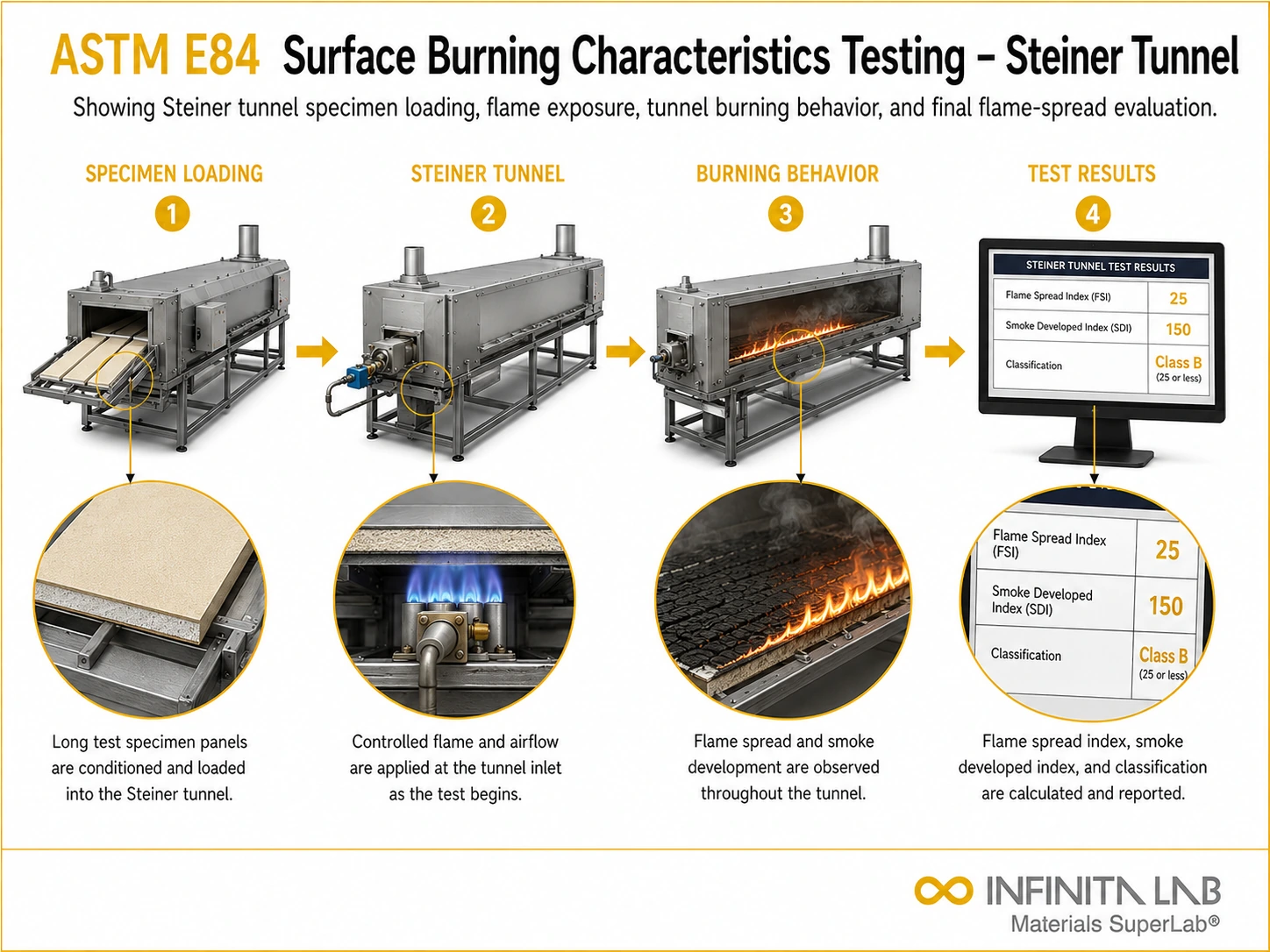
ASTM E84, commonly known as the “Steiner Tunnel Test,” is the industry standard for measuring how building materials contribute to the spread of fire and smoke generation. It provides two critical indices—the Flame Spread Index (FSI) and Smoke Developed Index (SDI)—used to classify materials into safety categories required by building codes such as the International Building Code (IBC).

Applications and Benefits of ASTM E84 Surface Burning Characteristics Testing
Scope
ASTM E84, commonly known as the Steiner Tunnel Test, covers the determination of the relative surface burning characteristics of building materials. The test evaluates flame spread and smoke development of materials when exposed to a controlled fire under standardized laboratory conditions. Results are expressed as Flame Spread Index (FSI) and Smoke Developed Index (SDI), which are widely used for material classification, code compliance, and fire safety assessment in buildings.
Applications
- Evaluation of wall, ceiling, and interior finish materials
- Fire performance assessment of insulation materials
- Testing of coatings, paints, and surface treatments
- Quality control for fire-retardant-treated products
- Certification and labeling for regulatory approvals
- Use in residential, commercial, and industrial building projects
Benefits
- Provides a standardized measurement of flame spread and smoke generation
- Supports compliance with building codes and fire safety regulations
- Enables comparison of fire performance among different materials
- Assists in material selection for fire-safe building design
- Helps manufacturers demonstrate fire performance of products
- Improves occupant safety by assessing fire growth potential
Our ASTM E84 Testing Procedure
Specimen Conditioning
Condition the test specimen at standard laboratory temperature and humidity before testing.
1Specimen Mounting
Mount the specimen on the ceiling of the Steiner tunnel with the exposed surface facing the flame.
2Apparatus Calibration
Calibrate the tunnel using standard reference materials to establish baseline values.
3Result Documentation
Record observations, calculated indices, and any unusual burning behavior in the report.
4ASTM E84 Test Parameters and Requirements
| Parameter | Details |
|---|---|
| Test Method | Steiner Tunnel Test |
| Test Chamber Length | Approximately 7.6 m (25 ft) |
| Test Chamber Width | Approximately 0.45 m (18 in.) |
| Test Chamber Height | Approximately 0.30 m (12 in.) |
| Measured Parameters | Flame Spread Index (FSI), Smoke Developed Index (SDI) |
| Result Expression | Relative index values compared to reference standards |


- Steiner Tunnel test apparatus
- Gas burner with controlled fuel supply
- Flame spread measuring system
- Smoke density measurement system (photocell)
- Airflow and temperature control instruments
- Specimen mounting and support frame
- Data acquisition and recording system
Equipment and Instrumentation Used for ASTM E84 Testing
What You Receive: Test Report, Data, and Certification
- Flame Spread Index (FSI) value indicating the rate of flame propagation
- Smoke Developed Index (SDI) value indicating the amount of smoke generated
- Classification of material (Class A, B, or C) based on FSI limits
- Observation of burning behavior such as surface ignition, charring, or melting
- Presence or absence of sustained flaming after burner shutoff
- Qualitative notes on dripping, delamination, or unusual flame spread behavior
ASTM E84 Surface Burning Characteristics FAQs
ASTM E84 determines the surface burning characteristics of building materials by evaluating flame spread across the exposed surface and smoke development under controlled fire-test conditions. The primary results are the Flame Spread Index (FSI) and Smoke Developed Index (SDI).
The Steiner Tunnel is the apparatus used for ASTM E84 testing. A specimen is exposed to controlled airflow and a prescribed flame exposure inside the tunnel, while technicians monitor flame travel and smoke generation during the 10-minute test.
ASTM E84 is commonly used for interior wall and ceiling finishes, insulation, wood products, panels, plastics, foam plastics, paints, coatings, and other building materials where surface-burning performance needs to be evaluated.
The FSI provides a comparative measure of how flame spreads across the specimen, while the SDI indicates the amount of smoke developed during the test. These are separate measurements and do not necessarily have a direct relationship with each other.
Yes. ASTM E84 results are commonly used to support building-code evaluations, product specifications, material qualification, and construction submittals. For example, commonly referenced classifications use FSI ranges of 0–25 (Class A), 26–75 (Class B), and 76–200 (Class C), with SDI ≤450; the applicable classification requirements should always be verified against the governing code or project specification.
The Steiner Tunnel test evaluates the surface-burning characteristics of building materials under controlled fire exposure. A specimen is mounted inside a tunnel apparatus and exposed to a gas burner while a controlled airflow carries the flame and combustion products along its surface. Observations are used to determine flame spread and smoke development, commonly reported as the Flame Spread Index (FSI) and Smoke Developed Index (SDI) under ASTM E84.
Why Choose Infinita Lab for Surface Burning Characteristics Testing
When your Surface Burning Characteristics results have to hold up - for compliance, a customer audit, or an engineering decision - ASTM E84 accuracy and an unbiased third-party report matter more than price. Infinita Lab routes your ASTM E84 surface burning characteristics testing to ISO/IEC 17025-accredited U.S. partner labs with hands-on method experience, so you get defensible data, transparent reporting, and turnaround times built around your project deadline - not ours.

Need ASTM E84 Surface Burning Characteristics Testing You Can Rely On?
Send query us at hello@infinitalab.com or call us at (888) 878-3090 to learn more about our services and how we can support you.