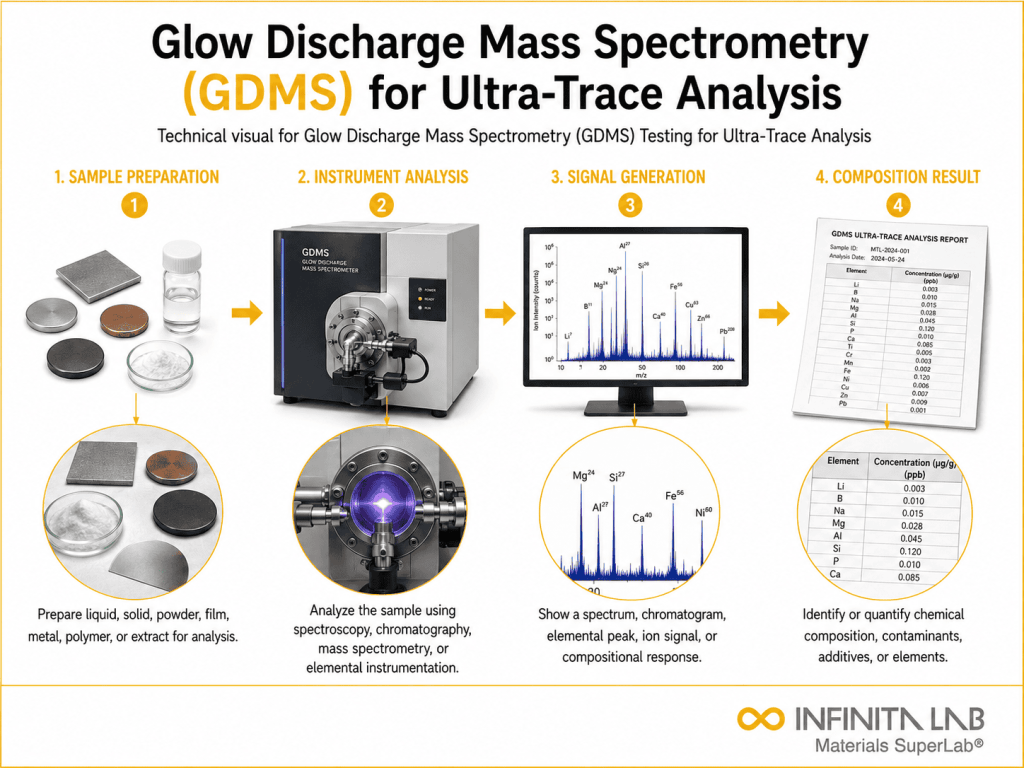


What Is Glow Discharge Mass Spectrometry GDMS?
Glow Discharge Mass Spectrometry (GD-MS) is an ultra-sensitive characterization technique for analyzing elements in a material. This technique is used for the direct analysis of trace elements and impurities in metallic and semiconductor solids at parts-per-billion and parts-per-trillion concentrations. The GD-MS technique provides a comprehensive range of elements across the periodic table in a single analysis, which is a great advantage for materials engineers, researchers, and quality engineers in obtaining definitive analyses of trace impurities and the composition of high-purity materials.
Applications and Benefits of Glow Discharge Mass Spectrometry GDMS Testing
Scope
Directly, GD-MS uses a glow-discharge plasma source to sputter the surface of the solid sample, atomizing and ionizing it for injection into the mass spectrometer for direct analysis of solid materials without the need for acid digestion or complicated sample preparation techniques.
GD-MS analysis evaluates:
- Ultra-trace elemental impurity content in high-purity metals, alloys, and semiconductor materials
- Bulk elemental composition and major, minor, and trace element quantification across the periodic table
- Metallic and non-metallic impurity analysis in electronic, aerospace, and advanced material systems
- Depth profile elemental distribution analysis across surface and near-surface material layers
- Compliance with material purity and elemental composition specification requirements
Applications
- High-purity metals and target materials for semiconductor and electronic device manufacturing
- Aerospace and defense alloys requiring ultra-trace impurity characterization and certification
- Nuclear and energy materials requiring comprehensive bulk elemental purity analysis
- Semiconductor substrates, sputtering targets, and electronic-grade materials
- Advanced material research programs requiring ultra-sensitive bulk elemental characterization
Benefits
- Delivers ultra-sensitive trace elemental analysis at parts-per-billion and parts-per-trillion levels
- Provides direct solid sample analysis without acid dissolution or complex sample preparation
- Identifies trace impurities across the full periodic table within a single analytical run
- Delivers traceable, laboratory-certified elemental data for material
- Reduces material risk by detecting trace impurity levels early in the qualification cycle
Our Testing Procedure
Sample Preparation
Solid specimens sectioned, surface-cleaned, and mounted within glow discharge source.
1Glow Discharge Sputtering
Argon plasma sputters sample surface atomizing and ionizing material for mass spectrometric detection.
2Mass Spectrometric Detection
Ionized material separated and detected generating elemental mass spectra for quantification.
3Data Analysis & Reporting
Mass spectral data processed to generate elemental composition profiles and test compliance result.
4Test parameters and requirements
| Parameter | Details |
|---|---|
| Applicable Materials | High-purity metals, alloys, semiconductors, sputtering targets, electronic grade materials |
| Analytical Technique | Glow discharge plasma sputtering with high-resolution mass spectrometric detection |
| Detection Capability | Ultra-trace elemental detection at parts-per-billion to parts-per-trillion levels |
| Measured Parameters | Full periodic table elemental composition and trace impurity concentration |
| Measured Outputs | Elemental composition profile, trace impurity concentrations, test compliance result |


- High-resolution GD-MS system with glow discharge ionization source and mass spectrometric detection
- Argon plasma glow discharge sputtering source for direct solid sample atomization
- Elemental reference standards for quantitative calibration and method validation
- Specialist mass spectral data acquisition and elemental quantification software
- Sample preparation equipment for specimen sectioning, cleaning, and geometry preparation
- Data reporting and elemental composition visualization system
Equipment and Instrumentation Used for Testing
What You Receive: Test Report, Data, and Certification
- Full elemental composition profile across the periodic table for all analyzed specimens
- Trace impurity concentration data at parts-per-billion and parts-per-trillion detection levels
- Mass spectral identification data for all detected elemental species
- Test compliance result assessed against the defined material purity and composition specification criteria
- GD-MS analytical report
Glow Discharge Mass Spectrometry GDMS FAQs
GD-MS is an ultra-sensitive method for elemental characterization that directly analyzes a wide variety of solid materials using glow discharge plasma sputtering and mass spectrometric detection, providing detailed trace impurity and bulk composition data at parts-per-billion and parts-per-trillion levels.
GD-MS is used to detect and quantify metallic and non-metallic elemental impurities at parts-per-billion to parts-per-trillion concentrations across the entire periodic table. It is the preferred method for ultra-high-purity material characterization .
Schematic of the fundamental processes in a glow discharge. Typical discharge conditions used for GDMS are about 1 kV discharge voltage, an argon gas pressure in the order of 1 torr, and a d.c. Discharge current in the mA range.
Glow discharge plasmas offer several advantages. The plasma works at sufficiently low temperatures (kinetic temperatures in the range of 100-500K) to prevent the dissociation of the molecular species.
Mass spectrometry (MS) is an analytical technique that separates ionized particles such as atoms, molecules, and clusters by using differences in the ratios of their charges to their respective masses (mass/charge; m/z).
GDMS stands for Glow Discharge Mass Spectrometry, an analytical technique used to determine the elemental composition and trace impurities in solid materials. It uses a glow discharge plasma to release atoms from a sample surface and convert them into ions for mass spectrometric analysis. The technique can detect extremely low concentrations of impurities, often at parts-per-billion (ppb) levels. It is widely used to evaluate high-purity metals, alloys, semiconductors, and advanced materials.
A GDMS instrument combines a glow discharge ion source with a mass spectrometer to analyze solid samples. The specimen is exposed to a low-pressure inert gas, typically argon, under an applied electrical potential to generate plasma. Argon ions bombard the sample surface, releasing atoms through a process called sputtering. These atoms become ionized and enter the mass spectrometer, where they are separated according to their mass-to-charge ratio and detected to identify and quantify elements.
GDMS analysis determines the elemental composition and trace impurity levels in solid materials. A suitably prepared sample is introduced into the glow discharge source, where plasma sputtering releases atoms from its surface. The resulting ions are separated and measured according to their mass-to-charge ratios. Element concentrations are calculated using calibration factors or relative sensitivity factors (RSFs). The analysis helps assess material purity, identify contamination, and verify the quality of high-purity metals, alloys, and semiconductor materials.
Why Choose Infinita Lab for Glow Discharge Mass Spectrometry GDMS Testing
When your Glow Discharge Mass Spectrometry GDMS results have to hold up - for compliance, a customer audit, or an engineering decision - accuracy and an unbiased third-party report matter more than price. Infinita Lab routes your glow discharge mass spectrometry GDMS testing to ISO/IEC 17025-accredited U.S. partner labs with hands-on method experience, so you get defensible data, transparent reporting, and turnaround times built around your project deadline - not ours.

Looking for an Accredited Partner for Glow Discharge Mass Spectrometry GDMS Testing?
Send query us at hello@infinitalab.com or call us at (888) 878-3090 to learn more about our services and how we can support you.