


Ceramic
Infinita Lab’s Ceramics Material Testing offers unmatched precision and quality. Our U.S. labs provide over 2000 specialized tests, ensuring comprehensive analysis for all ceramic materials. Ceramic materials exhibit a distinctive combination of qualities that render them ideal for high-performance applications. Ceramic materials testing services provide an assessment of the thermal, chemical, and mechanical properties used in advanced industrial applications.


Top Testing Services
-
 ASTM E384: Microhardness Guide Testing Services
-
Micro Xanes X Ray Absorption Spectroscopy Testing Services
-
Field Emission SEM Fesem Testing Services
-
ASTM D149: Dielectric Strength Testing Services
-
ASTM D150: Dielectric Constant Dissipation Factor Testing Services
-
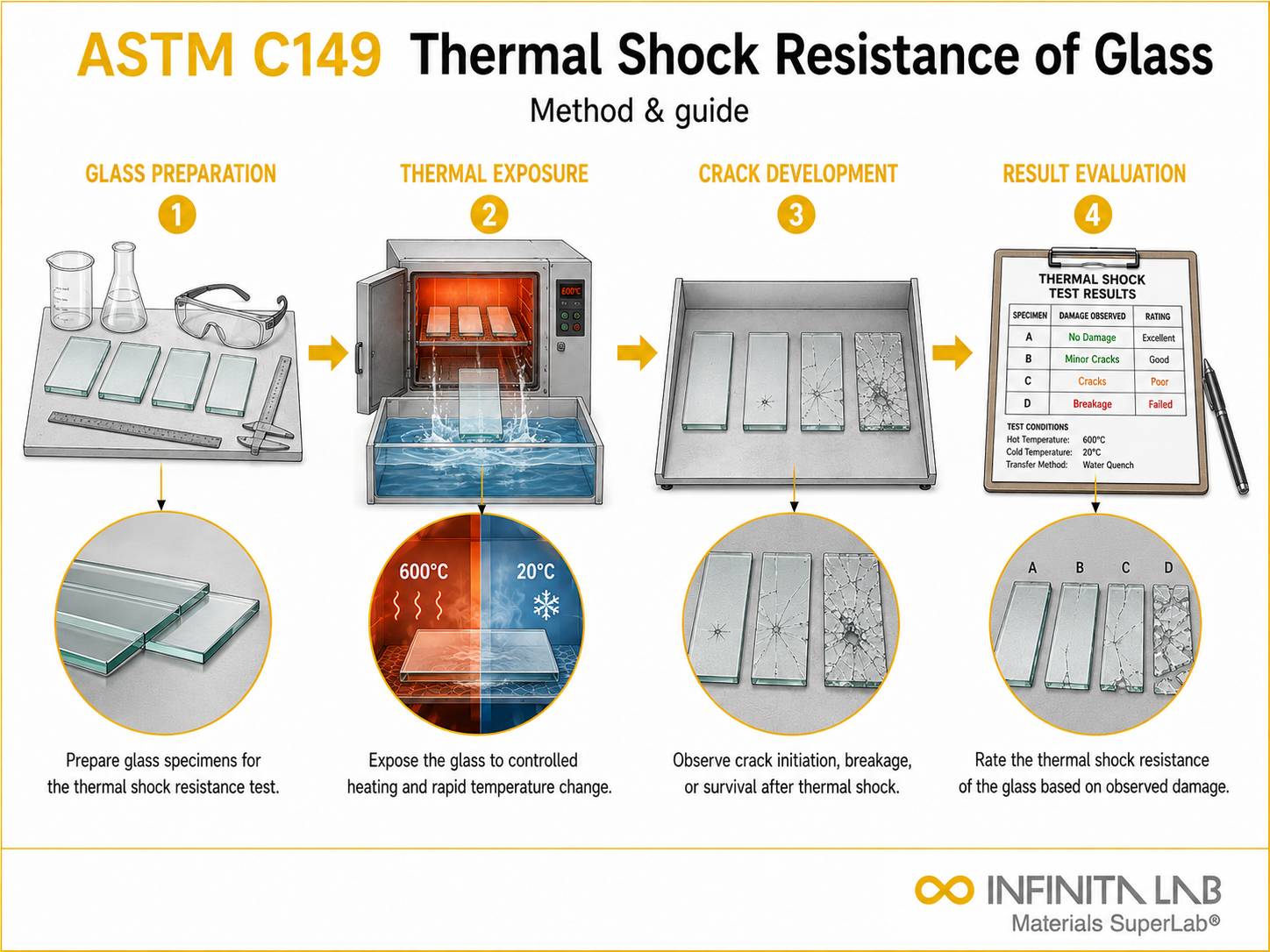
ASTM C149: Thermal Shock Resistance of Glass — Method & Guide






Introduction to Ceramic Materials Testing Services
Ceramic materials exhibit a distinctive combination of qualities that render them ideal for high-performance applications – from structural components in aerospace engines and rocket nozzles to insulators and substrates in semiconductors, brake pads in automotive systems, and cookware in consumer goods. Ceramic materials testing services provide a systematic assessment of the thermal, chemical, and mechanical properties essential for high-performance industrial applications.
At Infinita Lab, our U.S.-based labs provide over 2,000 specialised tests, ensuring comprehensive analysis for all ceramic materials – from raw material characterisation and product development to quality control, certification, and failure analysis. Our testing spans monolithic ceramics, ceramic matrix composites (CMCs), glazed whitewares, ceramic tiles, and advanced technical ceramics.
Our Ceramic Testing Services
Flexural Strength Testing
Flexural strength is the most critical mechanical property for ceramic materials – brittle ceramics fail primarily in tension under bending loads, making flexural testing essential for qualifying ceramics for structural and load-bearing applications. Infinita Lab provides flexural strength testing at both ambient and elevated temperatures for advanced ceramics, ceramic composites, and whiteware products.
Relevant ASTM Standards:
- ASTM C1161 – Flexural strength of advanced ceramics at ambient temperature, evaluating the material’s resistance to bending and fracturing under stress to ensure performance in structural applications, including aerospace components, cutting tools, and wear-resistant parts.
- ASTM C1211 – Flexural strength of advanced ceramics at elevated temperatures, assessing the retention of bending strength in ceramics under thermal loads representative of aerospace engine components, furnace hardware, and high-temperature structural applications.
- ASTM C1341 – Flexural properties of continuous fibre-reinforced advanced ceramic composites (CFCCs), evaluating bending strength and stiffness for ceramic matrix composites (CMCs) used in aerospace hot-section components and thermal protection systems.
- ASTM C1499 – Monotonic equibiaxial flexural strength of advanced ceramics at ambient temperature using the ball-on-ring or piston-on-ring method, characterising strength under biaxial stress states representative of disk- and plate-shaped ceramic components.
- ASTM C1505 – Breaking strength and modulus of rupture testing for ceramic tiles, determining the load at which tiles fracture and the modulus of rupture – key quality parameters for construction tile specification and compliance.
Fracture Toughness Testing
Fracture toughness defines the resistance of a ceramic to crack propagation – the fundamental property governing catastrophic failure under service loads. It is particularly important for advanced ceramics used in safety-critical aerospace, military, and medical applications, where crack tolerance is essential.
Relevant ASTM Standards:
- ASTM C1421 – Fracture toughness of advanced ceramics by the Chevron-Notched Beam (CNB), Surface Crack in Flexure (SCF), and Single Edge Pre-Cracked Beam (SEPB) methods, providing K₁c values for reliability and resistance to crack propagation under stress – the standard for advanced ceramic fracture characterisation.
Compressive Strength Testing
Compressive strength is the primary load-bearing property for ceramics in applications involving axial compressive loading, such as cutting tool inserts, structural supports, and load-bearing components.
Relevant ASTM Standards:
- ASTM C773 – Compressive strength of fired ceramic whiteware materials, used in material selection for manufacturing products where compressive strength determines suitability and quality.
Shear Strength Testing of Ceramic Composites
Interlaminar shear strength is a critical failure mode in fibre-reinforced ceramic matrix composites, in which delamination between plies can occur under in-service loading. Shear testing provides the design data needed for CMC component qualification.
Relevant ASTM Standards:
- ASTM C1292 – Interlaminar shear strength of advanced glass or ceramic matrix composites using unidirectional or bidirectional fibre reinforcement architecture, the primary shear characterisation test for CMC materials used in aerospace turbine components.
Dynamic Elastic Properties Testing
The elastic moduli of ceramics – Young’s modulus, shear modulus, and Poisson’s ratio – define the stiffness of the material under dynamic loading and are essential for structural design, vibration analysis, and finite element modelling of ceramic components.
Relevant ASTM Standards:
- ASTM C1259 – Dynamic Young’s modulus, shear modulus, and Poisson’s ratio for advanced ceramics by impulse excitation, providing accurate elastic property data for advanced ceramic design and material qualification.
- ASTM C1198 – Dynamic Young’s modulus, shear modulus, and Poisson’s ratio for ceramics at elevated temperatures using impulse excitation, enabling stiffness characterisation across the full service temperature range.
- ASTM C848 – Young’s modulus, shear modulus, and Poisson’s ratio for ceramic whitewares by the resonance method – the standard elastic property characterisation test for traditional and whiteware ceramics.
Hardness Testing
Hardness testing of ceramics provides rapid surface-quality assessment, abrasion-resistance characterisation, and quality-control data. It is particularly important for advanced technical ceramics, where hardness governs wear performance in cutting tools, armour, and tribological applications.
Relevant ASTM Standards:
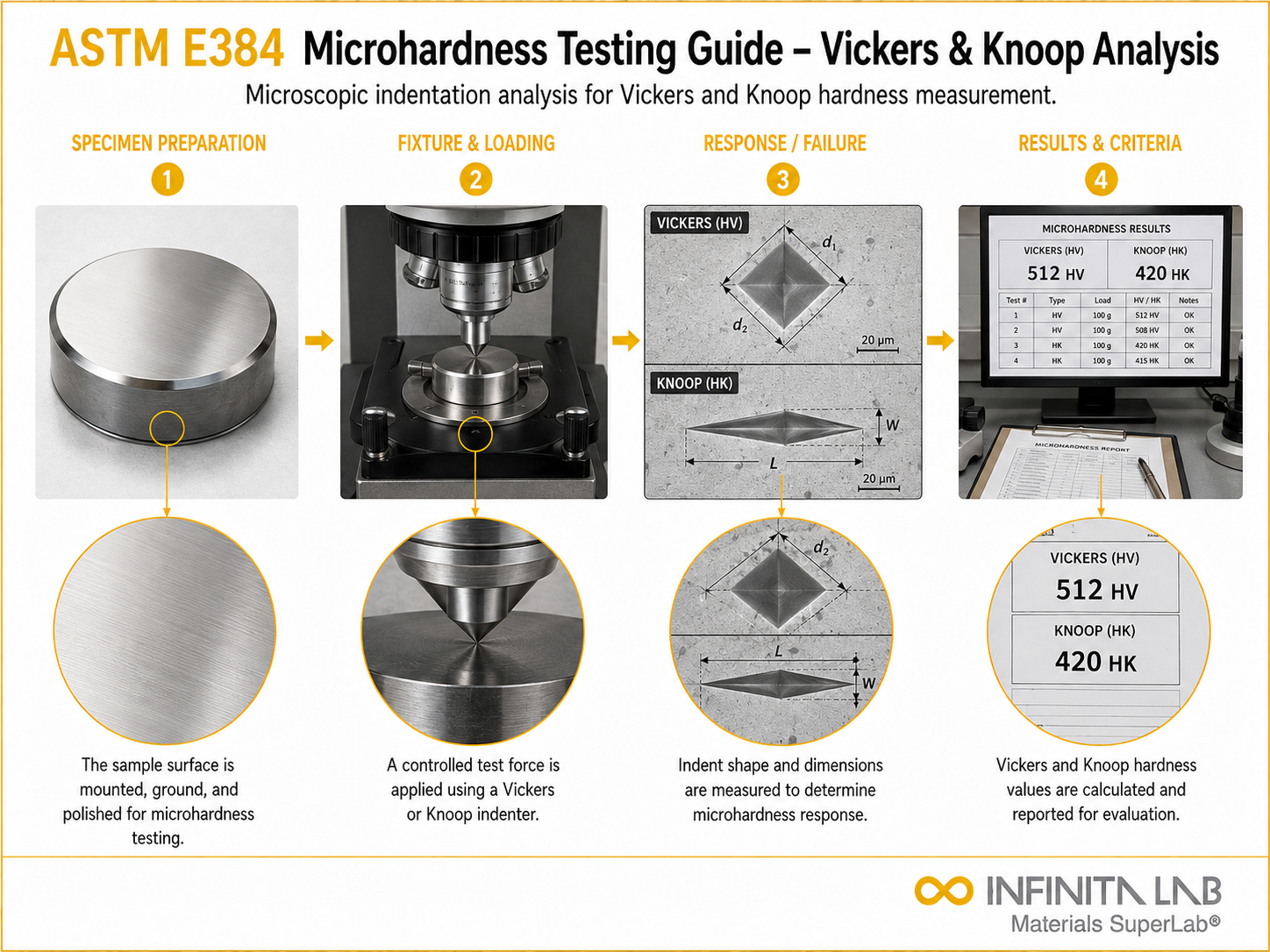
- ASTM E384 – Microindentation hardness testing (Vickers and Knoop) for ceramics, providing localised hardness measurement of ceramic surfaces, coatings, individual grains, and phase constituents – the primary hardness method for advanced ceramics and hard materials.
- ASTM C849 – Knoop indentation hardness testing for ceramic whitewares, using a pyramidal diamond indenter to characterise surface hardness of glazed and unglazed ceramic whiteware products.
Impact Resistance Testing
Impact resistance testing evaluates a ceramic’s ability to withstand sudden mechanical loads without fracturing – important for ceramic tableware, tiles, and components subjected to handling and service impacts.
Relevant ASTM Standards:
- ASTM C368 – Impact resistance testing for ceramic tableware, evaluating the ability of cups, plates, and bowls to survive drop impacts representative of normal handling and use conditions.
Water Absorption, Bulk Density & Porosity Testing
Water absorption, bulk density, and apparent porosity are fundamental physical properties that directly govern ceramic durability, freeze-thaw resistance, and suitability for different applications – particularly for ceramic tiles, sanitaryware, and whiteware products.
Relevant ASTM Standards:
- ASTM C373 – Water absorption, bulk density, apparent porosity, and apparent specific gravity testing for fired ceramic whiteware, ceramic tiles, and glass tiles – key properties for tile classification, freeze-thaw durability, and compliance with product specifications.
- ASTM C949 – Porosity testing in vitreous whitewares by dye penetration, verifying that fired ceramics are fully vitrified and free of accessible porosity that could lead to staining or microbial contamination.
Thermal Analysis & Conductivity Testing
Ceramics in aerospace, electronics, and energy applications must be characterised for thermal conductivity, thermal expansion, and thermal stability to ensure reliable performance across their service temperature range.
Relevant ASTM Standards:
- ASTM C177 – Thermal conductivity testing by the guarded hot plate method, measuring heat flow, metered section, and heat flux of ceramic materials – providing precise thermal conductivity data for insulating and refractory ceramics.
- ASTM C518 – Steady-state thermal transmission properties testing by heat flow meter for ceramics and insulating materials, calculating thermal transmittance and thermal conductivity under controlled steady-state conditions.
- ASTM C1300 – Linear thermal expansion of glaze frits and ceramic whiteware materials by the interferometric method, measuring the thermal expansion mismatch between glaze and ceramic body – critical for crazing resistance and glaze-body compatibility.
Thermal Shock Resistance Testing
Ceramics used in applications involving rapid temperature cycling – such as furnace components, engine parts, and cookware – must be tested for thermal shock resistance to ensure they will not crack or fracture under abrupt temperature changes.
Relevant ASTM Standards:
- ASTM C149 – Thermal shock resistance testing for glass and ceramic products, evaluating the ability of ceramic materials to withstand rapid temperature changes without cracking – essential for cookware, laboratory ceramics, and industrial refractory components.
Glaze Testing & Chemical Resistance
Glazed ceramics used in food-contact, sanitaryware, and decorative applications must meet strict chemical-resistance and safety requirements, including resistance to crazing, detergent attack, and heavy-metal leaching into food or beverages.
Relevant ASTM Standards:
- ASTM C738 – Lead and cadmium extraction testing from glazed ceramic surfaces by acid leaching, evaluating food safety compliance for mugs, plates, and ceramic cookware meeting FDA, California Prop 65, and international leachable metal limits.
- ASTM C1466 – Graphite furnace atomic absorption spectrometric determination of lead and cadmium extracted from ceramic foodware – providing highly sensitive quantification of heavy metals for regulatory compliance of food-contact glazed ceramics.
- ASTM C424 – Crazing resistance testing for fired glazed ceramic whitewares by autoclave treatment, evaluating glaze-body thermal expansion mismatch and stress resistance for sanitaryware, tile, and dinnerware production quality and durability control.
- ASTM C554 – Crazing resistance testing for fired glazed ceramic whitewares by thermal shock, assessing glaze durability under abrupt temperature changes relevant to dishwasher use and food service environments.
- ASTM C556 – Resistance of overglaze decorations to detergent attack, evaluating the durability of decorative ceramic finishes under repeated exposure to household cleaning agents.
- ASTM C584 – Specular gloss testing for ceramic materials, providing quantitative gloss-level measurements for decorative and functional ceramic coatings.
Solar Absorptance & Optical Testing
Ceramics used in solar energy, thermal management, and optical systems require characterisation of their solar absorptance, reflectance, and emittance to support energy-efficiency specifications and system design.
Relevant ASTM Standards:
- ASTM E903 – Solar absorptance, reflectance, and transmittance testing for ceramic materials and coatings, using spectrophotometric measurement to determine the fraction of incident solar radiation absorbed, reflected, or transmitted – essential for thermal control surfaces and solar energy applications.
Frequently Asked Questions
Our lab specializes in a comprehensive range of ceramic material testing services, covering mechanical strength, thermal conductivity, chemical resistance, and more. Our testing ensures that your ceramics meet industry standards, providing valuable insights into their performance and durability.
With the capacity to provide a wide range of specialized ceramic material testing services, our laboratory guarantees a thorough assessment of distinctive qualities and traits. We offer specialized services such as thermal shock testing, which evaluates the resistance of a ceramic material to abrupt temperature fluctuations. This is especially important for situations where there is a lot of heat cycling. Wear resistance testing is another specialist service that assesses a ceramic’s resistance to wear, friction, and abrasion over time. In industries where ceramics are exposed to harsh wear conditions, including cutting tools or mechanical components, this service is crucial.
Infinita Lab uses a methodical and exacting technique to guarantee the precision and dependability of ceramic test findings. Our specialized labs use cutting-edge testing apparatus that complies with industry-leading standards. This comprises sophisticated equipment for assessing mechanical strength, analyzing thermal conductivity, evaluating chemical resistance, and other tasks. Our lab’s certification further demonstrates our dedication to upholding the highest standards of quality. Our staff of highly qualified experts receives ongoing training to ensure they are up-to-date on the most recent developments in ceramic testing techniques. We adhere to standard testing standards. This guarantees that tests are carried out consistently and precisely, producing results that can be relied upon.
Throughout the testing process, we apply strict quality control methods to further improve accuracy. The procedures we follow for quality assurance include sample preparation, testing, and result interpretation. Since businesses rely on our test results for their decision-making, we understand how important accuracy is, which is why we go above and beyond to maintain the integrity of our findings.
Choosing Infinita Lab for ceramic material testing guarantees an unmatched, comprehensive approach to quality control. Certification attests to our dedication to quality and verifies that our testing procedures follow the strictest industry guidelines. This compliance ensures that your ceramic materials are put through strict testing procedures and that the results you receive meet or exceed legal criteria. We put cost-effectiveness first without sacrificing the precision of our findings. We maximize resource usage by utilizing streamlined testing processes and effective workflows, which translate into affordable prices for our clients. Our dedication to cost effectiveness goes beyond just lowering the possibility of pricey recalls or warranty claims by preventing flaws and failures through thorough testing.
At the center of our testing services is accuracy. Throughout the testing process, we use state-of-the-art technology, adhere to established testing procedures, and keep a strong quality control system in place. Our dedication to accuracy guarantees that the outcomes we produce are dependable, providing your company with solid information to support well-informed decision-making.
Read Our Blogs and Research Papers
In-depth examination of genuine material testing solutionsASTM D543 vs Other Plastic Chemical Resistance Tests: Comparison Guide
ASTM D543 vs Other Plastic Chemical Resistance Tests: Comparison Guide
Chemical resistance testing for plastics is not a single-method discipline. Different standards have been developed to address specific application needs,...
Read ArticleAsh Content Testing Services
Ash Content Testing Services
ASH CONTENT The most effective techniques are based on the fact that minerals may be heated without being damaged and...
Read ArticleISO 5173: Welding Bend Testing Services
ISO 5173: Welding Bend Testing Services
BS EN ISO 5173 The standard provides guidelines for determining the appropriate welding parameters for different thicknesses and types of...
Read Article
Get your Ceramic Material testing done from the largest network of accredited labs in the USA
We are a material testing lab with a vast network of accredited labs across the country. Our state-of-the-art equipment and experienced team provide accurate and timely testing services to meet the unique needs of our clients. Partner with us for reliable material testing solutions.
 Quick Turnaround and Hasslefree process
- Confidentiality Guarantee
- Free, No-obligation Consultation
- 100% Customer Satisfaction


