


Coating
Explore advanced coating analysis with Infinita Lab. Our U.S.-based labs specialize in over 2000 material tests, focusing on the durability, composition, and performance of various coatings. Coating analysis and testing are essential to ensure that components have the necessary performance and protection qualities and can maintain them over time.


Top Testing Services
-
 ASTM E384: Microhardness Guide Testing Services
-
ASTM G155: Xenon Arc Weathering Guide Testing Services
-
ASTM E408: Total Normal Emittance Testing by Inspection Meter
-
ASTM D1653: Water Vapor Transmission Organic Coating Testing Services
-
ASTM D1894: Film Coefficient Of Friction Testing Services
-
ASTM D149: Dielectric Strength Testing Services







Introduction to Coating Analysis and Testing
Coating analysis and evaluation testing are imperative for verifying that components possess the requisite performance and protective attributes and retain them throughout their service life. Infinita Lab’s domestic facilities specialise in an extensive catalogue of over 2,000 material tests, with a dedicated focus on the durability, chemical composition, and functional performance of diverse coating systems, ranging from industrial and automotive finishes to aerospace primers and specialised functional films.
Its physical properties and chemical constitution fundamentally determine the operational efficacy of a coating. Systematic coating evaluation programs facilitate the early identification of potential vulnerabilities and ensure compliance with rigorous quality standards by quantifying critical parameters, including adhesion, corrosion resistance, film thickness, and hardness. These assessments are vital for mitigating the risk of premature failure, reducing long-term maintenance expenditures, and maximising the service life of industrial assets.
Our Coating Testing Services
Adhesion Testing
Adhesion is the most fundamental coating property. A coating that does not adhere reliably to its substrate will fail regardless of its other performance characteristics. Infinita Lab provides the full range of adhesion testing methods – from rapid tape tests for production QC to quantitative pull-off testing for specification compliance and failure investigation.
Relevant ASTM Standards:
- ASTM D3359 – Cross-cut tape adhesion testing, in which a lattice pattern is cut through the coating to the substrate, and a pressure-sensitive tape is applied and removed. The percentage of coating retained provides an 0B-5B adhesion rating – fast, simple, and widely used for production quality control of paints and coatings on metal and plastic substrates.
- ASTM D4541 – Pull-off adhesion testing, where a dolly is bonded to the coating surface and pulled off perpendicular to the surface. The pull-off strength in MPa or psi, along with the failure mode (cohesive within the coating, adhesive at the substrate, or within the dolly adhesive), quantifies the adhesion quality of protective and industrial coatings on metal substrates.
- ASTM D7234 – Pull-off adhesion strength testing specifically for coatings applied to concrete substrates, complementing ASTM D4541, which is used for coatings on metal.
- ASTM C633 – Adhesion and cohesion strength testing for thermal spray coatings, measuring tensile adhesion strength – particularly important in aerospace, energy, and industrial sectors where bond integrity directly affects functional performance and safety.
Coating Thickness Testing
Coating thickness is a fundamental quality parameter that directly influences performance in terms of corrosion protection, adhesion, flexibility, and mechanical durability. Both destructive and non-destructive thickness measurement methods are available from Infinita Lab for dry film thickness (DFT) verification across all substrate types.
Relevant ASTM Standards:
- ASTM D6132 – Ultrasonic dry film thickness (DFT) testing for coatings on non-metallic, glass, and concrete substrates, providing non-destructive thickness measurement without magnetic contact to the substrate.
- ASTM D7027 – Scratch and mar resistance testing for coatings and surfaces, complementing thickness testing by verifying surface durability of thin functional coatings.
Hardness Testing
Coating hardness is a key indicator of scratch resistance, abrasion durability, and cure completeness. Infinita Lab offers both pencil hardness and indentation methods applicable across all coating types, from automotive topcoats and industrial epoxies to powder coatings and UV-cured films.
Relevant ASTM Standards:
- ASTM D3363 – Film hardness by pencil test, using a series of graphite pencils of increasing hardness to determine the hardest pencil that does not scratch the coating surface – a simple, fast, production-quality control method for coatings on rigid substrates.
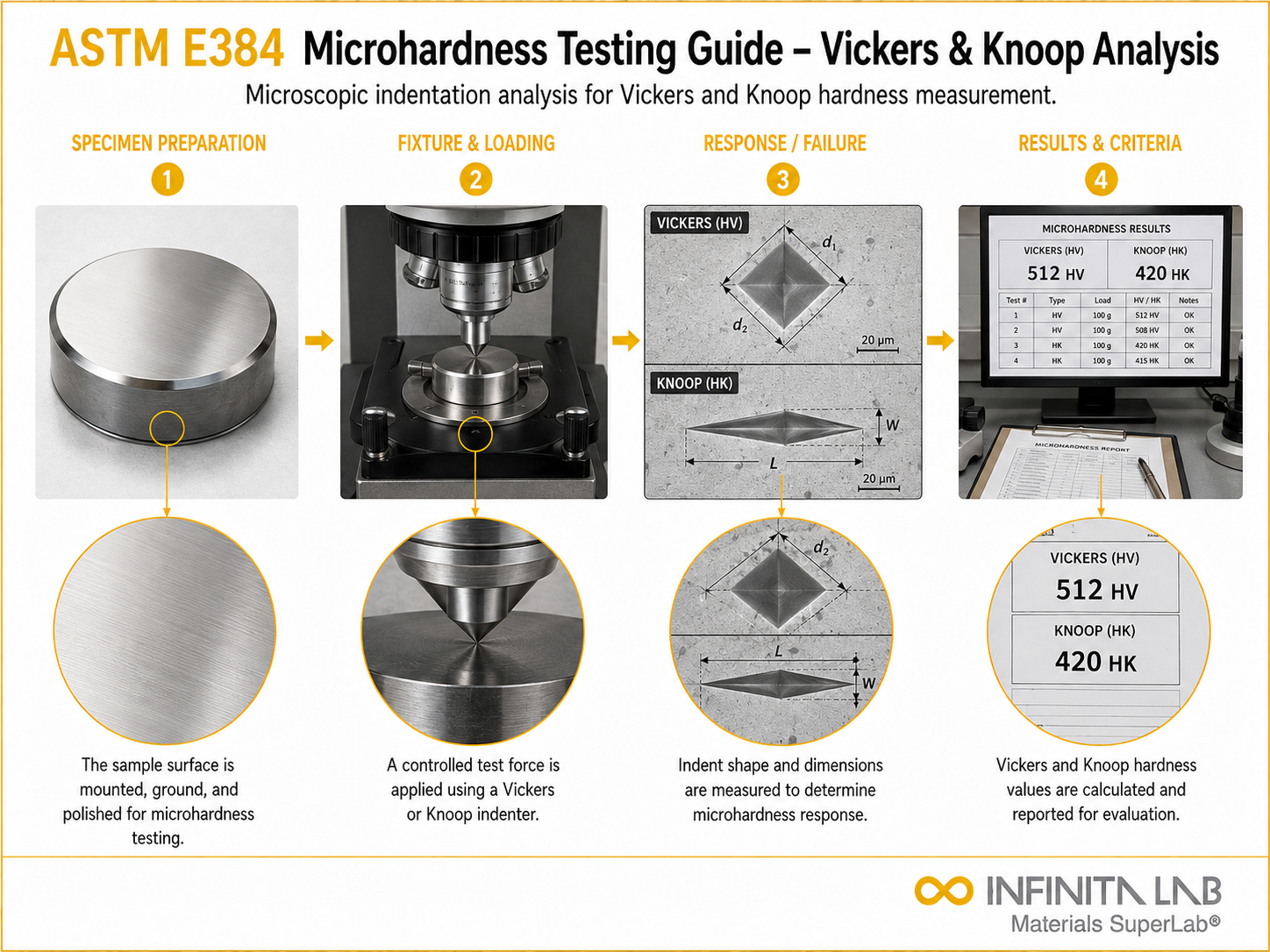
- ASTM E384 – Microindentation hardness testing (Vickers and Knoop) for thin coatings and surface films where macro hardness tests are not applicable, providing precise hardness mapping of coating cross-sections.
Impact & Flexibility Testing
Automotive, appliance, packaging, and architectural coatings must absorb impact and flex with their substrates during forming, handling, and service without cracking or delaminating. Impact and flexibility testing verifies that a coating system will maintain adhesion and integrity under real-world mechanical loads.
Relevant ASTM Standards:
- ASTM D2794 – Impact resistance testing for organic coatings, in which a weighted dart is dropped onto the coated panel from specified heights. The energy required to crack or lose adhesion characterises impact resistance – a critical property for automotive, appliance, and packaging coatings.
- ASTM D522 – Mandrel bend flexibility testing for coatings, evaluating the coating’s ability to flex with the substrate without cracking around a cylindrical mandrel of defined diameter – essential for coil coatings, flexible packaging, and formed metal products.
- ASTM D4145 – Coating flexibility testing for prepainted steel sheets, covering T-bend and cylindrical mandrel test methods to evaluate whether coatings withstand forming and fabrication processes without cracking or loss of adhesion.
- ASTM D2794 – Also used to evaluate the ability of automotive and consumer coatings to withstand abrupt deformation without cracking, which is essential for assessing durability in these applications.
Abrasion & Wear Resistance Testing
Coatings on floors, automotive interiors, appliances, and industrial equipment are subjected to continuous abrasive contact throughout their service life. Abrasion and wear resistance testing quantifies the coating’s ability to resist surface degradation under controlled friction and abrasive loading conditions.
Relevant ASTM Standards:
- ASTM D4060 – Taber abrasion testing measures weight loss per unit area (mg/1000 cycles) for organic coatings applied to rigid substrates, evaluating wear resistance for floor coatings, automotive interior surfaces, and industrial protective coatings using rotating abrasive wheels under defined load.
- ASTM D1044 – Taber abrasion testing measures the change in optical haze (%) of transparent coatings and plastic panels after exposure to an abrasive wheel – used for clear coats, window glazings, and optical film applications.
- ASTM D7027 – Scratch and mar resistance testing for coatings and surfaces, evaluating resistance to light surface damage from contact with hard objects – important for automotive topcoats, consumer electronics housings, and appliance finishes.
Corrosion Resistance Testing
Corrosion resistance is the primary performance requirement for protective coatings on metal substrates in automotive, infrastructure, marine, and industrial applications. Infinita Lab provides the full range of accelerated corrosion tests used for coating qualification and product development.
Relevant ASTM Standards:
- ASTM B117 – Salt spray (fog) testing is the most widely used accelerated corrosion test for coated metal panels. Specimens are exposed to a continuous 5% NaCl fog at 35°C, and the time to first rust, blister formation, and scribe undercutting is measured – the standard for industrial and automotive coating corrosion qualification.
- ASTM D1654 – Evaluation of painted and coated specimens subjected to corrosive environments, rating creep from scribes, blistering, and adhesion loss after salt spray and humidity exposure – essential for automotive and industrial protective coating corrosion-protection assessment.
- ASTM D5894 – Cyclic salt fog and UV exposure testing for painted metal substrates, alternating salt spray and UV exposure cycles to more closely simulate real-world outdoor corrosion conditions – increasingly preferred over continuous salt spray for automotive and infrastructure qualification.
- ASTM D714 – Blistering evaluation of painted surfaces, providing a standardised rating scale (size and frequency of blisters) for coated panels subjected to corrosive or humidity exposure – used in conjunction with ASTM B117, D4585, and D5894 tests.
- ASTM D6943 – Immersion corrosion testing for metallic materials and coated substrates subjected to continuous liquid immersion, evaluating coating performance in submerged or liquid-contact service environments.
Water Resistance & Moisture Testing
Water permeation through a coating film is the primary initiator of substrate corrosion and coating delamination. Water resistance and moisture testing evaluate the coating’s barrier performance against water vapour, liquid water, and condensation – critical for protective coatings in outdoor, marine, and high-humidity environments.
Relevant ASTM Standards:
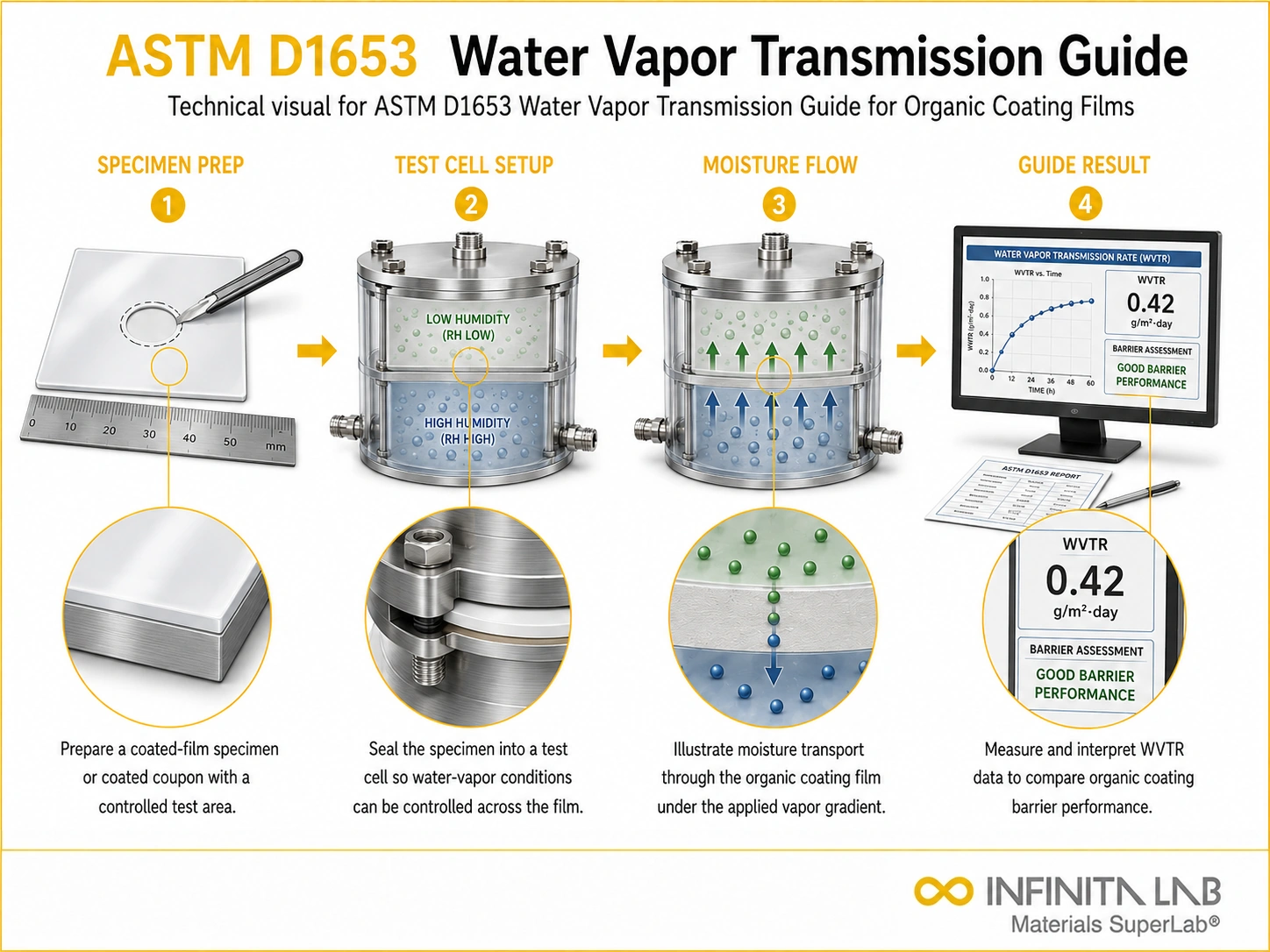
- ASTM D1653 – Water vapour transmission rate (WVT) testing for organic coating films by wet and dry cup methods, measuring vapour permeance and permeability for paint films, clear coatings, and barrier coatings – the standard for moisture-protection specifications of architectural and industrial coatings.
- ASTM D4585 – Water resistance testing for coatings using controlled condensation, evaluating blistering, adhesion loss, and corrosion at coating defects under continuous condensing moisture – for architectural, automotive, and industrial protective coating specifications.
Weathering & UV Resistance Testing
Exterior coatings must resist years of UV radiation, moisture cycling, and temperature extremes without chalking, cracking, or losing adhesion. Accelerated weathering and UV testing simulate years of outdoor exposure in a controlled laboratory environment to predict long-term durability.
Relevant ASTM Standards:
- ASTM G154 – QUV fluorescent UV accelerated weathering testing for coatings, evaluating UV-induced photodegradation, colour change, gloss loss, and mechanical property retention under controlled UV-A or UV-B lamp exposure with condensation cycles.
- ASTM G155 – Xenon arc accelerated weathering testing that provides a more complete simulation of sunlight, including visible and infrared radiation, with water spray cycles – the preferred method for automotive topcoat durability qualification and exterior architectural coating testing.
- ASTM D5894 – Cyclic corrosion and UV weathering testing alternating salt spray, UV exposure, and dry-off cycles – simulating real-world outdoor corrosion attack on painted metal substrates.
Optical & Appearance Testing
Gloss level, colour, and surface appearance are critical quality metrics for automotive topcoats, decorative coatings, and any coating where aesthetics are part of the product specification. Optical testing provides objective, quantitative measurements of surface appearance.
Relevant ASTM Standards:
- ASTM D523 – Gloss measurement at 20°, 60°, or 85° specular geometry, characterising coating gloss level from matte to high-gloss. Gloss uniformity and retention after weathering are key quality control metrics for automotive, architectural, and industrial coatings.
- ASTM D2244 – Spectrophotometric colour measurement that provides CIE Lab values, quantifying colour match, batch-to-batch consistency, and weathering-induced colour change (ΔE) for production quality control and weathering assessment.
- ASTM E1980 – Solar Reflectance Index (SRI) testing for cool roof coatings and solar-reflective surfaces, measuring reflectance and thermal emittance to calculate the SRI, used in energy-efficiency specifications.
VOC & Volatile Content Testing
Volatile organic compound (VOC) content and solids content are regulatory compliance parameters for architectural, automotive, and industrial coatings in the United States and globally. Accurate testing of volatile content supports formulation compliance and quality control across all coating types.
Relevant ASTM Standards:
- ASTM D2369 – Volatile content testing for paints and coatings by oven drying, measuring per cent volatile and non-volatile (solids) content by weight loss – the standard method for VOC formulation compliance, film build specification, and coating quality control.
- ASTM D5895 – Drying and curing time testing for organic coating films during film formation, using two methods: a straight-line type recorder (Method A) and a circular mechanical type drying-time recorder (Method B) – supporting coating process development and production control.
- ASTM D1353 – Nonvolatile matter testing in volatile solvents, measuring the residue remaining after evaporation to characterise coating formulations and support quality control.
Speciality & Functional Coating Testing
Beyond standard paint and coating evaluations, Infinita Lab offers testing for speciality functional coatings, including outgassing for aerospace applications, thermal spray coating qualification, and pipeline coating corrosion protection.
Relevant ASTM Standards:
- ASTM E595 – Outgassing testing for total mass loss (TML) and collected volatile condensable materials (CVCM) from coatings and materials in a simulated space environment – mandatory for coatings used on spacecraft, satellite components, and optical systems.
- ASTM D6676/D6676M – Cathodic disbonding testing for exterior pipeline coatings, measuring resistance to disbonding under cathodic protection – essential for pipeline longevity and safety in the energy and infrastructure sectors.
- ASTM D7786 – Enamel holdout testing for coating systems, evaluating the ability of a primer or intermediate coat to prevent topcoat absorption and ensure proper finish gloss development.
Frequently Asked Questions
Infinita Lab provides an extensive range of coating testing services tailored to the various requirements of the construction, automotive, and aerospace industries. These services are designed to give companies vital information on the performance, longevity, and quality of coatings; as a result, your company will gain from them in several ways. Adhesion testing, corrosion resistance evaluations, thickness measurements, accelerated weathering tests, and other tests are all part of our testing portfolio.
Your company can attain quality assurance, streamline manufacturing procedures, and adhere to industry requirements by utilizing our coatings testing services. By taking a proactive stance, you can lower the chance of errors or malfunctions, increase the lifespan and dependability of your products, and save money on production costs overall.
Infinita Lab adeptly manages time-sensitive coating testing projects through a streamlined and focused approach.
- Efficient Project Prioritization: Time-sensitive projects are immediately flagged as high priority, ensuring swift allocation of resources and personnel.
- Direct Communication: We maintain clear, direct communication with clients to quickly gather essential project details, facilitating a fast and accurate testing process.
- Optimized Scheduling: Utilizing our network of diverse labs across the U.S., we strategically schedule tests to maximize resource availability and efficiency, effectively reducing turnaround time.
- Rapid Reporting: Our advanced technological capabilities enable quick data processing, ensuring that clients receive prompt and accurate results.
Testing for coatings is essential to guaranteeing adherence to rules and industry standards. Our lab complies with industry-specific standards, such as ASTM, ISO, and other pertinent guidelines, and uses established testing procedures. Businesses can obtain the information required to prove compliance with regulatory requirements by performing tests including adhesive strength, chemical resistance, and salt spray testing. This improves the items’ reputation and marketability, in addition to making the certification and approval processes easier. Businesses may be confident that their goods are reliable, competitive, and compliant in the marketplace because coatings testing guarantees that coatings meet or surpass the performance criteria specified in industry standards.
Infinita Lab is fully equipped to accommodate custom requirements for coating testing. Our approach is client-centric, understanding that unique projects demand tailored solutions. We engage closely with clients to comprehend their specific needs and objectives. Leveraging our extensive network of specialized labs across the U.S., we have the flexibility and resources to design and execute tests that meet these custom requirements. Whether it’s adapting test methodologies, focusing on particular performance attributes, or complying with specific industry standards, Infinita Lab ensures that each client’s unique testing needs are met with precision, quality, and efficiency.
Read Our Blogs and Research Papers
In-depth examination of genuine material testing solutionsAsh Content Testing Services
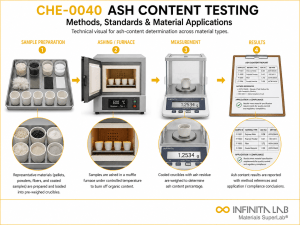
Ash Content Testing Services
ASH CONTENT The most effective techniques are based on the fact that minerals may be heated without being damaged and...
Read ArticleASTM D882: Standard for Tensile Testing of Thin Plastic Sheeting
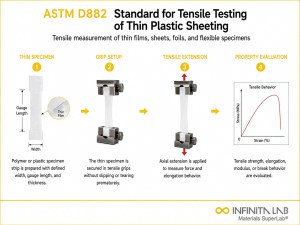
ASTM D882: Standard for Tensile Testing of Thin Plastic Sheeting
What Is ASTM D882? ASTM D882 is the Standard Test Method for Tensile Properties of Thin Plastic Sheeting, specifically designed...
Read ArticleAccelerated Aging Testing Services

Accelerated Aging Testing Services
Introduction Accelerated aging in product testing is a methodology that simulates the long-term effects of environmental factors on a product...
Read Article
Get your Ceramic Material testing done from the largest network of accredited labs in the USA
We are a material testing lab with a vast network of accredited labs across the country. Our state-of-the-art equipment and experienced team provide accurate and timely testing services to meet the unique needs of our clients. Partner with us for reliable material testing solutions.
 Quick Turnaround and Hasslefree process
- Confidentiality Guarantee
- Free, No-obligation Consultation
- 100% Customer Satisfaction


