


ASTM C1326: Ceramic Knoop Hardness Testing Services
ASTM C1326 Knoop Hardness Testing determines the hardness of advanced ceramics and hard materials using a rhombic pyramid indenter under low loads — used for material qualification, grade verification, coating characterisation, and QC of ceramic components in aerospace, semiconductor, biomedical, and defence applications.
TRUSTED BY


Get ASTM C1326 compliant results — request your ceramic knoop hardness testing quote
- Overview
- Scope, Applications, and Benefits
- Test Process
- Specifications
- Instrumentation
- Results and Deliverables
What Is ASTM C1326 Ceramic Knoop Hardness?
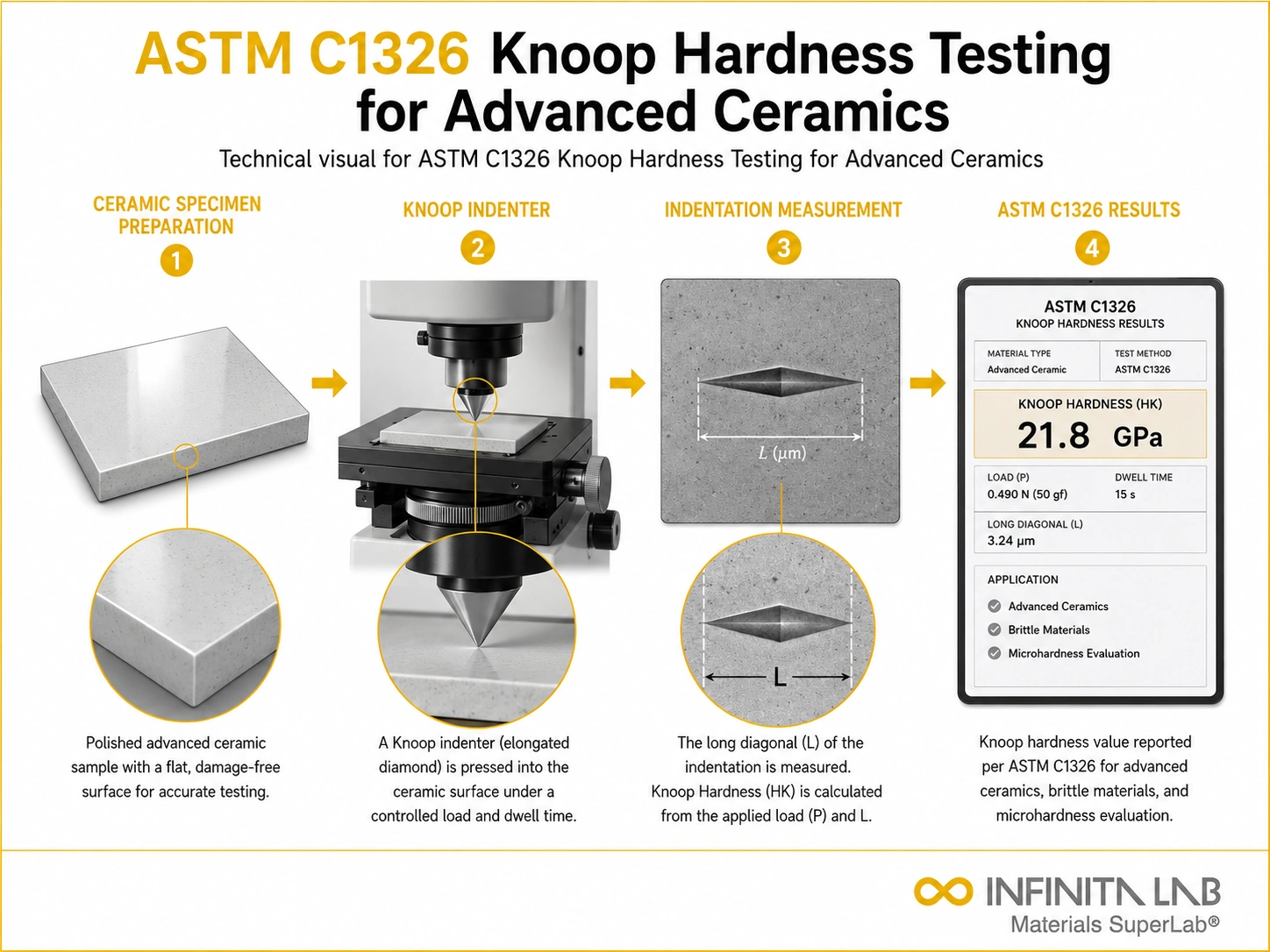
ASTM C1326 specifies the Knoop indentation hardness test for advanced ceramics — a method in which a rhombic-based pyramidal diamond indenter is pressed into a polished ceramic surface under a defined load and the resulting elongated indent is measured optically along its long diagonal. The Knoop hardness number (HK) is calculated from the applied load and the projected indent area. Because the Knoop indenter produces a shallow, elongated impression compared to the Vickers pyramid — with an aspect ratio of approximately 7:1 — it is specifically suited to brittle, anisotropic, and crack-prone materials where deeper indentation would induce radial cracking and distort the hardness reading. The standard applies to monolithic ceramics, ceramic composites, hard coatings, and refractory materials across a hardness range of approximately HK 500–2500.
Testing requires specimens polished to Ra <0.1 µm, a minimum of 5 valid indentations per location measured at 400–1000× magnification, and indent spacing of at least 3× the long diagonal. Infinita Lab sources accredited laboratories for ASTM C1326 Knoop hardness testing across all major advanced ceramic applications — from aerospace TBC qualification and SiC armour verification to biomedical implant QC and semiconductor ceramic carrier inspection. We confirm specimen preparation requirements, laboratory capability, and manage the process through to a certified ISO 17025 test report.

Applications and Benefits of ASTM C1326 Ceramic Knoop Hardness Testing
Scope
ASTM C1326, published by ASTM International, covers the determination of Knoop indentation hardness of advanced ceramic materials using a micro indentation technique. The method is intended for dense, fine-grained ceramics where precise hardness measurement at small loads is required.
Applicable to advanced structural ceramics.
Uses Knoop microindentation method.
Suitable for small or thin specimens.
Measures resistance to localized plastic deformation.
Defines load range, dwell time, and measurement procedure.
Applications
- Aerospace thermal barrier coating (TBC) qualification — Knoop hardness of yttria-stabilised zirconia (YSZ) TBC layers on turbine blades and vanes to verify coating integrity and process consistency.
- Cutting tool grade verification — Hardness qualification of cemented carbide, alumina, and silicon nitride cutting tool inserts to confirm grade compliance before production release.
- Semiconductor ceramic carrier QC — Hardness testing of alumina and aluminium nitride (AlN) substrates, wafer chucks, and ceramic insulators used in semiconductor processing equipment.
- Biomedical implant hardness — Knoop hardness of alumina femoral heads, zirconia dental crowns, and hydroxyapatite (HA) coatings on orthopaedic implants for wear resistance qualification.
- Ballistic ceramic armour verification — Hardness QC of boron carbide (B₄C), silicon carbide, and alumina armour tiles to verify sintered density and hardness uniformity across production batches.
- Hard coating characterisation — Knoop microhardness of CVD diamond, DLC, TiN, TiAlN, and Al₂O₃ PVD coatings on tool substrates and wear-resistant components.
- Refractory & structural ceramics QC — Incoming and production hardness testing of sintered SiC, Si₃N₄, and boron carbide structural components for industrial furnace, pump, and wear applications.
Benefits
High precision for brittle materials.
Suitable for small-scale testing.
Minimal specimen damage.
Reliable comparison of ceramic materials.
Standardized testing methodology.
Our ASTM C1326 Testing Procedure
Specimen Preparation
Prepare flat, polished surface free from cracks or surface defects.
1Load Application
Apply specified test load using a Knoop diamond indenter for defined dwell time.
2Indentation Measurement
Measure the long diagonal of the indentation using an optical microscope.
3Hardness Calculation & Reporting
Calculate Knoop hardness number (HK) based on applied load and indentation length, and document results.
4ASTM C1326 Test Parameters and Requirements
| Parameter | Details |
|---|---|
| Material Type | Advanced ceramics |
| Indenter Type | Knoop diamond indenter |
| Load Range | Typically 0.1 kgf to 5 kgf |
| Dwell Time | 10–15 seconds per ASTM C1326 |
| Typical HK ranges | Al₂O₃: 1400–2000 HK, SiC: 2000–2500 HK, ZrO₂: 1000–1300 HK ,Si₃N₄: 1400–1800 HK |
| Measured Parameter | Knoop Hardness Number (HK) |
| Optical measurement | 400–1000× magnification; long diagonal measured to ±0.5 µm accuracy |
| Specimen Thickness | Sufficient to avoid substrate influence |
| Environment | Room temperature testing |
| Result unit | Knoop hardness number (HK) with applied load specified |


Microhardness Testing Machine
Knoop Diamond Indenter
Optical Microscope with Measurement Scale
Calibration Reference Blocks
Polishing Equipment
Micrometer
Equipment and Instrumentation Used for ASTM C1326 Testing
What You Receive: Test Report, Data, and Certification
Knoop Hardness Value (HK)
Applied Load and Dwell Time
Indentation Diagonal Measurements
Surface Preparation Details
Calibration Verification Record
Test Conditions Documentation
Complete Test Report as per ASTM International standard
ASTM C1326 Ceramic Knoop Hardness FAQs
ASTM C1326 covers the determination of Knoop indentation hardness of advanced ceramic materials using a microindentation technique, providing hardness values based on controlled loads and precise measurement of indentation length.
Knoop hardness testing is suitable for brittle ceramics because it uses lower loads and produces elongated indentations, minimizing cracking while allowing accurate hardness evaluation of hard, fragile materials.
Use Knoop for thin coatings, anisotropic materials, and crack-prone ceramics — the shallow 7:1 elongated indent minimises radial cracking and enables directional hardness measurement. Use Vickers for isotropic bulk ceramics or when comparing against published HV databases, where most literature data is reported in Vickers.
A minimum of 5 valid indentations per test location is required. Indentations affected by pores, pre-existing cracks, or grain pullout may be excluded but must be documented in the test report. Indent spacing must be at least 3× the long diagonal centre-to-centre to avoid plastic zone overlap. For heterogeneous materials, a higher count across multiple locations is recommended.
ASTM C1326 requires specimens polished to Ra <0.1 µm (100 nm). Typical preparation involves sequential SiC grinding followed by diamond paste polishing to 1 µm or finer, finishing with 0.05 µm colloidal silica. Surface cracks, grain boundary pullout, residual grinding damage, or porosity cause erratic readings and must be documented or excluded. Inadequate surface preparation is the single largest source of scatter in ceramic hardness data.
Why Choose Infinita Lab for Ceramic Knoop Hardness Testing
At the core of this breadth is our network of 2,000+ accredited laboratories across the USA, offering access to over 10,000 testing methods and analytical services. From advanced materials characterization (SEM, TEM, RBS, XPS) to mechanical, chemical, environmental, biological, and standardized ASTM/ISO-compliant testing, we deliver unmatched flexibility, specialization, and scale. You are never limited by geography, facility, or methodology — Infinita Lab connects you to the right expertise and testing solution, every time.

Looking for an Accredited Partner for ASTM C1326 Ceramic Knoop Hardness Testing?
Send query us at hello@infinitalab.com or call us at (888) 878-3090 to learn more about our services and how we can support you.



Request a Quote
Submit your material details and receive testing procedures, pricing, and turnaround time within 24 hours.
 Quick Turnaround and Hasslefree process
 Confidentiality Guarantee
 Free, No-obligation Consultation
 100% Customer Satisfaction
