


ASTM A105: Carbon Steel Forging Testing Services
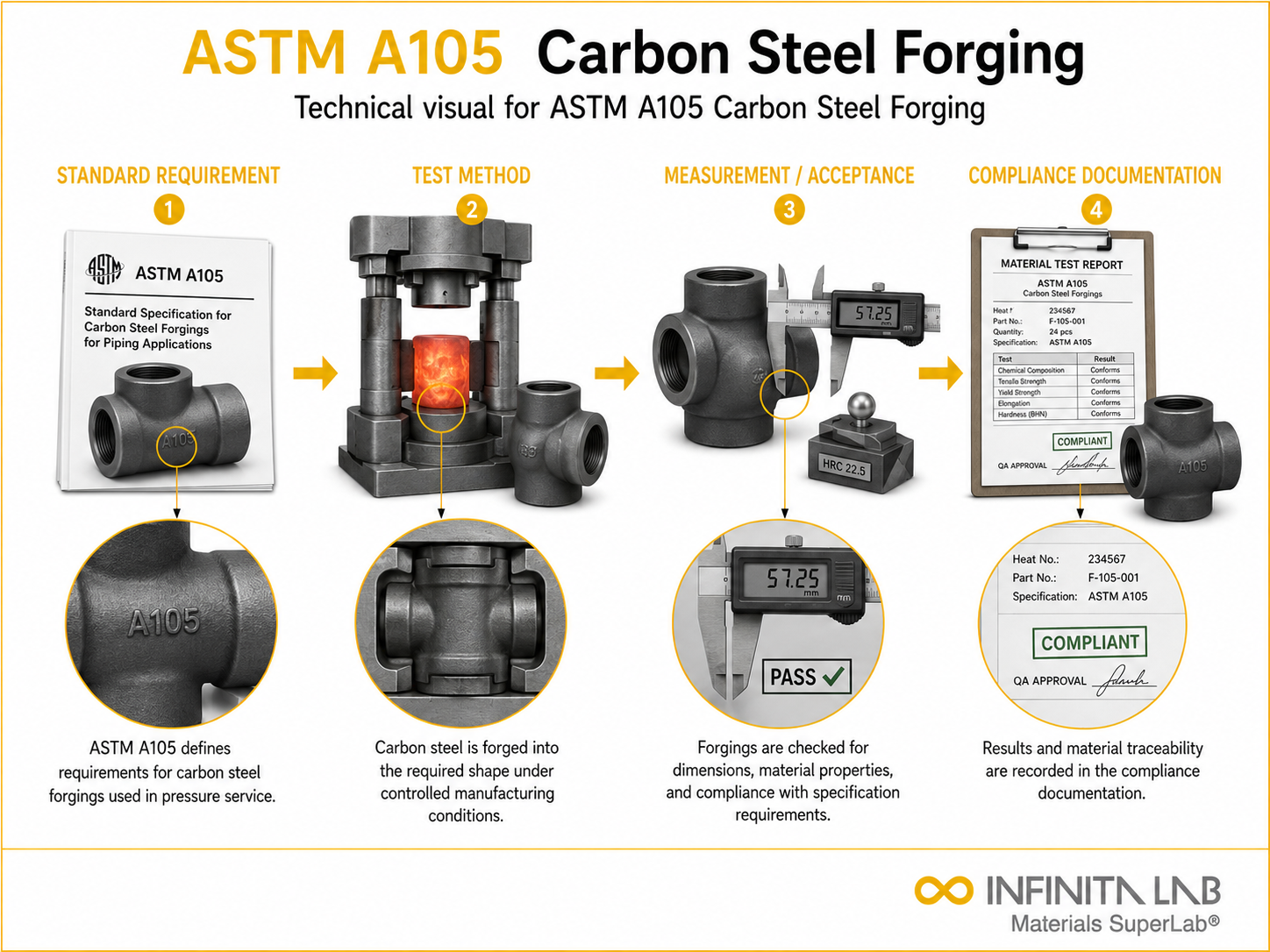
ASTM A105/A105M-21 test method determines the role of forged carbon steel piping components for ambient and higher temperature services in pressure systems. This method does not cover the tube sheets and hollow cylindrical forgings for pressure vessel shells. The final results of this method are displayed keeping in view the international standards and inch-pound units.
TRUSTED BY


Get ASTM A105 compliant results — request your carbon steel forging testing quote
- Overview
- Scope, Applications, and Benefits
- Test Process
- Specifications
- Instrumentation
- Results and Deliverables
What Is ASTM A105 Carbon Steel Forging?
ASTM A105/A105M is the standard specification covering forged carbon steel piping components for ambient- and higher-temperature service in pressure systems. It applies to forged components such as flanges, fittings, valves, and similar parts used in piping. The specification does not cover tube sheets or hollow cylindrical forgings intended for pressure vessel shells. Results are reported in inch-pound units (with SI equivalents).
A105 is one of the most widely referenced specifications for piping components in the oil and gas, petrochemical, power generation, and process industries. Because these components operate under pressure – sometimes at elevated temperature – they must meet defined requirements for chemical composition, mechanical properties, and condition. Verifying these requirements through testing is what allows a component to be accepted as A105-compliant and used with confidence in a pressure system.
Testing to A105 confirms that a forged component meets the specification’s limits across several areas: chemical composition (including carbon equivalent), tensile properties, hardness, and heat treatment condition. Together, these checks establish that the material has the strength, ductility, and metallurgical condition required for safe service in pressure piping.

Applications and Benefits of ASTM A105 Carbon Steel Forging Testing
Scope
ASTM A105 testing covers verification of forged carbon steel piping components against the chemical, mechanical, and metallurgical requirements of the specification. The testing confirms that the component meets the limits required for use in ambient- and elevated-temperature pressure piping service.
Key aspects of the testing scope include:
- Chemical composition – verification of carbon, manganese, phosphorus, sulfur, silicon, and the residual/alloy elements against the specification limits, including calculation of the carbon equivalent (CE), which governs weldability
- Tensile properties – tensile strength, yield strength, and elongation determined per ASTM A370 to confirm the material meets the minimum mechanical requirements
- Hardness – hardness testing (typically Brinell) against the specified maximum, which relates to both machinability and the controlled strength of the component
- Heat treatment condition – verification that the component was supplied in the required condition; certain sizes and applications require the forging to be heat treated (annealed, normalized, or normalized and tempered)
- Excluded items – the specification does not cover tube sheets or hollow cylindrical forgings for pressure vessel shells
- Units – results reported in inch-pound units with SI equivalents
Applications
- Pressure piping components – verification of forged flanges, fittings, valve bodies, and connectors used in pressurized piping systems in process and energy industries
- Oil and gas industry – testing of A105 components used in upstream, midstream, and downstream piping where pressure-containing integrity is essential
- Petrochemical and chemical processing – confirming forged components meet A105 requirements for service in process piping systems
- Power generation – verification of carbon steel forged piping components used in power plant piping operating at ambient and elevated temperatures
- Incoming material verification – confirming that purchased A105 components match their material certification before installation in a pressure system
- Component qualification – establishing that a forging supplier’s product meets the full A105 requirement set before approval
- Failure investigation support – verifying whether an A105 component met its specified chemistry and properties as part of investigating a piping failure
Benefits
- Confirms fitness for pressure service – A105 testing verifies the combination of chemistry, strength, ductility, and condition needed for a forged component to be used safely in a pressure piping system
- Carbon equivalent verification supports weldability – because A105 components are frequently welded into piping, confirming the carbon equivalent is within limits is essential to ensure the component can be welded without cracking
- Covers the full requirement set in one engagement – chemical, tensile, hardness, and heat-treatment verification can be performed together to fully qualify a component against the specification
- Supports material acceptance and traceability – testing provides the documented evidence needed to accept A105 components and maintain traceability in regulated pressure-system applications
- Recognized industry specification – A105 is a widely accepted reference for carbon steel piping forgings, so verification against it provides a consistent, accepted basis for component acceptance across the supply chain
Our ASTM A105 Testing Procedure
Identify and Sample
Document the forging and collect test samples according to ASTM A370.
1Analyse Composition
Measure the chemical composition and calculate the carbon equivalent against ASTM A105 limits.
2Test Mechanical Properties
Perform tensile and hardness testing to determine strength, elongation, and hardness.
3Evaluate and Report
Compare all results with ASTM A105 requirements and issue a pass/fail report.
4ASTM A105 Test Parameters and Requirements
| Parameter | Details |
|---|---|
| Component Types | Forged flanges, fittings, valves, and piping components |
| Chemical Analysis | C, Mn, P, S, Si, and residual/alloy elements; carbon equivalent (CE) |
| Tensile Properties | Tensile strength, yield strength, elongation (per ASTM A370) |
| Hardness | Typically Brinell, against specified maximum |
| Heat Treatment | Verification of required supply condition (anneal/normalize/normalize and temper) |
| Service Range | Ambient and elevated temperature pressure piping |
| Excluded | Tube sheets, hollow cylindrical forgings for pressure vessel shells |


- Optical emission spectrometer (OES) for chemical composition
- Combustion carbon/sulfur analyzer (for C and S as required)
- Universal Testing Machine (UTM) for tensile testing
- Brinell hardness tester
- Metallographic equipment (for heat-treatment condition verification where needed)
- Specimen machining equipment for tensile sample preparation
- Analytical balance and supporting laboratory instrumentation
Equipment and Instrumentation Used for ASTM A105 Testing
What You Receive: Test Report, Data, and Certification
- Test report – measured chemical composition, carbon equivalent, tensile properties, and hardness against the ASTM A105 specification limits
- Chemical analysis results – element concentrations with the calculated carbon equivalent and pass/fail against the limits
- Mechanical test results – tensile strength, yield strength, and elongation values with pass/fail against the minimum requirements
- Hardness results – measured hardness against the specified maximum
- Heat treatment confirmation – verification of the supplied condition where required by the specification
- Sample records – component identification, sampling location and orientation, and traceability information
ASTM A105 Carbon Steel Forging FAQs
ASTM A105 is primarily a material specification rather than a single test method. It defines manufacturing, heat-treatment, chemical-composition, mechanical-property, inspection and marking requirements.
The specification covers forged flanges, fittings, valves and similar pressure-containing piping components. Individual forgings are limited to a maximum weight of 10,000 lb, or 4,540 kg.
Typical evaluations include chemical analysis, tensile testing and hardness testing. Hydrostatic testing is also required when specified by the applicable product standard or purchase requirements.
Tensile testing measures tensile strength, yield strength, elongation and reduction of area. These results confirm that the forging has sufficient strength and ductility for the intended pressure-service application.
Hardness testing verifies that the forging meets the maximum hardness requirement and has not become excessively hard during manufacturing or heat treatment. Excessive hardness may indicate reduced ductility or unsuitable processing.
Why Choose Infinita Lab for Carbon Steel Forging Testing
At the core of this breadth is our network of 2,000+ accredited laboratories across the USA, offering access to over 10,000 testing methods and analytical services. From advanced materials characterization (SEM, TEM, RBS, XPS) to mechanical, chemical, environmental, biological, and standardized ASTM/ISO-compliant testing, we deliver unmatched flexibility, specialization, and scale. You are never limited by geography, facility, or methodology — Infinita Lab connects you to the right expertise and testing solution, every time.

Need ASTM A105 Carbon Steel Forging Testing You Can Rely On?
Send query us at hello@infinitalab.com or call us at (888) 878-3090 to learn more about our services and how we can support you.



Request a Quote
Submit your material details and receive testing procedures, pricing, and turnaround time within 24 hours.
 Quick Turnaround and Hasslefree process
 Confidentiality Guarantee
 Free, No-obligation Consultation
 100% Customer Satisfaction
