


RBS XRF Thin Film Analysis Testing Services
RBS-XRF stands for Rutherford Backscattering Spectrometry - X-ray Fluorescence. It is a surface analysis technique used to study the composition of materials. RBS is used to determine the concentration and depth distribution of elements in a sample, while XRF is used to identify the chemical elements present in the sample. This technique is commonly used in materials science, semiconductor analysis, and environmental monitoring. RBS-XRF is a non-destructive technique, meaning that the sample can be reused or analyzed further after the analysis is complete.
TRUSTED BY


Get compliant results — request your RBS XRF thin film analysis testing quote
- Overview
- Scope, Applications, and Benefits
- Test Process
- Specifications
- Instrumentation
- Results and Deliverables
What Is RBS XRF Thin Film Analysis?
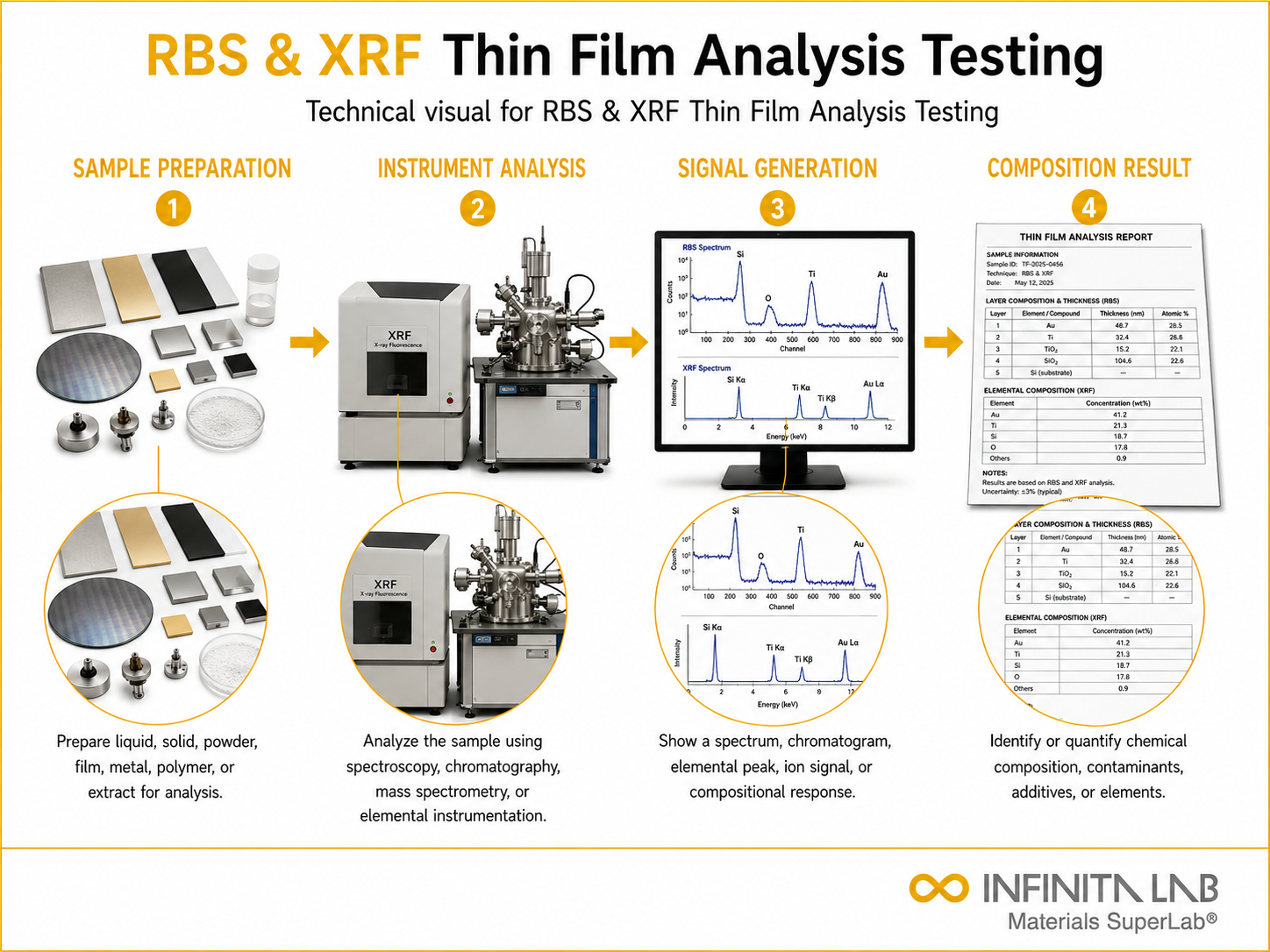
Rutherford Backscattering Spectrometry (RBS) and X-ray Fluorescence (XRF) are analytical techniques used to determine elemental composition and thickness of materials. RBS provides depth profiling, while XRF offers rapid surface-level elemental analysis.
These techniques are widely used for material characterization, coating analysis, and impurity detection. They provide accurate, non-destructive evaluation of elemental composition across metals, semiconductors, and advanced materials.

Applications and Benefits of RBS XRF Thin Film Analysis Testing
Scope
RBS & XRF testing evaluates:
- Elemental composition and concentration
- Thin film thickness and depth profiling (RBS)
- Surface elemental analysis (XRF)
- Impurity and contamination detection
Applications
- Semiconductor and electronics
- Coatings and thin films
- Metallurgy and alloys
- Environmental and material analysis
- Research and advanced materials
Benefits
- Non-destructive elemental analysis
- High accuracy and sensitivity
- Rapid multi-element detection
- Supports thin film characterization
- Enables material verification
Our Testing Procedure
Sample Preparation
Samples are cleaned and positioned to ensure accurate detection and minimal interference.
1Excitation
High-energy ion beams (RBS ~1–3 MeV He⁺ ions) or X-rays (XRF ~1–50 keV) are directed at the sample.
2Signal Detection
Backscattered ions (RBS) or fluorescent X-rays (XRF) are detected and recorded.
3Data Analysis
Elemental composition and thickness are calculated using calibration models and spectral analysis.
4Test parameters and requirements
| Parameter | Details |
|---|---|
| Standard | ASTM E572, ISO 3497 (XRF) |
| Applicable Materials | Metals, coatings, semiconductors, ceramics |
| Minimum Sample Size | Few mm² flat surface |
| Measured Outputs | Elemental composition (% / ppm), thickness (nm–µm) |
| Detection Limit | ~1 ppm (XRF), ~0.1 at% (RBS) |
| Accuracy | ±1–3% |


- XRF spectrometer (EDXRF/WDXRF)
- Ion accelerator (for RBS)
- Solid-state detectors
- Vacuum chamber (RBS)
- Calibration standards
- Data processing software
Equipment and Instrumentation Used for Testing
What You Receive: Test Report, Data, and Certification
- Quantitative elemental composition
- Thin film thickness and depth profiles (RBS)
- Surface elemental analysis (XRF)
- Trace impurity detection
- Comparative material characterization
RBS XRF Thin Film Analysis FAQs
RBS-XRF spectroscopy is a hybrid analytical technique that combines Rutherford Backscattering Spectrometry (RBS) with X-ray Fluorescence (XRF).
The two complementary techniques are RBS, which bombards the sample with high-energy ions to analyze atomic structure and depth profile, and XRF, which uses X-rays to excite atoms in the sample to emit characteristic fluorescent X-rays.
The key advantages of RBS-XRF are the non-destructive nature, high precision, and information from the surface and subsurface.
In general, RBS-XRF spectroscopy requires more sophisticated equipment than what is available in any contemporary handheld X-ray fluorescence device.
Portable X-ray fluorescence (XRF) devices are designed for quick, non-destructive elemental analysis in the field or on-site, making them highly convenient for many applications.
Why Choose Infinita Lab for RBS XRF Thin Film Analysis Testing?
At the core of this breadth is our network of 2,000+ accredited laboratories across the USA, offering access to over 10,000 testing methods and analytical services. From advanced materials characterization (SEM, TEM, RBS, XPS) to mechanical, chemical, environmental, biological, and standardized ASTM/ISO-compliant testing, we deliver unmatched flexibility, specialization, and scale. You are never limited by geography, facility, or methodology — Infinita Lab connects you to the right expertise and testing solution, every time.

Looking for an Accredited Partner for RBS XRF Thin Film Analysis Testing?
Send query us at hello@infinitalab.com or call us at (888) 878-3090 to learn more about our services and how we can support you.



Request a Quote
Submit your material details and receive testing procedures, pricing, and turnaround time within 24 hours.
 Quick Turnaround and Hasslefree process
 Confidentiality Guarantee
 Free, No-obligation Consultation
 100% Customer Satisfaction
