


ASTM E1695 Industrial CT System Performance Testing
The spatial resolution and contrast sensitivity of X-ray and γ- ray computed tomography (CT) volumes are determined using the standard test method ASTM E1695. The result is determined by looking at the CT volume of a uniform cylinder of material. The values expressed in SI units should be considered standard.
TRUSTED BY


Precision-driven testing for dimensional accuracy and compliance
- Overview
- Scope, Applications, and Benefits
- Test Process
- Specifications
- Instrumentation
- Results and Deliverables
Overview
ASTM E1695 is a standardized test method intended to assess the overall performance of an industrial CT scanner. It evaluates key performance parameters such as spatial resolution, contrast sensitivity, and the system’s stability.
This standard provides a standardized procedure that will enable the buyer and seller of a CT system or CT inspection services to assess whether the performance is as expected. While E1695 is used to evaluate the performance of the system as a whole, there are other standards such as Guide E1000, Practice E2737, and Practice E2002 that evaluate individual components such as X-ray tubes, gamma sources, and detector systems.

Scope, Applications, and Benefits
Scope
ASTM E1695 applies to industrial computed tomography (CT) systems, including X-ray and gamma-ray based systems, as well as fan-beam and cone-beam CT configurations. The standard provides a framework for evaluating the performance of CT systems to ensure consistent image quality and reliable inspection results.
It evaluates:
- Modulation Transfer Function (MTF)
- Contrast Discrimination Function (CDF)
- Spatial resolution
- Contrast sensitivity
- System stability
- Overall performance acceptability
Applications
- Acceptance testing of new CT systems
- Performance verification of installed CT equipment
- Supplier and buyer system qualification
- Periodic system performance validation
- Additive manufacturing inspection
- Non-destructive testing (NDT) laboratories
- Research and development CT facilities
Benefits
- Standardized system performance evaluation
- Quantitative measurement of spatial resolution
- Assessment of contrast sensitivity
- Improved confidence in CT inspection quality
- Benchmarking of CT systems
- Enhanced quality assurance
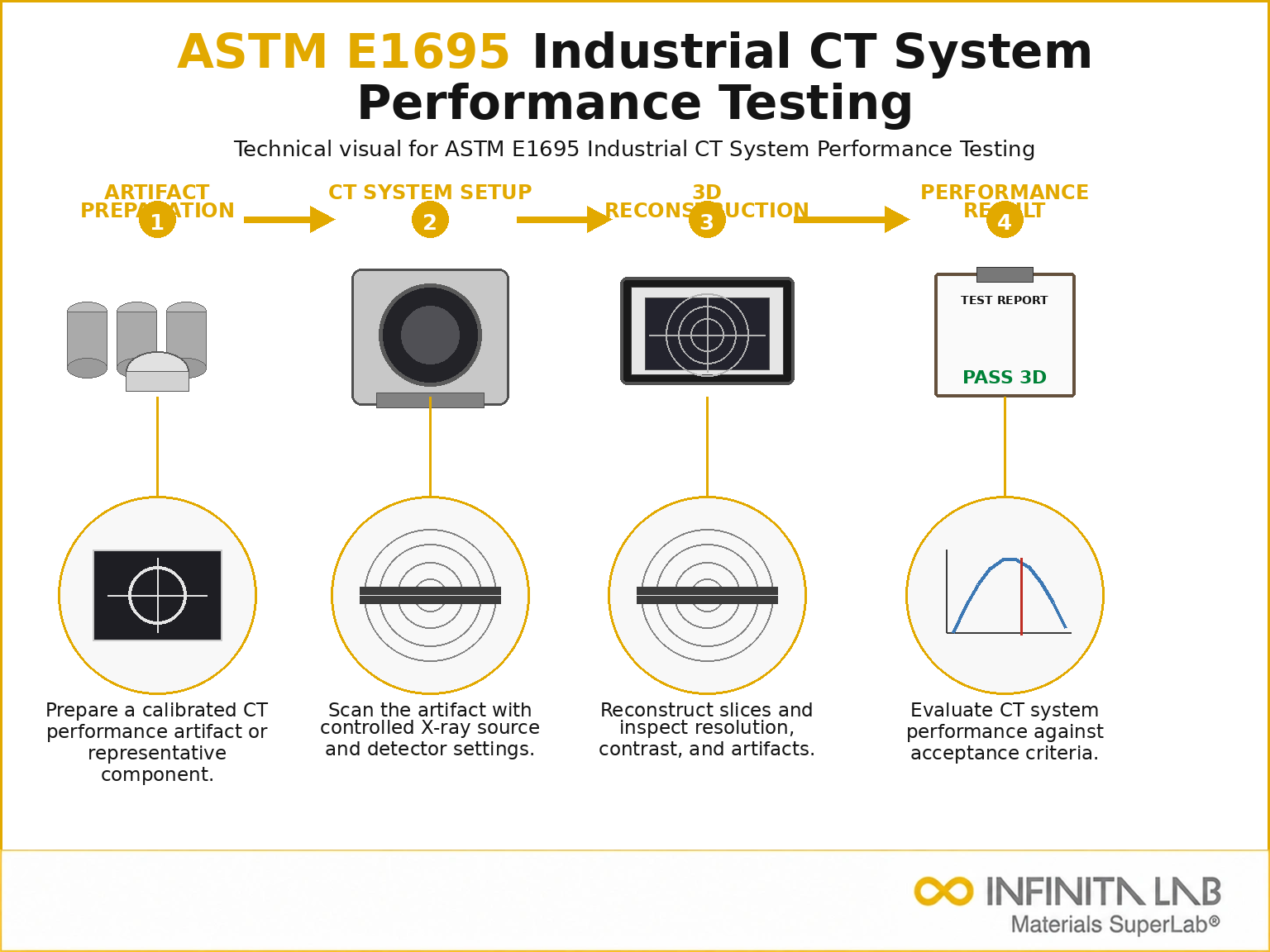
Test Process
Phantom Setup & Parameter Configuration
Install the standard phantom as per ASTM E1695 and set data acquisition parameters identical to inspection conditions.
1Slice Acquisition
Capture required slices — one slice for fan-beam CT, or three slice planes at different detector positions for cone-beam CT.
2Image Quality Measurements
Calculate Modulation Transfer Function (MTF) and Contrast Discrimination Function (CDF) for each slice.
3Performance Evaluation
Analyze and document spatial resolution, contrast sensitivity, and overall system performance.
4Technical Specifications
| Parameter | Details |
|---|---|
| Measured Parameters | MTF (Modulation Transfer Function), CDF (Contrast Discrimination Function) |
| CT Configurations | Fan-beam and Cone-beam systems |
| Data Acquisition | Identical to inspection scan settings |
| Minimum Reconstruction Requirement | ≥ 250 voxels across phantom diameter |
| Phantom Height Requirement | ≥ 80% of detector height |
| Output Format | Graphical representation of MTF and CDF |


Instrumentation Used for Testing
- Industrial CT system (X-ray or gamma source)
- Detector array
- Standard ASTM E1695 phantom
- Reconstruction software
- Image analysis software for MTF and CDF calculation
- Data acquisition system
Results and Deliverables
- Graphical representation of Modulation Transfer Function (MTF)
- Graphical representation of Contrast Discrimination Function (CDF)
- Spatial resolution performance data
- Contrast sensitivity performance data
- Documentation of scan parameters influencing results
- System stability assessment
- Performance acceptability evaluation report
Frequently Asked Questions
ASTM E1695 is a testing method used for evaluating the performance of industrial computed tomography system, ensuring image quality, dimensional accuracy, and reliability for non-destructive examination application.
ASTM E1695 evaluates spatial resolution, contrast detectability, geometric accuracy, slice thickness, image noise, and artifact presence to determine overall CT system imaging performance and reliability.
Spatial resolution refers to the system's ability to distinguish small details or closely spaced features within a scanned object, typically measured using pair phantoms or resolution test patterns.
ASTM E1695 ensures consistent CT imaging quality, reliable defect detection, and accurate dimensional measurements, supporting compliance with industry standards and improving safety, quality control, and inspection confidence.
Unlike conventional hardness tests, ASTM E1695 records the full load–displacement curve, enabling calculation of both hardness and elastic modulus from a single indentation.
Why Choose Infinita Lab for Advanced Materials Testing and Characterization?
At the core of this breadth is our network of 2,000+ accredited laboratories across the USA, offering access to over 10,000 testing methods and analytical services. From advanced materials characterization (SEM, TEM, RBS, XPS) to mechanical, chemical, environmental, biological, and standardized ASTM/ISO-compliant testing, we deliver unmatched flexibility, specialization, and scale. You are never limited by geography, facility, or methodology — Infinita Lab connects you to the right expertise and testing solution, every time.

Looking for a Trusted Partner for Accurate and Reliable Testing Services?
Send query us at hello@infinitlab.com or call us at (888) 878-3090 to learn more about our services and how we can support you.



Request a Quote
Submit your material details and receive testing procedures, pricing, and turnaround time within 24 hours.
 Quick Turnaround and Hasslefree process
 Confidentiality Guarantee
 Free, No-obligation Consultation
 100% Customer Satisfaction
