


Polypropylene
Infinita Lab provides comprehensive polypropylene testing services covering mechanical, thermal, chemical, and compositional evaluation for homopolymer, copolymer, and reinforced PP grades. From melt flow rate, tensile, impact, and hardness testing to DSC, TGA, UV weathering, and chemical resistance, we support every stage of the product lifecycle — from raw material validation to regulatory compliance. With access to 2,000+ accredited U.S. laboratories, Infinita Lab is your trusted single point of contact for all polypropylene testing needs.





Introduction to Polypropylene Testing Services
Polypropylene (PP) is a primary thermoplastic in global manufacturing, distinguished by its superior chemical resistance, low density, high fatigue strength, and processability. Its application is critical across diverse industrial sectors, including automotive components such as bumpers and instrument panels, medical instrumentation, laboratory apparatus, food-grade packaging, and synthetic textiles.
Infinita Lab facilitates extensive mechanical, thermal, chemical, and compositional evaluation of polypropylene through a sophisticated national network comprising more than 2,000 accredited facilities. Our technical services provide comprehensive support throughout the product lifecycle, including raw material validation, developmental research, quality assurance, and regulatory adherence for homopolymer, copolymer, and reinforced polypropylene grades.
Our Polypropylene Testing Services
Melt Flow Rate Testing
Melt flow rate (MFR) is the primary quality control test for polypropylene, directly reflecting molecular weight and processability. MFR data guides grade selection across PP processing methods – from extrusion and blow molding to thin-wall injection molding – and is the most sensitive indicator of lot-to-lot consistency and degradation in recycled PP.
Relevant ASTM Standards:
- ASTM D1238 – Melt flow rate testing for polypropylene, measured at the standard PP condition of 230°C/2.16 kg. Low MFR grades (0.5-4 g/10 min) suit extrusion and blow molding; high MFR grades (20-80 g/10 min) suit thin-wall injection molding. MFR is the primary incoming QC test for all PP resins and the most sensitive indicator of molecular weight changes from degradation or contamination.
Tensile Testing
Tensile testing is the foundational mechanical characterisation for PP, providing yield strength, ultimate tensile strength, elongation at break, and Young’s modulus – the core properties used for structural design and material specification compliance across all PP grades and applications.
Relevant ASTM Standards:
- ASTM D638 – Tensile property testing for polypropylene, measuring yield strength (30-40 MPa for homopolymer), elongation at break, and tensile modulus (1.2-1.7 GPa) using dog-bone specimens at controlled crosshead speed. The primary tensile characterisation test for all thermoplastics, including PP homopolymer, random copolymer, and impact copolymer grades.
Flexural Testing
Flexural stiffness defines the resistance of polypropylene to bending loads – a critical property for automotive structural panels, appliance housings, storage containers, and furniture components. Flexural modulus is one of the most frequently cited properties in PP datasheet specifications.
Relevant ASTM Standards:
- ASTM D790 – Flexural properties testing for polypropylene, measuring flexural strength and flexural modulus by three-point bending – directly paired with ASTM D638 tensile testing to complete the fundamental mechanical property profile for PP material qualification and datasheet generation.
Impact Resistance Testing
Impact resistance is the most application-critical mechanical property for many PP grades, particularly impact copolymers designed for automotive, consumer, and low-temperature applications. Izod impact testing quantifies the energy absorbed during fracture and distinguishes ductile from brittle failure modes.
Relevant ASTM Standards:
- ASTM D256 – Izod notched impact resistance testing for polypropylene, measuring the energy absorbed during fracture of a notched specimen under pendulum impact loading. The primary impact test for PP grade differentiation – homopolymer PP (typically 20-45 J/m) versus impact copolymer PP (typically 60-800 J/m) – and for low-temperature impact performance verification.
Hardness Testing
Hardness is a rapid, non-destructive indicator of surface quality for PP and is correlated with tensile strength and abrasion resistance. Shore D hardness is the standard test for semi-rigid and rigid PP products, providing fast production-floor screening.
Relevant ASTM Standards:
- ASTM D2240 – Shore hardness testing for polypropylene using the Shore D durometer scale, measuring surface resistance to indentation under a defined spring load – a rapid, low-cost, production-quality screening test for PP components and molded parts.
Heat Deflection Temperature Testing
Heat deflection temperature (HDT) determines the upper service temperature limit of polypropylene under load – the critical thermal performance parameter for PP components used in automotive under-hood environments, hot-fill packaging, and appliances.
Relevant ASTM Standards:
- ASTM D648 – Heat deflection temperature testing for polypropylene, measuring the temperature at which a PP specimen deflects 0.25 mm under a defined flexural stress (0.46 or 1.82 MPa). Unfilled PP homopolymer typically deflects at 100-115°C at 0.46 MPa – a primary thermal performance specification for automotive and industrial PP components.
Vicat Softening Point Testing
Vicat softening point testing provides the temperature at which PP begins to soften under a needle indenter load – an alternative thermal characterisation to HDT that is particularly relevant for thin PP film and sheet products.
Relevant ASTM Standards:
- ASTM D1525 – Vicat softening point testing for polypropylene, measuring the temperature at which a flat-ended needle penetrates 1 mm into the PP surface under defined loading – a commonly specified thermal property for PP packaging, thin-wall containers, and medical device materials.
Density & Specific Gravity Testing
Density is the fundamental physical property that confirms the PP grade type – distinguishing PP homopolymer (0.900-0.910 g/cm³) from random copolymer (0.895-0.905 g/cm³) and impact copolymer (0.895-0.920 g/cm³) grades – and detects contamination, filler addition, or incorrect material substitution.
Relevant ASTM Standards:
- ASTM D792 – Specific gravity and density testing for polypropylene by water displacement (Archimedes method), confirming PP grade type and detecting material substitution, incorrect compounding, or filler content deviation. PP density of 0.89-0.92 g/cm³ makes it the lightest commodity thermoplastic – a key specification parameter for lightweight design applications.
Water Absorption Testing
Polypropylene’s very low water absorption is one of its key advantages over polyamides and other engineering thermoplastics. Verification of water absorption confirms material identity and suitability for wet and humid service environments.
Relevant ASTM Standards:
- ASTM D570 – Water absorption testing for polypropylene by immersion, measuring the weight gain after defined immersion periods to characterise moisture uptake. PP’s very low water absorption (typically <0.01-0.03%) confirms its suitability for food contact, medical device, and outdoor applications where dimensional stability under wet conditions is required.
Chemical Resistance Testing
One of polypropylene’s greatest advantages is its broad chemical resistance – it resists acids, bases, alcohols, and most organic solvents, making it the preferred material for chemical containers, laboratory equipment, and piping. Chemical resistance testing verifies that PP performs as expected in the specific chemical environments of its intended application.
Relevant ASTM Standards:
- ASTM D543 – Chemical resistance testing for polypropylene, evaluating dimensional, mass, and property changes after immersion in specific chemical reagents – confirming resistance to the acids, bases, solvents, and process fluids encountered in the intended service environment of PP chemical containers, piping, and laboratory equipment.
Thermal Analysis
Thermal analysis characterises the crystalline structure, melting behaviour, cure state, and thermal stability of polypropylene – providing data essential for processing optimisation, material identification, filler content determination, and quality control of incoming resin and compounded PP grades.
Relevant ASTM Standards:
- ASTM D3418 – Differential Scanning Calorimetry (DSC) for polypropylene, measuring melting point (160-170°C for homopolymer), crystallinity (40-70%), crystallisation temperature, and heat of fusion – enabling PP grade identification, confirmation of degree of crystallinity, and comparative evaluation of different PP formulations.
- ASTM E1131 – Thermogravimetric Analysis (TGA) for polypropylene, determining filler content, thermal stability onset temperature, and decomposition profile. TGA data distinguish unfilled PP from talc-filled, glass-fibre-filled, or carbon black-stabilized grades and detect contamination by incompatible polymers or excessive residual catalyst.
Material Specification Compliance Testing
PP material specification testing verifies that incoming resin lots and compounded PP grades meet all property requirements defined in the applicable product specification – supporting supplier qualification, incoming inspection, and production lot release against ASTM reference standards.
Relevant ASTM Standards:
- ASTM D4101 – Standard specification for polypropylene injection and extrusion materials, classifying PP resins by type (homopolymer, copolymer), grade, and property requirements, including melt flow rate, density, tensile strength, flexural modulus, and HDT. The foundational specification standard for PP material procurement, incoming inspection, and supplier qualification.
UV Weathering & Accelerated Aging Testing
Polypropylene is susceptible to UV-induced degradation – chain scission, discolouration, and surface chalking – unless stabilised with UV absorbers and HALS additives. UV weathering testing evaluates the effectiveness of PP stabilisation systems and predicts long-term outdoor durability for automotive exterior, outdoor furniture, and agricultural applications.
Relevant ASTM Standards:
- ASTM G154 – Fluorescent UV-accelerated weathering testing for polypropylene using UVA-340 or UVA-351 lamps to simulate sunlight exposure, assessing long-term UV resistance, colour stability, and retention of mechanical properties in outdoor PP applications.
- ASTM G155 – Xenon-arc accelerated weathering testing for polypropylene, providing the most complete simulation of full-spectrum natural sunlight, including UV, visible, and near-infrared components – the preferred weathering test for automotive exterior PP components requiring correlation to outdoor exposure data.
Read Our Blogs and Research Papers
In-depth examination of genuine material testing solutionsWhat Is Tear Resistance Testing? Methods Explained
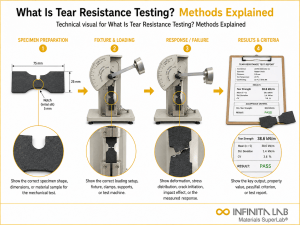
What Is Tear Resistance Testing? Methods Explained
What Is Tear Resistance Testing? Tear resistance testing measures the force required to initiate or propagate a tear through a...
Read ArticleTolerance Classification in Metrology: IT Grades, Fits & Dimensional Standards
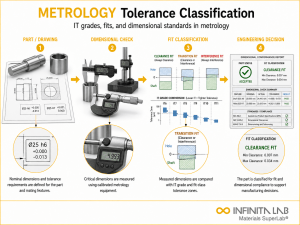
Tolerance Classification in Metrology: IT Grades, Fits & Dimensional Standards
Metals What Is Tolerance Classification in Metrology? Tolerance classification in metrology is a systematic framework for specifying, measuring, and verifying...
Read ArticleIngress Protection IP Guide Testing Services

Ingress Protection IP Guide Testing Services
IP code testing, also known as ingress protection testing Testing for regulatory compliance with ingress protection is a type of...
Read Article
Get your Ceramic Material testing done from the largest network of accredited labs in the USA
We are a material testing lab with a vast network of accredited labs across the country. Our state-of-the-art equipment and experienced team provide accurate and timely testing services to meet the unique needs of our clients. Partner with us for reliable material testing solutions.
 Quick Turnaround and Hasslefree process
- Confidentiality Guarantee
- Free, No-obligation Consultation
- 100% Customer Satisfaction


