


Paint
Infinita Lab’s Paint Testing Services ensure the highest standards of quality and reliability for all materials. Tests, therefore, can be described as coating tests; however, they fall under general product reliability assessments. Other advanced methodologies that we cover include: Abrasion Resistance, Colorimetry, VOC Analysis, etc. Protective strength and aesthetic appeal are the assurances that our services will provide through reliable insights supporting innovation in product development and quality assurance.


Top Testing Services
-
 ASTM D1653: Water Vapor Transmission Organic Coating Testing Services
-
Orange Peel Coating Failure Analysis Testing Services
-
Coating Analysis & Testing Services
-
ASTM D4541: Pull Off Adhesion Testing Services
-
ASTM E1347: Tristimulus Color Testing — Method & Laboratory Guide
-
ASTM D4086: Metamerism Visual Evaluation Testing Services






Introduction to Paint Testing
Surface coatings serve functions beyond mere aesthetic enhancement; they are critical for surface protection, the preservation of material integrity, and the maintenance of structural durability across diverse sectors, including architectural, industrial, and aerospace applications. Infinita Lab provides comprehensive, ASTM-compliant Paint Testing Services, encompassing rigorous evaluations of adhesion, durability, flexibility, chemical resistance, optical properties, volatile organic compound (VOC) content, and environmental weathering performance.
Leveraging an extensive network of more than 2,000 accredited laboratories and a portfolio of over 20,000 specialised tests, Infinita Lab ensures precise, technically robust data. These results facilitate advanced product development, rigorous quality assurance, and comprehensive regulatory compliance for stakeholders within the automotive, aerospace, infrastructure, and architectural markets.
Our Paint Testing Services
Adhesion Testing
Adhesion is the most fundamental performance property of any paint system – a coating that does not bond reliably to its substrate will fail regardless of any other properties. Infinita Lab provides both qualitative and quantitative adhesion testing methods to satisfy the full range of specification and quality control requirements.
Relevant ASTM Standards:
- ASTM D3359 – Cross-cut (X-cut and crosshatch) tape adhesion testing for paints and coatings, providing a semi-quantitative adhesion rating (0B-5B) based on the area of coating removed after tape application – the most widely used routine adhesion screen for paint systems on metal, plastic, and wood substrates.
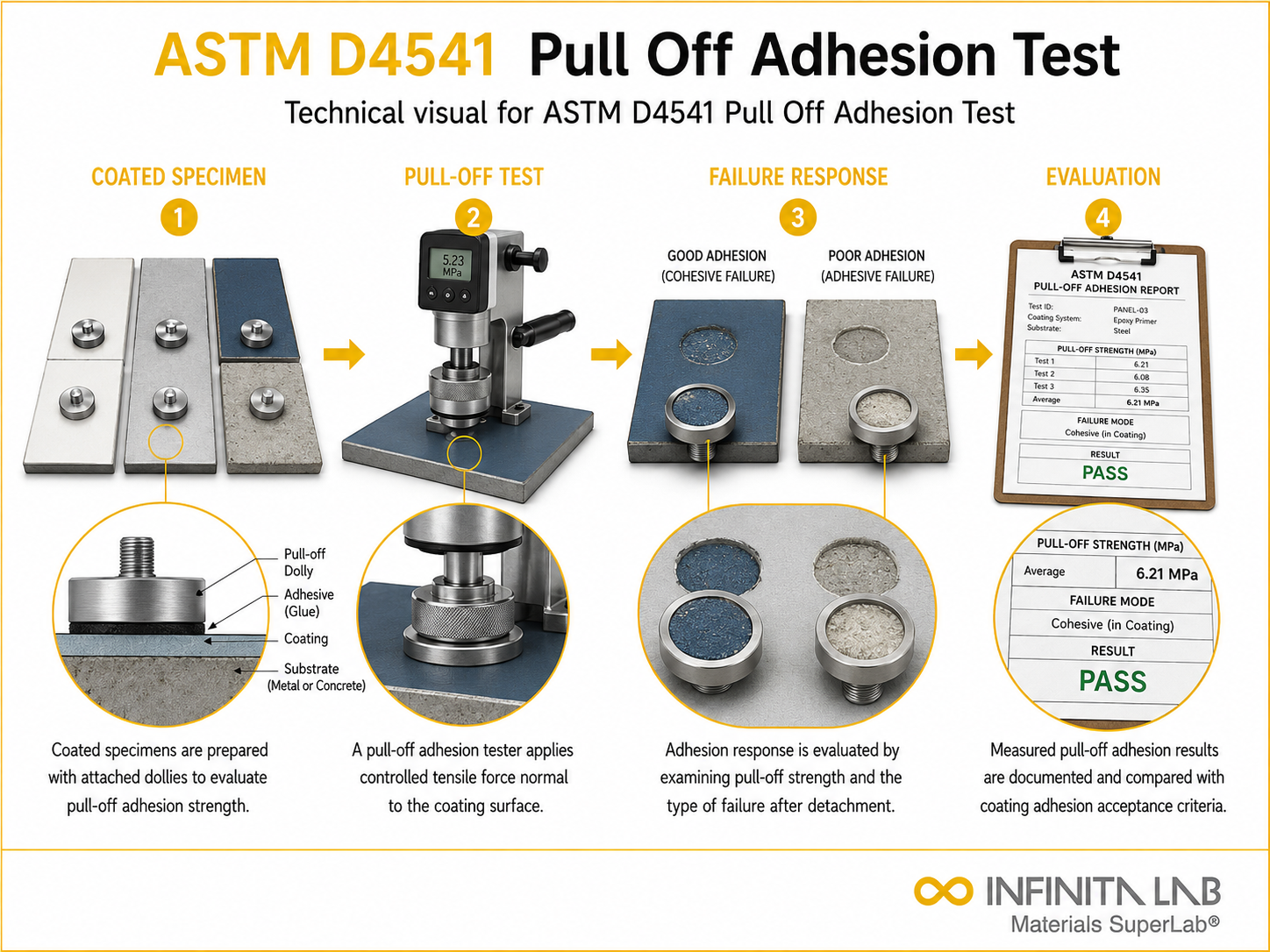
- ASTM D4541 – Pull-off adhesion testing for coatings on metal substrates, quantitatively measuring the force per unit area (MPa or psi) required to detach a dolly bonded to the coating surface – the standard for structural coating specifications that require a minimum adhesion strength.
- ASTM D7234 – Pull-off adhesion strength testing for coatings applied to concrete substrates, evaluating the bond strength of architectural, protective, and floor coatings to concrete and cementitious surfaces.
- ASTM C633 – Adhesion and cohesion strength testing for thermal spray coatings, measuring the tensile adhesion strength of thermally sprayed paint and protective coatings in aerospace, energy, and industrial applications where bond integrity directly governs functional performance and safety.
Coating Density Testing
Density is a sensitive indicator of paint formulation consistency – detecting deviations in pigment loading, solvent content, filler concentration, and raw material quality before defective batches reach production. It is one of the most important routine quality control tests in the paint industry.
Relevant ASTM Standards:
- ASTM D1475 – Density testing for liquid coatings, inks, varnishes, lacquers, and related fluid products using a weight-per-gallon cup or pycnometer. Density data support coverage calculations, solids estimation, VOC reporting, and batch-to-batch formulation uniformity verification.
Drying & Curing Rate Testing
The drying and curing rate of a paint film directly determines application productivity, recoat windows, and the readiness of coated surfaces for service. Drying time recording provides the data needed to optimise paint formulations and processing conditions.
Relevant ASTM Standards:
- ASTM D5895 – Drying or curing rate testing during film formation of organic coatings, using straight-line or circular mechanical drying-time recording instruments to evaluate the stages and rate of dry film formation – critical for determining when a freshly painted floor, room, or staircase is ready for use.
Gloss & Optical Properties Testing
Gloss level is a primary aesthetic specification for paint products across all market segments – from ultra-matte interior wall paints to high-gloss automotive topcoats. Specular gloss measurement provides the quantitative data needed for formulation development, batch-to-batch consistency control, and specification compliance.
Relevant ASTM Standards:
- ASTM D523 – Specular gloss measurement for paint and coatings at 20°, 60°, and 85° geometries, characterising coating gloss level from matte to high-gloss – the primary gloss measurement standard for architectural, automotive, and industrial paint specification and quality control.
- ASTM D2244 – Colour difference measurement for paints and coatings using CIELab colorimetry, calculating ΔE colour difference for weathering evaluation, batch-to-batch colour consistency verification, and colour acceptance specification in industrial and consumer paint products.
Impact Resistance Testing
Impact resistance evaluates a paint film’s ability to withstand sudden mechanical deformation without cracking or losing adhesion – an essential durability parameter for automotive, appliance, and packaging coatings that experience mechanical stress during service.
Relevant ASTM Standards:
- ASTM D2794 – Impact resistance testing for organic coatings, evaluating a paint film’s ability to withstand abrupt deformation from a weighted dart drop without cracking – the standard for assessing impact durability in consumer and automotive paint applications.
Flexibility & Bend Testing
Paint films applied to metal substrates must remain intact when the substrate is bent, formed, or rolled during fabrication. Flexibility testing verifies that paint systems can withstand mechanical deformation without cracking or delaminating.
Relevant ASTM Standards:
- ASTM D522 – Mandrel bend and conical mandrel flexibility testing for paints and coatings, evaluating a coating film’s ability to flex with the substrate without cracking – essential for coil coatings, flexible packaging, and formed metal products.
- ASTM D4145 – Coating flexibility testing for prepainted metal sheets, evaluating whether organic coatings on precoated metallic sheets can withstand rolling, bending, or similar deformation during fabrication without cracking or loss of adhesion.
Abrasion & Scratch Resistance Testing
Abrasion and scratch resistance determine the durability of paint surfaces under wear, cleaning, and handling – critical for floor coatings, automotive interior and exterior finishes, appliance coatings, and decorative laminates.
Relevant ASTM Standards:
- ASTM D4060 – Taber abrasion resistance testing for paints and coatings, using rotating abrasive wheels under a defined load to quantify weight loss per unit area (mg/1000 cycles) – the standard for evaluating the wear resistance of floor coatings, automotive interior surfaces, and industrial protective paints.
- ASTM D7027 – Progressive load scratch testing for paint and coating surfaces, evaluating critical scratch load, mar visibility, and coating deformation for automotive clearcoats, furniture coatings, and decorative laminates requiring surface hardness specification.
- ASTM D6279 – Rub abrasion and mar resistance testing for high-gloss coatings, measuring surface durability against rub-induced gloss loss and mar damage – especially relevant for appliances, consumer electronics, and high-gloss decorative finishes.
Water & Moisture Resistance Testing
Moisture resistance is a critical durability parameter for exterior architectural paints, protective coatings, and anti-corrosion systems. These tests evaluate the performance of paint films as moisture barriers and their resistance to blistering and water vapour transmission under humid conditions.
Relevant ASTM Standards:
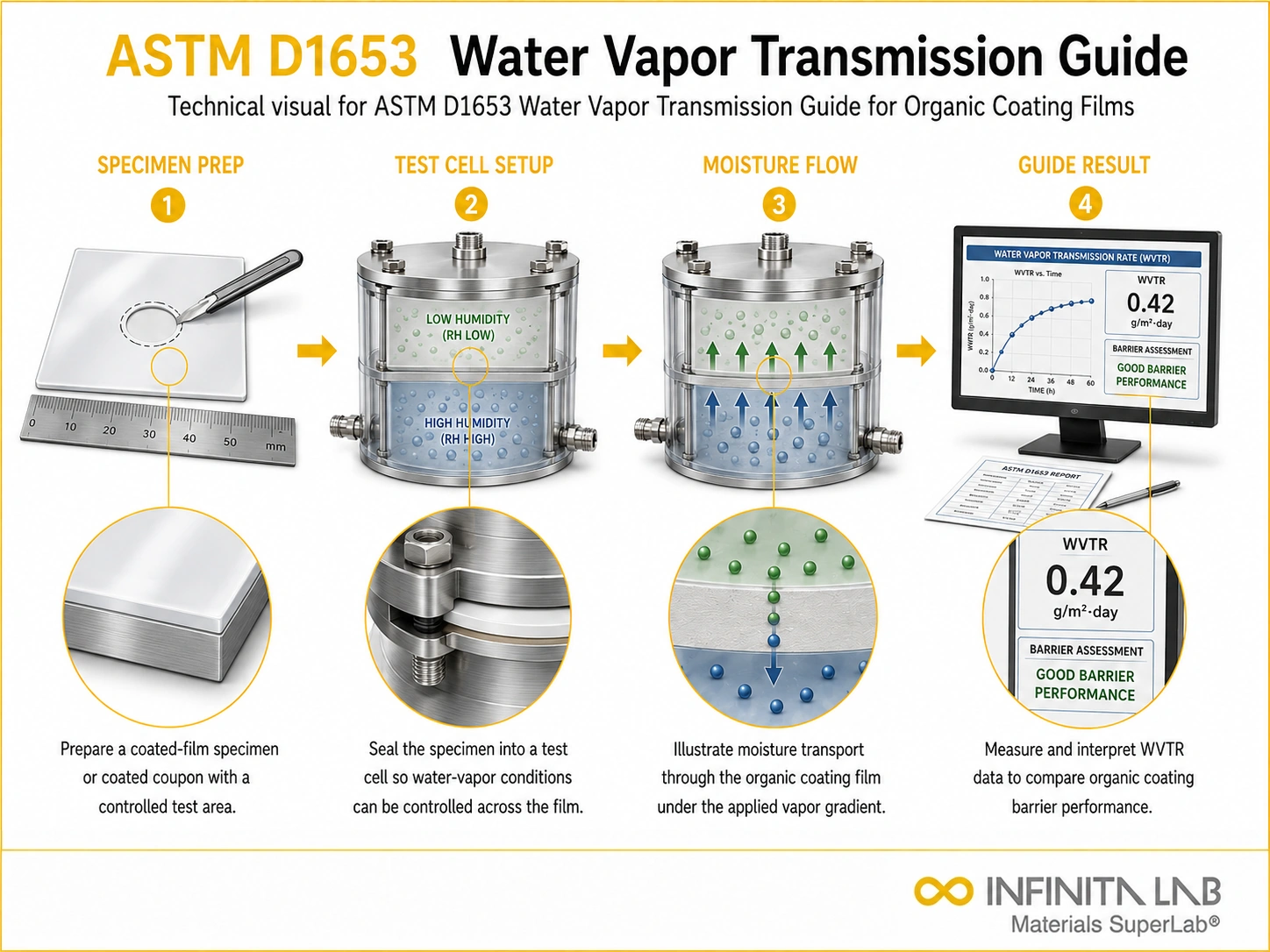
- ASTM D1653 – Water vapour transmission testing for organic coating films, measuring the effectiveness of paint films as moisture barriers by quantifying the water vapour transmission rate – essential for corrosion-protection coatings, exterior architectural paints, and moisture-sensitive substrate protection.
- ASTM D714 – Blistering evaluation for paint films on metal substrates, providing a standardised photographic rating scale for blister size (2-10) and density (from dense to few) – used to evaluate water resistance and the onset of osmotic blistering in corrosion-protection and architectural paint systems.
Corrosion Resistance & Weathering Testing
Long-term corrosion protection and weathering performance are the most critical requirements for industrial, architectural, and automotive paint systems. Infinita Lab evaluates paint performance under accelerated salt spray, UV weathering, and cathodic disbonding conditions.
Relevant ASTM Standards:
- ASTM B117 – Salt spray (fog) accelerated corrosion testing for painted and coated metal substrates, providing standardised exposure conditions to evaluate the corrosion protection performance of paint systems on steel, aluminium, and other metallic substrates.
- ASTM D1654 – Evaluation of painted or coated specimens subjected to corrosive environments, providing rating methods for blister formation, rust creep from a scribe, and overall coating degradation after salt spray or weathering exposure.
- ASTM D6676 – Cathodic disbonding testing for exterior pipeline coatings, measuring the resistance of paint and protective coatings to disbonding under cathodic protection conditions – essential for pipeline corrosion protection performance in infrastructure and energy applications.
Mold & Biological Resistance Testing
Paint systems used in humid environments – including bathrooms, kitchens, exterior surfaces, and marine applications – must resist mold and microbial growth to maintain appearance and substrate protection over time.
Relevant ASTM Standards:
- ASTM D3273 – Mold growth resistance testing for interior paints and coatings, evaluating the resistance of dry paint films to fungal growth under controlled high-humidity conditions – the standard for antimicrobial paint performance claims and specification compliance.
VOC & Volatile Content Testing
Volatile organic compound (VOC) content is a key regulatory and formulation parameter for all paint systems. Accurate measurement of volatile content supports VOC compliance reporting, regulatory submissions, and coating formulation development.
Relevant ASTM Standards:
- ASTM D2369 – Volatile content testing for paints and coatings by oven drying, measuring per cent volatile and non-volatile (solids) content by weight loss – the primary method for VOC calculation, formulation verification, and coating film build prediction.
- ASTM D1353 – Nonvolatile matter testing in volatile solvents, determining the total amount of non-volatile residue left after evaporation – important for quality control of paint solvents, varnishes, and clear coat vehicles.
- ASTM D6133 – Solvent content testing in paints and coatings, determining the total concentration of acetone, p-chlorobenzotrifluoride, methyl acetate, or t-butyl acetate in solvent-reducible and water-reducible paints by gas chromatography – supporting VOC exemption verification and regulatory compliance.
Solvent Resistance Testing
Solvent resistance is an important performance property for paint systems used in harsh chemical environments – including industrial facilities, automotive refinish applications, and chemical processing equipment.
Relevant ASTM Standards:
- ASTM D7835 – Solvent resistance testing for organic coatings using a mechanical rubbing machine, providing consistent stroke length, rate, pressure, and contact area to evaluate paint film resistance to solvent attack – the standard for chemical resistance qualification of industrial and automotive paint systems.
Speciality & Functional Paint Testing
Infinita Lab also provides testing of speciality functional paint properties, including rheology, stain resistance, enamel holdout, and pavement-marking retroreflectance, supporting the full breadth of architectural, industrial, and traffic-marking paint applications.
Relevant ASTM Standards:
- ASTM D7836 – Yield stress measurement for paints, inks, and related liquid materials using a viscometer or rheometer, providing data on flow resistance and sag tendency – used in diagnosing formulation root causes of orange peel, sagging, and flow defects.
- ASTM D6686 – Tannin stain resistance evaluation for paint coatings applied over wood substrates, including oak, cedar, and redwood, assessing the effectiveness of paints in preventing yellow/brown tannin discolouration from migrating through the coating film.
- ASTM D7786 – Enamel holdout testing for coating systems, evaluating the ability of a primer or intermediate coat to prevent excessive absorption of the topcoat – critical for achieving specified gloss levels in architectural and industrial multi-coat paint systems.
- ASTM E1710 – Retroreflectance testing for pavement marking paints, measuring the retroreflective performance of road marking paints under simulated nighttime driving conditions – ensuring roadway visibility and safety compliance for traffic paint applications.
Frequently Asked Questions
Infinita Lab excels in environmental exposure testing for paints by leveraging advanced methodologies and technologies. Our labs are equipped to simulate a wide range of environmental conditions, offering insights into how paints perform over time under various stressors. This capability is critical for industries where durability and longevity are paramount. Our streamlined process ensures fast turnaround times without compromising on precision, providing clients with reliable data to make informed decisions.
Infinita Lab recognizes the importance of regulatory compliance in the paint industry. Our testing services are designed to help clients navigate complex regulatory landscapes, ensuring their products meet all relevant standards and certifications. With a deep understanding of regulatory requirements across different jurisdictions, Infinita Lab provides comprehensive testing solutions that cover everything from VOC emissions to hazardous substance content. Our expertise in regulatory compliance makes us an invaluable partner for businesses aiming to market their paints globally.
For time-sensitive paint testing projects, Infinita Lab offers expedited services without sacrificing accuracy or detail. Our efficient project management and streamlined testing processes, combined with our extensive network of labs, enable us to deliver results faster than traditional single-site labs. This capability is particularly valuable for clients in fast-paced industries where speed to market is critical. With Infinita Lab, businesses do not have to choose between quality and speed; they get both.
Infinita Lab’s customer-centric approach ensures that clients seeking paint testing services receive unparalleled support throughout the testing process. From initial consultation to the delivery of results, our team is dedicated to providing personalized service, clear communication, and expert guidance. This approach fosters strong partnerships and trust, ensuring that our clients’ testing objectives are met with the utmost precision and care. Infinita Lab’s commitment to customer satisfaction is a cornerstone of our business, distinguishing us from competitors in the field.
Read Our Blogs and Research Papers
In-depth examination of genuine material testing solutionsASTM D1653: Water Vapor Transmission Organic Coating Testing Services

ASTM D1653: Water Vapor Transmission Organic Coating Testing Services
What is ASTM D1653 Testing? ASTM D1653 describes the standard test method for WVT through organic coating films. The test...
Read ArticleISO 5173: Welding Bend Testing Services
ISO 5173: Welding Bend Testing Services
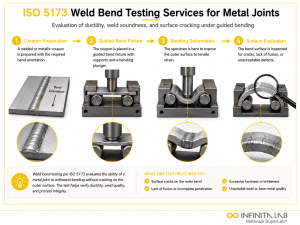
BS EN ISO 5173 The standard provides guidelines for determining the appropriate welding parameters for different thicknesses and types of...
Read ArticleCompression Testing & Its Importance
Compression Testing & Its Importance
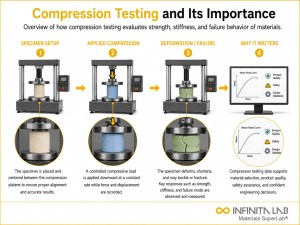
Introduction The standard test method ASTM D3164 assesses shear strength in adhesive bonds loaded in tension. The tensile load applied...
Read Article
Get your Ceramic Material testing done from the largest network of accredited labs in the USA
We are a material testing lab with a vast network of accredited labs across the country. Our state-of-the-art equipment and experienced team provide accurate and timely testing services to meet the unique needs of our clients. Partner with us for reliable material testing solutions.
 Quick Turnaround and Hasslefree process
- Confidentiality Guarantee
- Free, No-obligation Consultation
- 100% Customer Satisfaction


