


Coating Analysis & Testing Services
Coating analysis and testing services evaluate coating thickness, adhesion, hardness, composition, corrosion resistance, and surface quality. We test paints, metallic coatings, protective films, and specialised surface treatments using applicable ASTM and ISO methods. Results support quality control, failure investigation, product development, and coating performance verification.
TRUSTED BY


Precision-driven testing for dimensional accuracy and compliance
- Overview
- Scope, Applications, and Benefits
- Test Process
- Specifications
- Instrumentation
- Results and Deliverables
Coating Analysis and Testing Overview
Coating analysis and testing evaluates the properties, performance, and composition of coatings – paints, platings, thin films, conversion coatings, thermal spray, and functional surface treatments – to confirm they meet specifications and perform as intended. A coating that is too thin, poorly adhered, improperly composed, or that degrades under weathering or corrosion exposure can fail to protect the substrate and cause expensive field problems. Testing verifies that coatings are applied correctly, have the required properties, and will hold up in service.
The testing spans several distinct areas. Physical and mechanical testing addresses the properties most directly tied to in-service performance: coating thickness (by magnetic, eddy-current, or cross-section measurement), adhesion (pull-off or cross-cut), hardness, flexibility, and impact resistance. Chemical and compositional analysis characterizes what the coating is made of – by XRF for elemental composition and plating thickness, by FTIR and Raman for organic coating identification and formulation analysis, and by SEM-EDS for layer structure and interfacial analysis. Performance testing subjects the coating to the conditions that drive degradation in service: salt spray exposure (ASTM B117), accelerated weathering (ASTM D4459/G155), humidity, and corrosion testing to assess its durability and protective performance.
Together these capabilities cover the full range of coating types – organic paint and lacquer systems, metallic platings, conversion coatings, thin-film optical and electronic coatings, and thermal spray deposits – across the industries that depend on surface protection and functional coating performance.

Coating Analysis and Testing Scope, Applications, and Benefits
Scope
Coating analysis and testing covers the physical, mechanical, chemical, and performance characterization of coatings on substrates, using methods appropriate to the coating type and the testing objective.
Key test areas within the scope include:
- Coating thickness – magnetic induction (ASTM D1186) and eddy-current methods (ASTM D1400) for non-destructive thickness on metallic and non-metallic substrates; XRF for plating and thin-film thickness; cross-section metallography for definitive layer thickness
- Adhesion – pull-off adhesion (ASTM D4541) measures the force required to detach the coating; cross-cut adhesion (ASTM D3359) assesses coating adhesion by scribing a grid and applying tape
- Hardness – pencil hardness (ASTM D3363), Knoop/Vickers microhardness of hard coatings
- Flexibility and impact resistance – mandrel bend (ASTM D522) and impact tests (ASTM D2794) for paint and organic coating ductility
- Chemical/compositional analysis – XRF for elemental composition and metallic coating thickness; FTIR and Raman for polymer/resin identification; SEM-EDS for coating cross-section, layer identification, and interfacial analysis
- Corrosion resistance – salt spray / neutral salt fog per ASTM B117; copper-accelerated acetic acid salt spray (CASS) per ASTM B368
- Weathering and UV durability – accelerated weathering (xenon arc per ASTM D4459/G155; UV-condensation per ASTM D4587); evaluation of color change, gloss loss, and chalking
- Applicable standards – ASTM, ISO, and industry-specific coating standards depending on the coating type and application
Applications
- Paint and organic coating qualification – verifying the thickness, adhesion, hardness, and performance of paints, lacquers, primers, and topcoats before application or after application on a substrate
- Metallic plating verification – confirming the thickness, composition, and adhesion of electroplated, electroless, and hot-dip metallic coatings (zinc, chrome, nickel, gold, etc.)
- Corrosion protection evaluation – salt spray and humidity testing to assess how long a coating protects the substrate against corrosion under accelerated conditions
- Weathering and UV durability – evaluating the outdoor durability of coatings through accelerated weathering, including color retention, gloss retention, and chalking resistance
- Thin-film characterization – XRF and SEM-EDS analysis of optical, semiconductor, and electronic thin films for thickness and compositional uniformity
- Coating failure investigation – determining the cause of adhesion failure, delamination, corrosion, or early degradation through a combination of analytical techniques
- Incoming inspection and QC – verifying that coating thickness, composition, and adhesion meet specifications on incoming coated components
- Conversion coating and surface treatment – characterizing phosphate, chromate, and anodize conversion coatings for thickness, composition, and corrosion resistance
Benefits
- Covers the full coating characterization workflow – from thickness and adhesion through composition and performance testing, the full set of measurements needed to qualify and verify a coating are available in one service
- Identifies coating failures before field deployment – adhesion, corrosion, and weathering testing catches coatings that will fail prematurely before they leave the plant or reach service
- Compositional analysis identifies unknown or suspect coatings – XRF, FTIR, and SEM-EDS identify what a coating is, confirming it matches the specification or revealing what went wrong in a failure
- Accelerated testing predicts long-term durability – salt spray and weathering tests compress years of outdoor or corrosive service into manageable laboratory test durations
- Cross-section SEM reveals hidden layer problems – metallographic and SEM cross-section examination reveals layer thickness, interface quality, contamination, and adhesion issues that surface measurements cannot detect
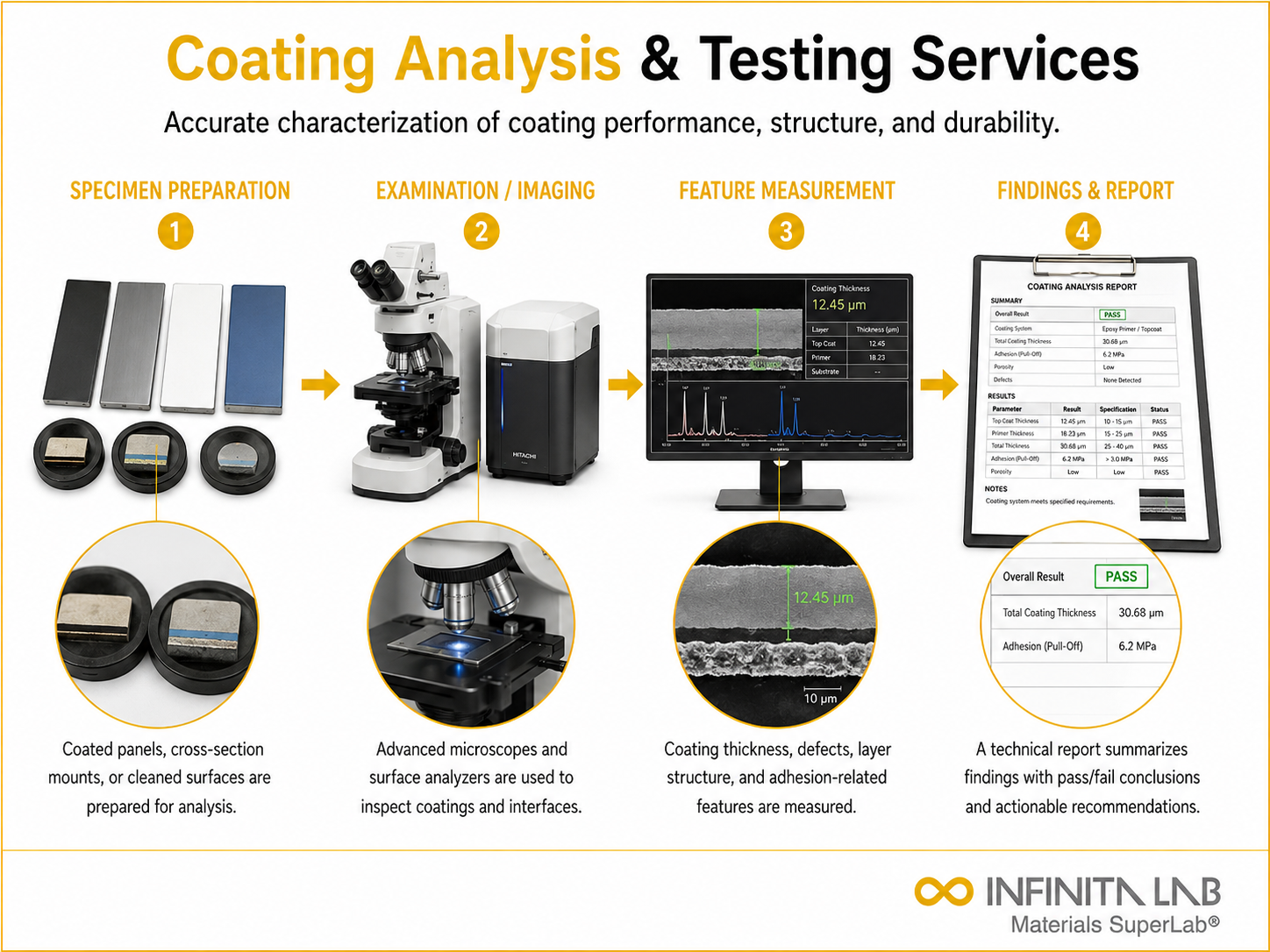
Coating Analysis and Testing Process
Select the Tests
Choose coating tests based on the coating type, substrate, and evaluation objective.
1Test Physical Properties
Measure thickness, adhesion, hardness, flexibility, and impact resistance as required.
2Analyse Composition
Use XRF, FTIR, Raman, or SEM-EDS to verify coating chemistry and layer structure.
3Evaluate and Report
Perform durability testing, compare results with specifications, and report the pass/fail outcome.
4Coating Analysis and Testing Technical Specifications
| Parameter | Details |
|---|---|
| Adhesion | Pull-off (ASTM D4541), cross-cut tape (ASTM D3359) |
| Hardness | Pencil hardness (ASTM D3363), microhardness (Knoop/Vickers) |
| Flexibility/Impact | Mandrel bend (ASTM D522), impact (ASTM D2794) |
| Composition | XRF (elemental), FTIR/Raman (organic/polymer), SEM-EDS (cross-section) |
| Corrosion Resistance | Salt spray ASTM B117, CASS ASTM B368 |
| Weathering/UV | Xenon arc (ASTM D4459/G155), UV-condensation (ASTM D4587) |
| Coating Types | Organic paints/lacquers, metallic platings, conversion coatings, thin films |


- Magnetic induction and eddy-current coating thickness gauges
- XRF spectrometer (elemental analysis and plating thickness)
- Pull-off adhesion tester (ASTM D4541)
- Cross-cut adhesion kit (ASTM D3359)
- Pencil hardness tester; Knoop/Vickers hardness tester
- Mandrel bend and impact test equipment
- Salt spray chamber (ASTM B117)
- Xenon-arc weathering chamber (ASTM D4459/G155)
- SEM with EDS for cross-section characterization
- FTIR spectrometer for organic coating identification
- Metallographic preparation equipment for cross-sections
Instrumentation Used for Coating Analysis and Testing
Coating Analysis and Testing Results and Deliverables
- Coating analysis report – the tests performed, measured values, and pass/fail determination against the applicable specification
- Thickness results – coating thickness at specified locations with the measurement method
- Adhesion results – pull-off strength and/or cross-cut rating with failure mode classification
- Compositional findings – elemental composition (XRF), chemical identification (FTIR/Raman), and cross-section layer analysis (SEM-EDS) where performed
- Performance test results – salt spray, weathering, or humidity test outcomes with condition assessments at specified intervals
- Failure analysis findings (where applicable) – root cause of adhesion failure, delamination, or corrosion identified through the analytical evidence
- Sample records – coating type, substrate, application method (where known), and specimen identification
Frequently Asked Question
Testing can be performed on paints, powder coatings, metallic coatings, polymer films, ceramic coatings and conversion layers. Both coated test panels and finished components may be evaluated.
Thickness may be measured using magnetic induction, eddy-current, ultrasonic or microscopic cross-section methods. The correct technique depends on the coating and substrate materials.
Adhesion testing measures how strongly a coating remains attached to its substrate. Common methods include cross-cut, pull-off, peel and scrape adhesion tests.
Coated specimens may be exposed to salt spray, humidity, cyclic corrosion or immersion conditions. The coating is then examined for rust, blistering, delamination and underfilm corrosion.
Surface preparation, coating thickness, curing conditions, application method and environmental exposure can influence performance. Contamination and poor substrate compatibility may also cause failure.
Why Choose Infinita Lab for Advanced Materials Testing and Characterization?
At the core of this breadth is our network of 2,000+ accredited laboratories across the USA, offering access to over 10,000 testing methods and analytical services. From advanced materials characterization (SEM, TEM, RBS, XPS) to mechanical, chemical, environmental, biological, and standardized ASTM/ISO-compliant testing, we deliver unmatched flexibility, specialization, and scale. You are never limited by geography, facility, or methodology — Infinita Lab connects you to the right expertise and testing solution, every time.

Looking for a Trusted Partner for Accurate and Reliable Testing Services?
Send query us at hello@infinitalab.com or call us at (888) 878-3090 to learn more about our services and how we can support you.



Request a Quote
Submit your material details and receive testing procedures, pricing, and turnaround time within 24 hours.
 Quick Turnaround and Hasslefree process
 Confidentiality Guarantee
 Free, No-obligation Consultation
 100% Customer Satisfaction
