


ASTM D7867: Rotational Viscosity Liquid Testing Services
ASTM D7867 uses rotational viscometers to find out the temperature dependence of apparent viscosity of paints, inks, and similar liquid materials. The final values are expressed in SI units.
TRUSTED BY


Get ASTM D7867 compliant results — request your rotational viscosity liquid testing quote
- Overview
- Scope, Applications, and Benefits
- Test Process
- Specifications
- Instrumentation
- Results and Deliverables
What Is ASTM D7867 Rotational Viscosity Liquid?
ASTM D7867 provides a standard test method for measuring the rotational viscosity of liquid materials, including paints, inks, adhesives, and related products, using a rotational viscometer. Viscosity is a fundamental rheological property governing flow behavior during application, pumping, and storage, and is one of the most commonly measured quality control parameters in the coatings and inks industry.
Rotational viscosity measurement with standardized spindles and speeds enables rapid, comparable characterization of medium- to high-viscosity liquids, supporting formulation development, quality control, and specification compliance.

Applications and Benefits of ASTM D7867 Rotational Viscosity Liquid Testing
Scope
ASTM D7867 evaluates:
- Apparent viscosity of Newtonian and non-Newtonian liquids
- Viscosity at defined spindle geometries and rotation speeds
- Viscosity-shear rate relationships (for structured fluids)
- Temperature dependence of viscosity
Applications
- Architectural and industrial paint QC
- Printing ink viscosity grading
- Adhesive and sealant processing viscosity
- Cosmetics and personal care product formulation
- Food product viscosity characterization
Benefits
- Rapid, simple viscosity measurement for QC workflows
- Wide viscosity range coverage with interchangeable spindles
- Enables standardized comparison across batches and suppliers
- Applicable to both Newtonian and non-Newtonian materials
- Supports specification writing and compliance verification
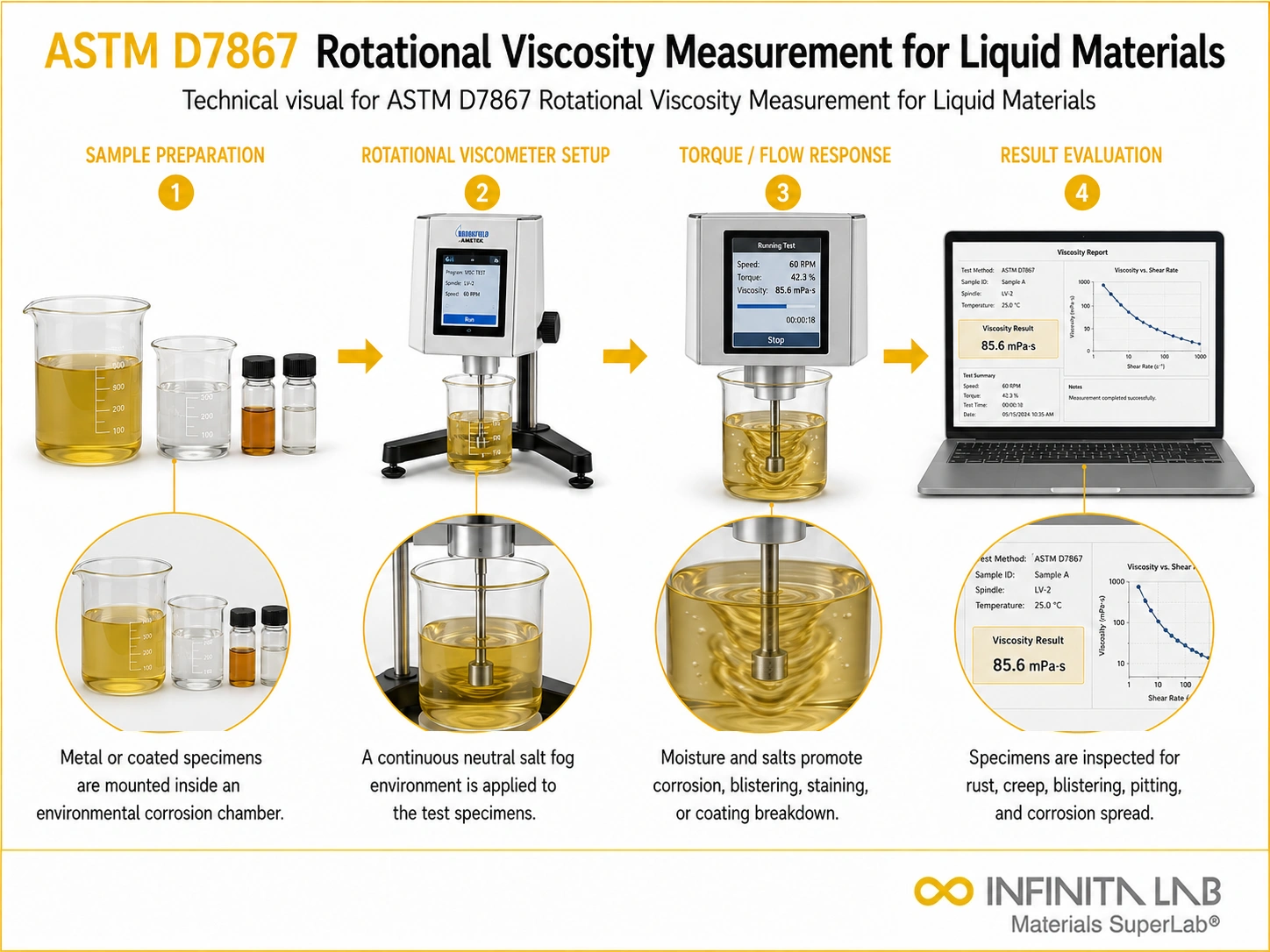
Our ASTM D7867 Testing Procedure
Sample Preparation
The sample is brought to the specified test temperature (typically 25 °C) and loaded into the measurement container without introducing air bubbles.
1Spindle Selection & Setup
The appropriate spindle (LV, RV, HA, or HB series) and rotation speed are selected based on the expected viscosity range to achieve mid-scale readings.
2Measurement
The spindle is immersed to the required depth and rotation is initiated at the specified RPM; the viscometer reading is taken after the display stabilizes (typically 60 seconds).
3Calculation & Reporting
Viscosity (mPa·s or cP) is calculated by multiplying the percent torque reading by the spindle/speed factor; results are reported with spindle type, speed, and temperature.
4ASTM D7867 Test Parameters and Requirements
| Parameter | Details |
|---|---|
| Instrument | Brookfield-type rotational viscometer |
| Viscosity Range | 1 mPa·s to 8,000,000 mPa·s (spindle dependent) |
| Rotation Speeds | 0.3–200 RPM (model dependent) |
| Temperature | Ambient or controlled (±0.1 °C with thermostat) |
| Spindle Types | LV, RV, HA, HB (Brookfield compatible) |


- Digital rotational viscometer (Brookfield DV-II, DV-III, or equivalent)
- Calibrated spindle set
- Temperature-controlled bath or Peltier system
- Calibration oil standards (NIST-traceable)
- Sample containers of appropriate diameter
Equipment and Instrumentation Used for ASTM D7867 Testing
What You Receive: Test Report, Data, and Certification
- Viscosity value (mPa·s or cP) at specified conditions
- Spindle type, rotation speed, and temperature documentation
- Viscosity-speed profile (if multi-point measurement)
- Calibration verification data
- Full viscosity test report per ASTM D7867
ASTM D7867 Rotational Viscosity Liquid FAQs
Absolute viscosity (dynamic viscosity) is a true material property of Newtonian fluids. Apparent viscosity is the measured viscosity of a non-Newtonian fluid at a specific shear rate — it changes with rotation speed and is instrument and condition-dependent, which is why full reporting of spindle type and speed is mandatory.
Start with a mid-range spindle (RV series) at a moderate speed and note the percent torque reading. Adjust spindle and/or speed to achieve a torque reading between 20% and 80% of full scale for optimal accuracy. Readings below 10% or above 90% are unreliable.
Rotational viscometers measure apparent viscosity at a defined shear rate. For non-Newtonian (shear-thinning) materials, the viscosity value is only meaningful when reported with the exact spindle and speed used. For full flow curve characterization, a controlled-stress rheometer per ASTM D7836 or D4287 is preferred.
Critical. Most paints and inks show viscosity changes of 5–10% per °C. Without temperature control, viscosity values are not reproducible or comparable. All ASTM D7867 measurements should be made at ±0.5 °C of the specified temperature.
The viscometer should be verified against NIST-traceable viscosity reference oils (typically S200 or S600 oils) before use. The measured viscosity must be within ±2% of the reference oil certified value for the instrument to be considered calibrated.
Why Choose Infinita Lab for Rotational Viscosity Liquid Testing
At the core of this breadth is our network of 2,000+ accredited laboratories across the USA, offering access to over 10,000 testing methods and analytical services. From advanced materials characterization (SEM, TEM, RBS, XPS) to mechanical, chemical, environmental, biological, and standardized ASTM/ISO-compliant testing, we deliver unmatched flexibility, specialization, and scale. You are never limited by geography, facility, or methodology — Infinita Lab connects you to the right expertise and testing solution, every time.

Looking for an Accredited Partner for ASTM D7867 Rotational Viscosity Liquid Testing?
Send query us at hello@infinitalab.com or call us at (888) 878-3090 to learn more about our services and how we can support you.



Request a Quote
Submit your material details and receive testing procedures, pricing, and turnaround time within 24 hours.
 Quick Turnaround and Hasslefree process
 Confidentiality Guarantee
 Free, No-obligation Consultation
 100% Customer Satisfaction
