About Industries Testing
Infinita Lab provides specialized testing services tailored to the specific operational requirements of engineers and manufacturers across all primary industrial sectors. Recognizing that industries such as aerospace and consumer goods possess distinct priorities, and that medical devices operate under different regulatory frameworks than packaging, our organization has established an extensive network of accredited laboratories throughout the United States. This infrastructure ensures the delivery of accurate and traceable results, eliminating the need for clients to coordinate with multiple laboratories.
Our expertise encompasses regulatory compliance, quality assurance, failure investigation, and research and development support. We maintain a profound understanding of the specialized standards, material properties, and technical challenges inherent to each industry, providing the necessary capabilities to address these requirements effectively.
Aerospace
Aerospace doesn’t tolerate material failure. Parts going into aircraft, spacecraft, and defense systems face extreme temperatures, sustained vibration, high-cycle fatigue, and pressure conditions that would destroy lesser materials – and every single one of those parts needs to be verified before it flies.
We support aerospace engineers and manufacturers with testing across structural metals, composites, polymers, and interior materials – helping teams meet traceability and compliance requirements without the usual coordination headaches.
Relevant ASTM Standards:
- ASTM E21 – Elevated temperature tensile testing for metallic materials used in aerospace structural components
- ASTM A418 – Ultrasonic examination of turbine and generator steel rotor forgings and structural aerospace components
- ASTM E8/E8M – Tension testing of metallic materials, including bars, tubes, sheets, and castings used across aerospace structures
- ASTM E1086 – Spark atomic emission spectrometry for chemical composition analysis of aerospace-grade steels and alloys
- ASTM D7791 – Fatigue testing under cyclic loading for aerospace-grade polymer and composite components
- ASTM D3039 – Tensile testing for polymer matrix composites reinforced with continuous fibers such as carbon, glass, aramid, or basalt
- ASTM E1354 – Cone calorimeter testing for heat release and flammability evaluation of aircraft interior materials
Automotive
Between tightening safety regulations, OEM spec requirements, lightweighting pushes, and the shift toward EVs, automotive suppliers and manufacturers have a lot riding on material and component testing. We work across the full range – structural plastics, coatings, elastomers, and electrical insulation – so you can move from development to production with confidence.
Relevant ASTM Standards:
- ASTM D638 – Tensile testing for structural plastics, measuring yield strength, tensile strength, and elongation at break
- ASTM D790 – Flexural properties testing for plastics and composites under bending loads
- ASTM D256 – Izod impact resistance testing for notched plastic specimens – important for interior and exterior components
- ASTM D648 – Heat deflection temperature (HDT) testing to define the service temperature limit for plastic parts
- SAE J2527 – Durability testing simulating conditions encountered during a part’s service lifetime
- ASTM G155 – Xenon arc UV weathering testing for exterior coatings and polymers
- ASTM A262 / ASTM G28 / ASTM G48 – Corrosion testing evaluating resistance to salt spray, humidity, and chemical exposure for metallic components
- ASTM E1640 – Dynamic Mechanical Analysis (DMA) for rubber, foam, and elastomeric components, measuring storage/loss modulus and glass transition temperature
- ASTM D149 – Dielectric strength testing for EV components and wiring insulation
- ASTM D257 – Volume and surface resistivity testing for electrical insulation in EV battery systems
Batteries
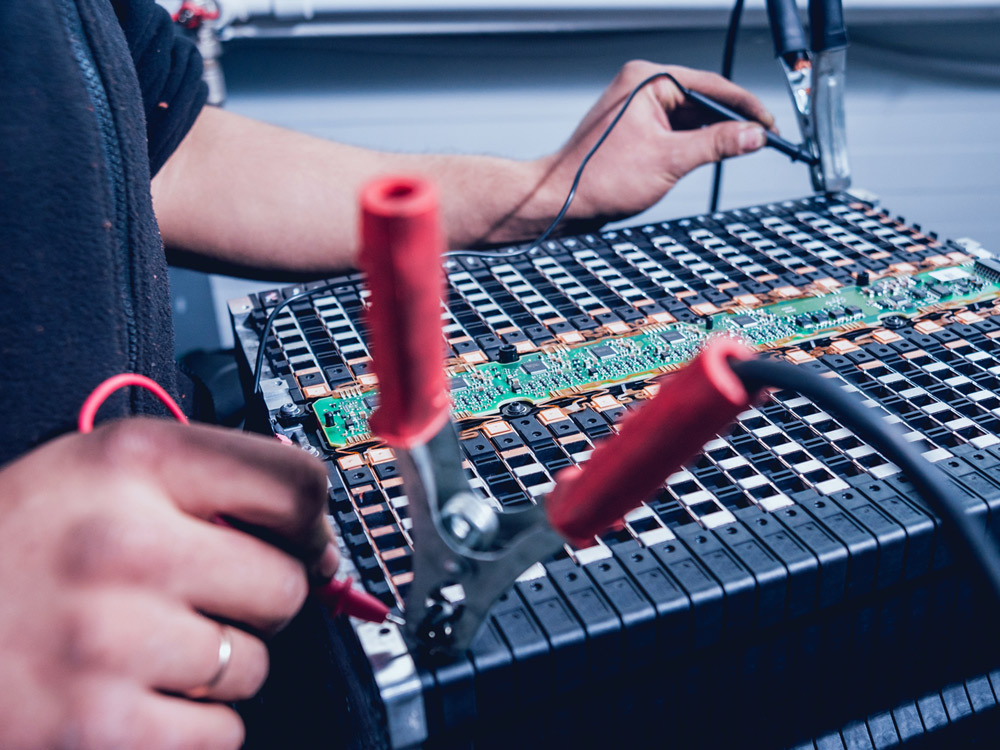
Battery testing covers a lot of ground – thermal stability, electrochemical performance, safety under abuse conditions, and long-term durability. Whether you’re developing lithium-ion cells, solid-state chemistries, or energy storage systems for grid applications, getting the material characterization right early saves a lot of trouble downstream.
Relevant ASTM Standards:
- ASTM D3418 – DSC thermal analysis for battery materials and electrolytes, measuring melting, crystallization, Tg, and oxidative induction time
- ASTM E1131 – TGA for thermal stability and decomposition profiling of battery materials
- ASTM D149 – Dielectric strength testing for battery separator and insulation materials
- ASTM D257 – Surface and volume resistivity testing for battery insulating and enclosure materials
- ASTM E1269 – Specific heat capacity testing by DSC for battery cell and electrolyte thermal characterization
Energy
Oil and gas, power generation, renewables, and nuclear materials used in energy applications are subject to heat, pressure, chemical exposure, and mechanical stress. Testing is how you know they’ll hold up and catch problems before they become failures in the field.
Relevant ASTM Standards:
- ASTM D3172 – Proximate analysis of coal and coke, covering moisture, volatile matter, ash, and fixed carbon for assessing combustion behavior and potential emissions
- ASTM D543 – Chemical resistance testing for energy sector materials exposed to reactive fluids, acids, and solvents
- ASTM E1131 – TGA for thermal stability and decomposition analysis of energy materials, including molten salts and insulation compounds
- ASTM E1269 – Specific heat capacity testing by DSC for energy storage and thermal management materials
- ASTM D149 – Dielectric strength testing for transformer oil and high-voltage electrical insulation
Medical Devices
Medical device testing sits at the intersection of regulatory compliance, patient safety, and material science. FDA requirements, ISO 13485, and biocompatibility standards all demand thorough characterization of any material that might contact a patient or operate in a clinical environment. There’s no grey area here – the testing either supports the submission or it doesn’t.
Relevant ASTM Standards:
- ASTM F2101 – Bacterial filtration efficiency (BFE) testing for medical device materials and surgical masks
- ASTM F2100 – Performance specification testing for materials used in medical face masks
- ASTM F2413 – Performance requirements for protective footwear, including puncture resistance and impact testing
- ASTM D7907 – Bactericidal efficacy testing on medical gloves
- ASTM D6319 – Nitrile examination gloves specification and testing for medical use
- ASTM D7791 – Fatigue testing for structural implant materials and surgical instruments under cyclic loading
- ASTM F732 – Wear resistance testing of polymeric materials used in total joint prostheses under lubricated physiological conditions
- ASTM F1608 – Microbial barrier performance testing for sterile medical packaging
Semiconductors
At the feature sizes semiconductor manufacturing works with today, standard lab techniques aren’t enough. Surface chemistry, thin-film composition, carrier concentration, and nanoscale structural integrity all require specialized instrumentation and the expertise to interpret what it shows you. Our network gives semiconductor engineers and fabs access to that level of analysis without having to source it themselves.
Relevant ASTM Standards:
- ASTM E1004 – Determining electrical conductivity by eddy current testing for semiconductor substrates and conductive materials
- ASTM D6097 – Relative resistance to vented water-tree growth in solid dielectric materials used in semiconductor packaging
- ASTM D149 – Dielectric strength testing for semiconductor insulation and packaging materials
- ASTM D257 – Surface and volume resistivity testing for semiconductor encapsulants and insulating layers
Packaging
Packaging failure means product failure – whether that’s a pharmaceutical losing sterility, a food product spoiling early, or a fragile component arriving damaged. Barrier performance, mechanical integrity, and microbial protection must all be tested under the actual conditions the package will face during distribution and storage.
Relevant ASTM Standards:
- ASTM F1249 – Water Vapor Transmission Rate (WVTR) testing for flexible barrier materials such as plastic films, laminates, and packaging structures
- ASTM D3985 – Oxygen Transmission Rate (OTR) testing for packaging barrier materials
- ASTM F1608 – Microbial barrier performance testing for porous medical and food packaging
- ASTM D6653 – High-altitude testing for packaging systems under reduced atmospheric pressure
- ASTM D1653 – Water vapor transmission testing through coating films and barrier laminates
- ASTM D6344 – Concentrated impact testing for transport packaging
Environmental and Geotechnical
Site investigation, remediation, and infrastructure design all depend on knowing how soils, construction materials, and geosynthetics actually behave – under load, in contact with groundwater, and in chemically aggressive environments. Solid testing data is what turns site characterization into engineering decisions you can stand behind.
Relevant ASTM Standards:
- ASTM D543 – Chemical resistance testing for geosynthetics and construction materials in aggressive environments
- ASTM D570 – Water absorption testing for geotechnical and construction materials
- ASTM C272 – Water absorption testing for core and sandwich construction materials in civil and geotechnical applications
Nanotechnology
Working at the nanoscale means properties can shift dramatically with small changes in composition, structure, or surface chemistry – and conventional testing won’t catch those shifts. Properly characterizing nanoparticles, thin films, and nanocomposites requires both the right instruments and people who know how to use them. That’s what our lab network brings to the table.
Relevant ASTM Standards:
- ASTM E1131 – TGA for thermal stability and compositional analysis of nanomaterials, nanocomposites, and thin film coatings
- ASTM D3418 – DSC for thermal characterization of nanostructured polymers and nanocomposite materials
- ASTM D149 – Dielectric strength testing for nanoscale insulating and barrier coatings
- ASTM E1004 – Electrical conductivity testing by eddy current for nanoscale conductive layers and thin films
Consumer Goods
Safety standards, durability expectations, and sustainability requirements keep evolving, and consumer goods manufacturers have to keep up with them all. Whether it’s a toy, an appliance, a piece of outdoor furniture, or sporting equipment, the product has to be validated before it reaches a customer – and the testing has to hold up under scrutiny.
Relevant ASTM Standards:
- ASTM D638 – Tensile testing for plastic and composite consumer product components
- ASTM D2240 – Shore hardness testing for rubber and soft polymer components
- ASTM G155 – Weathering and UV resistance testing for outdoor consumer products
- ASTM D635 – Horizontal burning flammability testing for plastics
- ASTM D3418 – DSC for material identification and quality control of consumer polymers
- ASTM D1505 – Density testing for plastics and polymer-based products to verify material quality and uniformity
Chemicals
Raw materials, intermediates, formulations, finished products – every stage of the chemical production process has quality and safety questions that testing needs to answer. Whether it’s a regulatory submission, a supplier qualification, or a process troubleshooting exercise, we provide the analytical testing to support it.
Relevant ASTM Standards:
- ASTM D4274 – Hydroxyl number testing for polyols in polyurethane raw materials, ensuring accurate formulation and quality control
- ASTM E203 – Volumetric Karl Fischer Titration for moisture content determination in hygroscopic chemical materials
- ASTM D543 – Chemical resistance testing for materials exposed to reactive chemical reagents
- ASTM D3418 – DSC for thermal characterization and purity analysis of chemical compounds and formulations
- ASTM E1131 – TGA for compositional analysis and thermal decomposition profiling of chemical materials
Electronics
Electronics manufacturers can’t afford to ship unreliable products. From PCBs and connectors to ICs and power supplies, material performance has a direct line to product reliability – and when something fails in the field, the cost goes well beyond the part. We provide the materials characterization, electrical testing, and reliability testing that electronics engineers actually need to catch problems before they ship.
Relevant ASTM Standards:
- ASTM D149 – Dielectric strength testing, measuring the maximum voltage before insulation breakdown in components and assemblies
- ASTM D150 – Dielectric constant and dissipation factor testing for AC loss characteristics and permittivity of solid insulation materials
- ASTM D257 – Surface and volume resistivity testing for insulating materials
- ASTM E1004 – Electrical conductivity testing by eddy current for conductive electronic materials
- ASTM D6097 – Relative resistance to water-tree growth in solid dielectric cable insulation
- ASTM D6053 – Volatile Organic Compound (VOC) content testing of electrical insulating varnishes
- ASTM D785 – Rockwell hardness testing of plastics and electrical insulating materials
Textile
Strength, durability, flammability, and chemical safety – the performance requirements for textiles vary a lot depending on whether the end use is apparel, military, industrial, or protective. We test across all of those markets, giving manufacturers the data they need to meet the right standards for the right application.
Relevant ASTM Standards:
- ASTM D629 – Quantitative fiber analysis and composition testing to determine the fiber blend and estimate moisture and non-fibrous material content
- ASTM G155 – Xenon arc accelerated weathering for outdoor technical and performance textiles
- ASTM D543 – Chemical resistance testing for textile materials exposed to reactive substances
Electrical
Wire and cable insulation, switchgear components, motor windings – electrical materials operate in environments where a performance gap can mean a safety failure. Service life depends on getting the material selection right and verifying it holds up under real operating conditions, not just ambient lab conditions.
Relevant ASTM Standards:
- ASTM D149 – Dielectric strength and dielectric breakdown testing for electrical insulating materials and components
- ASTM D150 – Dielectric constant and dissipation factor testing for insulating materials used in power and electrical systems
- ASTM D257 – Volume and surface resistivity testing for wire, cable, and component insulation
- ASTM E1004 – Electrical conductivity testing by eddy current for electrical conductors and components
- ASTM D6097 – Water tree growth resistance testing in solid dielectric cable insulation
- ASTM C657 – DC volume resistivity testing for glass and ceramic electrical insulating materials
Plastics & Polymers
Plastics and polymers are everywhere – in structural parts, housings, films, fibers, foams, and coatings across virtually every product category. That breadth means testing requirements vary enormously, and a lab setup that works for rigid engineering thermoplastics won’t necessarily cover elastomers or thin films. Infinita Lab’s testing suite covers it all.
Relevant ASTM Standards:
- ASTM D638 – Tensile strength, elongation, and modulus testing for all major plastic and polymer families
- ASTM D790 – Flexural modulus and flexural strength testing for polymer beams and structural plastic parts
- ASTM D256 – Izod impact resistance testing for notched polymer specimens
- ASTM D648 – Heat deflection temperature (HDT) testing for thermal service limits of plastics
- ASTM D1525 – Vicat softening temperature testing for upper use temperature under indentation load
- ASTM D3418 – DSC for melting, crystallization, Tg, and oxidative induction time of polymers
- ASTM E1131 – TGA for decomposition onset, thermal stability, and filler content of plastics
- ASTM D543 – Chemical resistance and fluid immersion testing for plastics
- ASTM D570 – Water absorption testing for polymeric materials
- ASTM D1505 – Density testing of plastics using the density gradient technique
- ASTM D1238 – Melt flow rate testing for the flowability of thermoplastic materials
- ASTM D7791 – Uniaxial fatigue testing for plastics under cyclic loading conditions
- ASTM G155 – UV weathering and aging testing for outdoor and exposed polymer applications
- ASTM E1640 – Dynamic Mechanical Analysis (DMA) for storage/loss modulus and Tg determination