


ASTM D897: Adhesive Bond Tensile Properties Testing Services
ASTM D897 test method determines the response of metals to specific conditions of temperature, pretreatment, and testing machine speed. The tensile properties of the adhesive bonds of metals are covered in this method. The final results of this method are displayed as per international standards.
TRUSTED BY


Get ASTM D897 compliant results — request your adhesive bond tensile properties testing quote
- Overview
- Scope, Applications, and Benefits
- Test Process
- Specifications
- Instrumentation
- Results and Deliverables
What Is ASTM D897 Adhesive Bond Tensile Properties?
ASTM D897 is a test method that is used to determine the tensile properties of adhesively bonded metal joints. The test method is basically a comparative procedure for testing adhesive bond performance.
It is commonly used to determine the impact of various surface preparation techniques, primers, and adhesive systems on bond strength. The ASTM D897 test standard is also used to assess the durability of adhesives under environmental and service conditions.

Applications and Benefits of ASTM D897 Adhesive Bond Tensile Properties Testing
Scope
ASTM D897 evaluates:
- Tensile strength of bonded metal joints
- Effect of surface preparation on bond performance
- Influence of primers and adhesive systems
- Adhesive environmental endurance
- Comparative performance of bonding systems
- Failure modes (cohesive, adhesive, contact failure)
The method applies to adhesively bonded metallic adherends.
Applications
- Automotive metal bonding
- Aerospace structural joints
- Industrial equipment assembly
- Metal fabrication industries
- Adhesive product qualification
- Surface treatment evaluation
- Quality control testing
- Research and development
Benefits
- Provides standardized tensile strength data
- Assists in adhesive system selection
- Evaluates surface preparation effectiveness
- Supports product development
- Enables comparison of bonding methods
- Improves joint reliability
- Enhances quality assurance processes
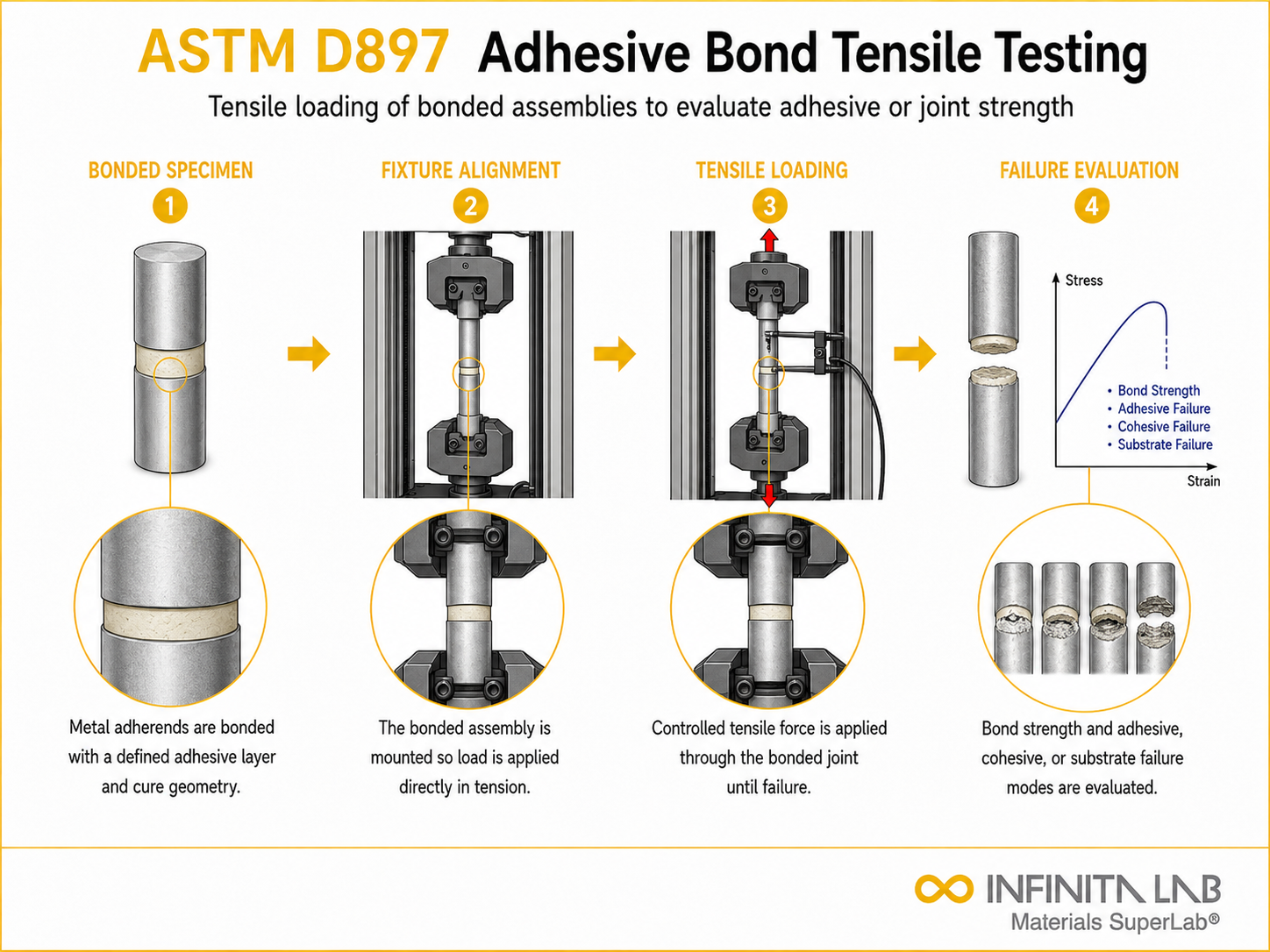
Our ASTM D897 Testing Procedure
Specimen Preparation & Surface Treatment
Metal adherends are prepared, surface-treated, and bonded using selected adhesives.
1Adhesive Application & Curing
Adhesive is applied and cured as per the manufacturer's recommendations.
2Specimen Mounting & Tensile Loading
Bonded specimens are mounted, and a controlled tensile load is applied.
3Measurement, Analysis & Reporting
Maximum load is recorded, the failure mode is identified, and the results are reported.
4ASTM D897 Test Parameters and Requirements
| Parameter | Details |
|---|---|
| Applicable Materials | Adhesively bonded metals |
| Number of Specimens | 10 specimens |
| Adhesive Layer Thickness | 0.025 mm (0.001 in.) |
| Loading Control | Adjustable test speed |
| Output Units | g/mm², psi |


- Universal tensile testing machine
- Precision alignment grips
- Load cell
- Displacement sensors
- Data acquisition system
Equipment and Instrumentation Used for ASTM D897 Testing
What You Receive: Test Report, Data, and Certification
- Tensile strength values
- Maximum breaking load data
- Failure mode classification
- Comparative performance analysis
- Quality assurance reports
ASTM D897 Adhesive Bond Tensile Properties FAQs
ASTM D897 determines the comparative tensile properties of adhesive bonds, measuring the force required to separate bonded metal adherends under controlled test conditions.
ASTM D897 is specifically intended for metal-to-metal adhesive bonds prepared as standard-shaped specimens. It is useful for evaluating different adhesive systems, surface treatments, primers, and bonding conditions.
Testing is performed under defined conditions of adherend surface pretreatment, specimen preparation, temperature, conditioning, and testing-machine speed. Maintaining consistent conditions is important because the results are primarily comparative.
The test provides data on the tensile strength of the adhesive bond, allowing comparison of bond performance among different adhesives, surface-preparation methods, primers, or processing conditions. Failure characteristics may also provide useful information about bond performance.
ASTM D897 testing can support adhesive development, quality control, surface-treatment optimization, environmental durability evaluation, and specification acceptance. It is particularly useful for identifying variations in surface preparation and adhesive systems and comparing their resulting bond strength.
Why Choose Infinita Lab for Adhesive Bond Tensile Properties Testing
At the core of this breadth is our network of 2,000+ accredited laboratories across the USA, offering access to over 10,000 testing methods and analytical services. From advanced materials characterization (SEM, TEM, RBS, XPS) to mechanical, chemical, environmental, biological, and standardized ASTM/ISO-compliant testing, we deliver unmatched flexibility, specialization, and scale. You are never limited by geography, facility, or methodology — Infinita Lab connects you to the right expertise and testing solution, every time.

Need ASTM D897 Adhesive Bond Tensile Properties Testing You Can Rely On?
Send query us at hello@infinitalab.com or call us at (888) 878-3090 to learn more about our services and how we can support you.



Request a Quote
Submit your material details and receive testing procedures, pricing, and turnaround time within 24 hours.
 Quick Turnaround and Hasslefree process
 Confidentiality Guarantee
 Free, No-obligation Consultation
 100% Customer Satisfaction
