

What Is ASTM D2290 Plastic Pipe Hoop Tensile Strength?
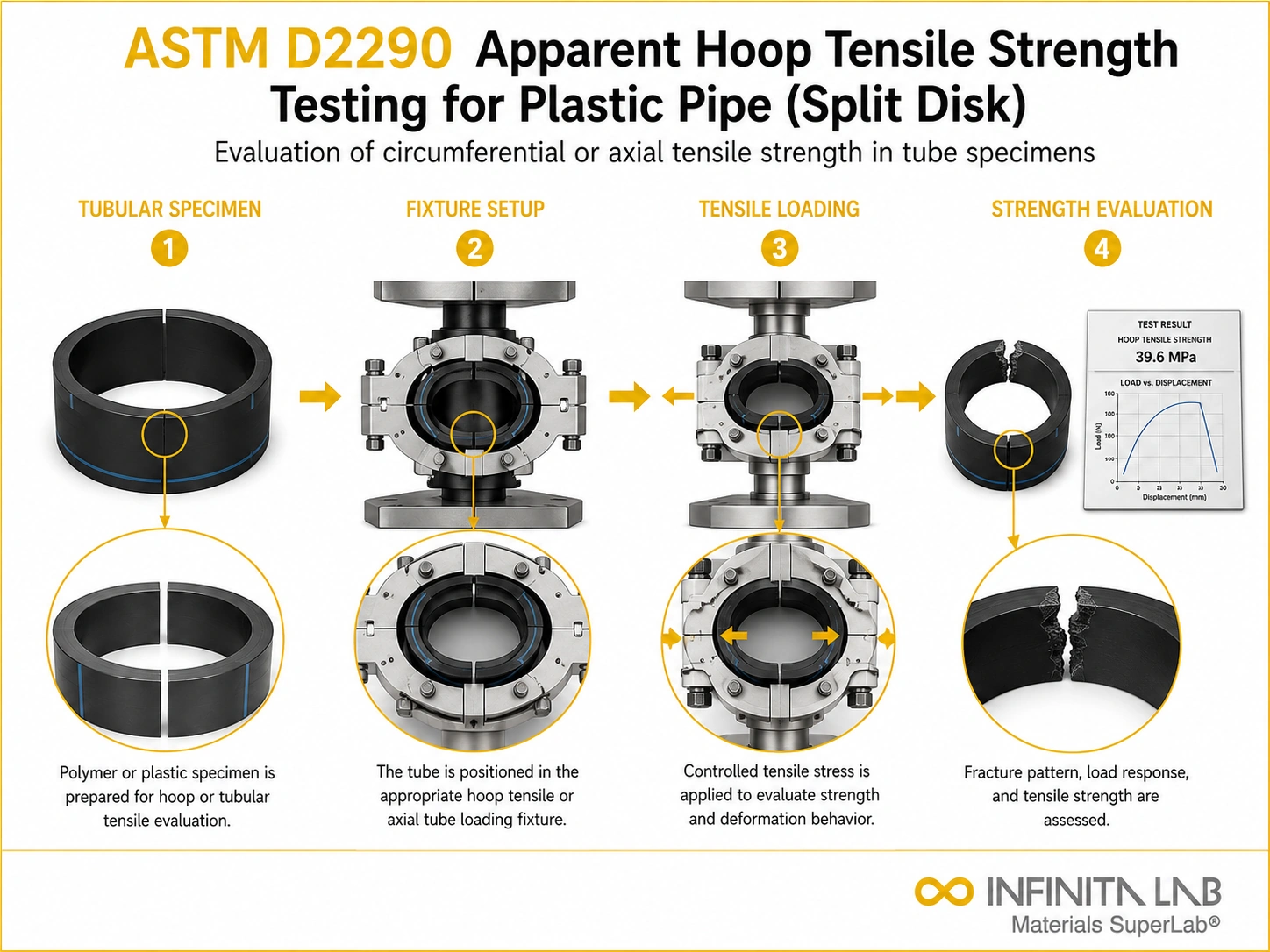
ASTM D2290 is a test method for determining the apparent hoop tensile strength of plastic and reinforced plastic pipe products. The test method assesses the resistance of pipe materials to circumferential tensile stress through a ring specimen prepared from the pipe.
The test involves separating a pipe ring specimen using a split-disk or ring segment fixture. The test load generates tensile stress in the hoop direction, enabling assessment of the apparent composite tensile strength of the pipe material.

Applications and Benefits of ASTM D2290 Plastic Pipe Hoop Tensile Strength Testing
Scope
ASTM D2290 is employed for the determination of the comparative apparent tensile strength of plastic and reinforced plastic pipe products. This test procedure applies to pipes subjected to specified pretreatment, environmental conditions, and loading rates.
ASTM D2290 evaluates:
- Apparent hoop tensile strength of plastic pipes
- Comparative tensile performance of pipe materials
- Behaviour of reinforced thermosetting resin pipes
- Performance of extruded and molded thermoplastic pipes
- Composite tensile strength characteristics
Applications
- Plastic piping systems
- Reinforced plastic pipes
- Thermosetting resin pipe products
- Thermoplastic pipes for fluid transport
- Construction and infrastructure piping
- Product qualification and comparison
Benefits
- Provides standardized hoop tensile strength values
- Enables comparison between pipe materials and designs
- Supports product qualification and validation
- Assists in material selection for piping applications
- Improves confidence in pipe performance
Our ASTM D2290 Testing Procedure
Specimen Preparation & Setup
Ring specimens are cut from the pipe in accordance with ASTM D2290 dimensional requirements and inspected before testing.
1Fixture Installation
The ring specimen is installed in a self-aligning split-disk or ring-segment fixture to ensure uniform load distribution.
2Load Application
Tensile load is applied circumferentially at a constant crosshead speed specified by the standard.
3Data Recording & Evaluation
The maximum load at failure is recorded and used to calculate the apparent hoop tensile strength.
4ASTM D2290 Test Parameters and Requirements
| Parameter | Details |
|---|---|
| Applicable Materials | Plastic and reinforced plastic pipes |
| Specimen Type | Pipe ring specimen |
| Fixture Type | Split disk or ring-segment fixture |
| Test Environment | Controlled temperature and humidity |
| Measured Outputs | Apparent hoop tensile strength |


- Universal testing machine
- Split disk or ring-segment test fixture
- Self-aligning loading fixtures
- Load measurement system
- Data acquisition and recording software
- Calibration and verification equipment
Equipment and Instrumentation Used for ASTM D2290 Testing
What You Receive: Test Report, Data, and Certification
- Apparent hoop tensile strength values
- Arithmetic mean of test results
- Standard deviation of measured values
- Average resin content weight percent
- Compliance report
ASTM D2290 Plastic Pipe Hoop Tensile Strength FAQs
ASTM D2290 determines pipe strength by a ring specimen loaded on a split disk fixture, which tests the circumferential tensile properties of the material instead of its flat behavior under direct tension, simulating internal pressure conditions.
Internal pressure generates circumferential stress, which may lead to longitudinal splitting of pipes. The data on hoop strength, as given in ASTM D2290, takes into account the actual operating conditions of pipes.
ASTM D2290 is commonly applied in the oil and gas industry, water treatment industry, aerospace industry, and construction industry, where pipes and pressure vessels are required to resist internal pressure without failure.
ASTM D2290 specifies that ring specimens must be removed from actual pipe or cylindrical specimens. The rings are usually 0.25 to 0.50 inches wide, with wall thickness that is measured accurately for precise strength determination.
Ring specimens retain pipe curvature and manufacturing stresses. ASTM D2290 tests the circumferential strength of a material under diametral loads, providing a realistic hoop performance that flat tensile specimens cannot capture.
Cured-in-place pipe (CIPP) hoop tensile testing evaluates the circumferential tensile strength of the cured liner material. A ring-shaped specimen is subjected to tensile loading, and the force at failure is measured to assess its strength and structural performance. The appropriate test method depends on the CIPP material and project requirements.
ASTM D2290 determines the apparent hoop tensile strength of plastic and reinforced plastic pipes using a split-disk or ring-segment test fixture. A pipe specimen is mounted in the fixture and pulled under controlled conditions until failure. The maximum load is used to calculate apparent hoop tensile strength for material evaluation and quality control.
Why Choose Infinita Lab for Plastic Pipe Hoop Tensile Strength Testing
When your Plastic Pipe Hoop Tensile Strength results have to hold up - for compliance, a customer audit, or an engineering decision - ASTM D2290 accuracy and an unbiased third-party report matter more than price. Infinita Lab routes your ASTM D2290 plastic pipe hoop tensile strength testing to ISO/IEC 17025-accredited U.S. partner labs with hands-on method experience, so you get defensible data, transparent reporting, and turnaround times built around your project deadline - not ours.

Looking for an Accredited Partner for ASTM D2290 Plastic Pipe Hoop Tensile Strength Testing?
Send query us at hello@infinitalab.com or call us at (888) 878-3090 to learn more about our services and how we can support you.





