


Water and Environmental Testing
Infinita Lab’s ASTM Water and Environmental Testing Services provide precise evaluations of water quality and environmental samples. We ensure your products and processes meet top industry standards for performance and safety. Our advanced methods accurately assess the samples’ chemical and physical properties.


Top Testing Services
-
 Atomic Absorption Spectroscopy AAS Testing Services
-
ASTM D512: Chloride Ion Water Testing Services
-
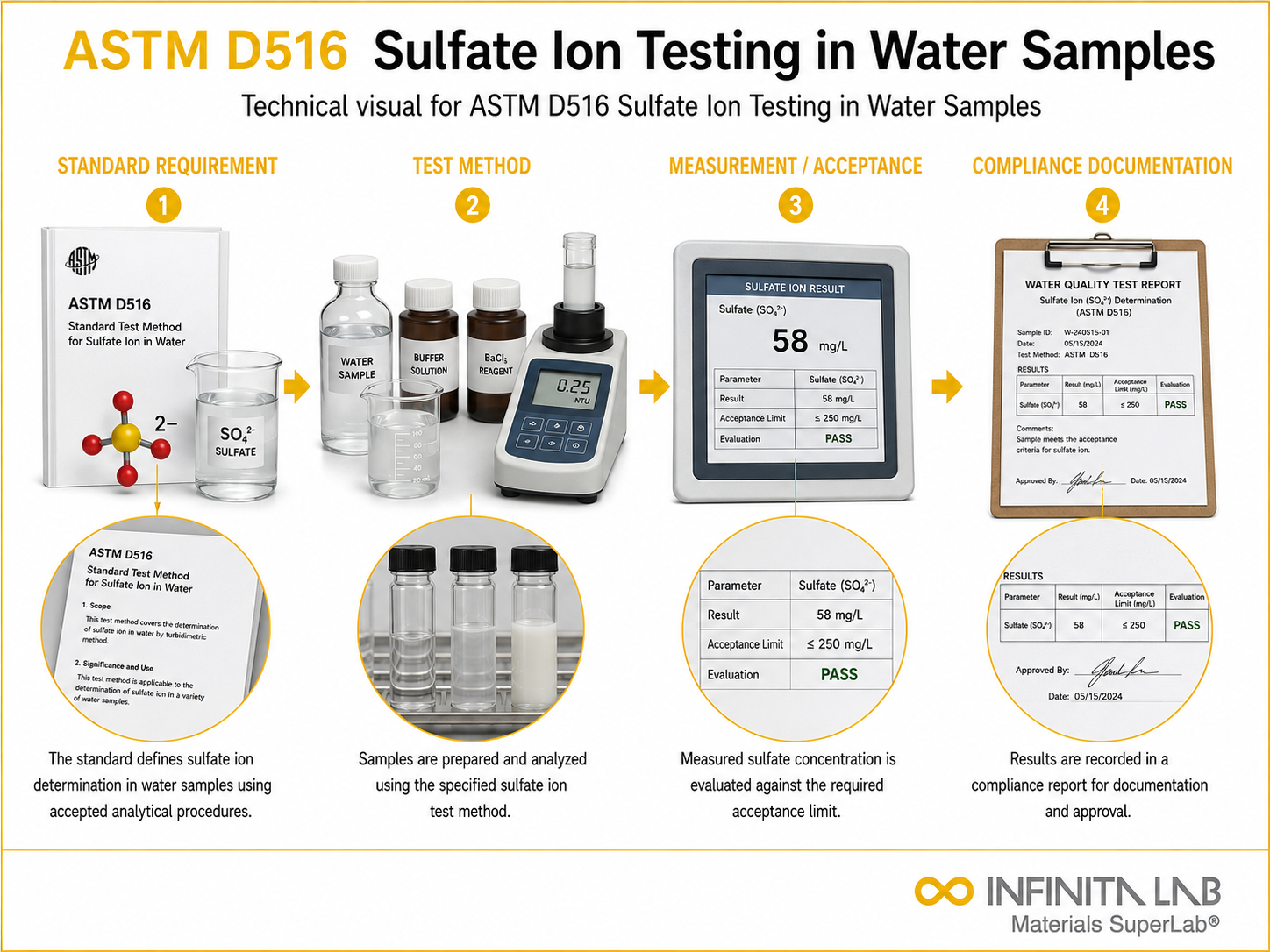
ASTM D516: Sulfate Ion Water Testing Services
-
Water System Validation Monitoring Testing Services
-
ASTM E394: Trace Iron Phenanthroline Testing Services
-
ASTM D6647: Acid Soluble Iron Atomic Absorption Testing Services







Introduction to Water & Environmental Testing Services
Infinita Lab’s ASTM Water and Environmental Testing Services facilitate the rigorous evaluation of water quality and environmental media. These services ensure that client products and operational processes adhere to established industry benchmarks for performance, safety, and regulatory alignment. Utilising advanced analytical methodologies, we characterise the chemical, physical, and biological attributes of water, soil, sediment, and air samples. These evaluations support diverse applications, including potable water treatment, industrial process water management, wastewater oversight, environmental remediation, and geotechnical investigations.
By leveraging a broad network of accredited laboratories across the United States, we offer an extensive portfolio of ASTM-compliant testing solutions. These services are structured to facilitate environmental quality assurance, verify regulatory compliance, investigate potential contamination, and support industrial water treatment initiatives.
Our Water & Environmental Testing Services
Water Quality Testing
Water quality testing analyses various water sources – including drinking water, groundwater, surface water, boiler feedwater, cooling water, and wastewater – to detect contaminants, monitor treatment effectiveness, and ensure compliance with health and environmental regulations. Our water quality testing services cover physical, chemical, and ionic parameters essential for complete water characterisation.
Relevant ASTM Standards:
- ASTM D1193 – Specification for reagent water, defining purity grades (Types I-IV) for laboratory and industrial water applications and establishing the analytical framework for water quality compliance across drinking water, industrial process water, and environmental monitoring programs.
- ASTM E70 – Determination of the pH of aqueous solutions using the glass electrode, providing an accurate measurement of hydrogen ion concentration – one of the most critical process control variables in water treatment, pollution management, and chemical processing.
- ASTM D512 – Chloride ion testing in water using potentiometric, argentometric, or colorimetric methods, monitoring chloride content in boiler feedwater, cooling water, drinking water, and process water for corrosion control and water treatment compliance.
- ASTM D516 – Sulfate ion testing in water samples, measuring sulfate concentration by turbidimetric or gravimetric methods for water quality monitoring, corrosion control, and environmental compliance in drinking water and industrial water systems.
- ASTM D888 – Dissolved oxygen measurement in water, providing methods for quantifying dissolved oxygen (DO) levels critical for aquatic life support, wastewater treatment monitoring, and water quality assessment programs.
Inorganic Constituents & Ion Analysis
Monitoring inorganic ions and dissolved constituents in water is essential for corrosion control, treatment process optimisation, regulatory compliance, and environmental contamination assessment. Infinita Lab provides comprehensive inorganic water chemistry analysis aligned with ASTM standards.
Relevant ASTM Standards:
- ASTM D512 – Chloride ion analysis in water using potentiometric, argentometric, and colorimetric test methods – applicable to potable, boiler, cooling, and environmental water samples.
- ASTM D516 – Sulfate ion determination in water, evaluating the sulfate concentration that contributes to scaling, corrosion, and biological activity in water distribution and industrial systems.
Dissolved Solids, Residue & Suspended Solids Testing
Dissolved and suspended solids in water affect turbidity, treatment efficiency, equipment fouling, and regulatory compliance. Accurate measurement of filterable and non-filterable residue is essential for wastewater characterisation and industrial water management.
Relevant ASTM Standards:
- ASTM D5907 – Filterable and non-filterable matter in water, measuring both dissolved (filterable) and suspended (non-filterable) residue fractions – essential parameters for wastewater characterisation, effluent discharge compliance, and treatment process monitoring.
- ASTM D6502 – On-line integrated measurement of low-level suspended solids and ionic solids in process water by X-ray fluorescence (XRF), providing continuous monitoring of corrosion products and particulate metals in power plant steam and water circuits – supporting heat transfer efficiency and plant reliability.
Carbon & Oxygen Demand Testing
Carbon and oxygen demand parameters are critical indicators of water quality, organic contamination, and biological oxygen demand in water treatment systems, supporting process control in wastewater treatment plants, industrial effluent monitoring, and drinking water compliance.
Relevant ASTM Standards:
- ASTM D5997 – Online monitoring of total organic carbon (TOC) and total inorganic carbon (TIC) in water from industrial, drinking water, and wastewater sources – the standard method for identifying and quantifying organic and inorganic carbon impurities in power, pharmaceutical, semiconductor, and waste treatment applications.
- ASTM D6238 – Total oxygen demand testing in water, providing a measure of the total oxidizable material in water samples – used as a screening test for assessing the oxidizable organic load in industrial wastewater and environmental water samples.
Soil & Sediment Testing
Soil and sediment testing assesses the physical and chemical properties of soil, including composition, contamination levels, and suitability for construction, agricultural, or environmental use. These tests are fundamental for environmental impact assessments, remediation planning, and geotechnical site investigations.
Relevant ASTM Standards:
- ASTM D2487 – Soil classification using the Unified Soil Classification System (USCS), categorising soils by grain size, plasticity, and other physical properties to characterise their suitability for construction and environmental applications.
- ASTM D698 – Standard Proctor soil compaction testing to determine the optimum moisture content and maximum dry density of soils for compaction specifications, earthwork quality control, and roadway and embankment subgrade design.
- ASTM D854 – Specific gravity of soil solids testing using a water pycnometer – a fundamental geotechnical property for void ratio calculation, consolidation analysis, and soil classification in site investigation projects.
- ASTM D2435 – One-dimensional soil consolidation properties testing, measuring how soils compress under incremental loading – essential for predicting settlement of structures and embankments founded on compressible soils.
Air Quality Testing
Air quality testing measures the concentration of pollutants in air – including particulate matter, volatile organic compounds (VOCs), and other hazardous substances – ensuring that air quality meets environmental standards, worker safety regulations, and product emissions requirements.
Relevant ASTM Standards:
- ASTM D1356 – Standard terminology for sampling and analysis of atmospheres, providing the definitional framework for air quality monitoring, pollutant characterisation, and atmospheric sampling procedures used in environmental and industrial air quality programs.
Process Water & Industrial Water Testing
Industrial process water – including boiler feedwater, cooling water, steam condensate, and power plant water circuits – must be rigorously monitored for ionic contaminants, corrosion products, dissolved gases, and organic impurities to ensure equipment reliability, heat transfer efficiency, and process integrity.
Relevant ASTM Standards:
- ASTM D512 – Chloride ion monitoring in boiler feedwater, cooling tower water, and process water – the primary corrosion control parameter for industrial water systems and steam generators.
- ASTM D516 – Sulfate ion monitoring in industrial process water for scale and corrosion management in boilers, cooling systems, and heat exchangers.
- ASTM D6502 – Online monitoring of suspended solids and ionic solids in power plant water and steam circuits, detecting corrosion product transit and providing time profiles that support plant efficiency and maintenance planning.
- ASTM D5997 – Online TOC/TIC monitoring for power generation, pharmaceutical, semiconductor, and industrial process water systems where organic carbon limits are critical for product quality and equipment protection.
Biodegradability & Aquatic Toxicity Testing
Environmental regulations and sustainability programs increasingly require testing of lubricants, chemicals, and industrial fluids for aquatic biodegradability and toxicity – supporting REACH, EPA, and international environmental compliance for chemical formulations.
Relevant ASTM Standards:
- ASTM D6731 – Aerobic aquatic biodegradability testing for lubricants and lubricant components in a closed respirometer, evaluating the rate and extent of biodegradation under controlled aerobic aquatic conditions – essential for environmental compliance of lubricants, process fluids, and industrial chemicals.
- ASTM D1292 – Resistance to aquatic toxicity testing for lubricants, measuring the acute toxic effects of lubricant materials on aquatic organisms to support environmental safety data generation and regulatory compliance.
Environmental Corrosion & Contamination Testing
Environmental corrosion testing evaluates how materials and components perform when exposed to natural and industrial environments – including salt fog, humidity, and chemical contamination – to predict service life and support material selection for outdoor and corrosive service applications.
Relevant ASTM Standards:
- ASTM B117 – Salt spray (fog) corrosion testing provides an accelerated evaluation of the corrosion resistance of materials, coatings, and surface finishes under controlled salt-mist conditions representative of marine and industrial corrosive environments.
- ASTM G48 – Pitting and crevice corrosion resistance testing for stainless steels and high-alloy materials using ferric chloride solution, evaluating resistance to localised corrosion initiation in chloride-containing environmental conditions.
- ASTM G5 – Standard electrochemical potentiodynamic polarisation testing for evaluating corrosion rate and behaviour of metallic materials in environmental and process water conditions.
Frequently Asked Questions
ASTM Water Testing involves standardized procedures to evaluate water quality, ensuring it meets regulatory and safety standards. This testing measures various parameters such as pH, turbidity, dissolved oxygen, and the presence of contaminants like heavy metals and pathogens. Key ASTM standards include ASTM D1193 for reagent water and ASTM D1129 for water terminology. These tests are essential for determining the suitability of water for drinking, industrial use, and environmental safety.
ASTM environmental testing services benefit industries, including automotive, aerospace, electronics, and construction. These services ensure materials and products meet stringent environmental standards, enhancing durability and safety. Testing validates component resilience under extreme conditions. Electronics manufacturers use ASTM tests to ensure device reliability and compliance with regulatory requirements. The construction industry relies on these tests to assess building materials’ resistance to environmental stressors, ensuring structural integrity and longevity. Overall, ASTM environmental testing is crucial for industries aiming to improve product quality, safety, and regulatory compliance in diverse operational environments.
ASTM Water and Environmental test results are crucial for effective environmental management. These results provide precise data on water quality, soil composition, air purity, and hazardous waste characteristics. By adhering to ASTM standards, such as ASTM D1193 for water quality and ASTM D2487 for soil classification, the data ensures regulatory compliance and aids in identifying pollution sources and contamination levels. Environmental managers use these insights to develop remediation strategies, monitor the effectiveness of pollution control measures, and ensure compliance with environmental regulations. This data-driven approach supports sustainable practices, protects public health, and preserves natural resources.
Read Our Blogs and Research Papers
In-depth examination of genuine material testing solutionsCompression Testing & Its Importance
Compression Testing & Its Importance
Introduction The standard test method ASTM D3164 assesses shear strength in adhesive bonds loaded in tension. The tensile load applied...
Read ArticleAccelerated Real Time Aging Testing Services
Accelerated Real Time Aging Testing Services
Accelerated & Real-Time Aging Real-time aging testing is the process of storing a product in standard conditions and observing it...
Read ArticleASTM D1653: Water Vapor Transmission Organic Coating Testing Services

ASTM D1653: Water Vapor Transmission Organic Coating Testing Services
What is ASTM D1653 Testing? ASTM D1653 describes the standard test method for WVT through organic coating films. The test...
Read Article
Get your Ceramic Material testing done from the largest network of accredited labs in the USA
We are a material testing lab with a vast network of accredited labs across the country. Our state-of-the-art equipment and experienced team provide accurate and timely testing services to meet the unique needs of our clients. Partner with us for reliable material testing solutions.
 Quick Turnaround and Hasslefree process
- Confidentiality Guarantee
- Free, No-obligation Consultation
- 100% Customer Satisfaction


