


ASTM D2103: Polyethylene Film Sheeting Specification Testing Services
Accredited ASTM D2103 polyethylene film sheeting specification testing from Infinita Lab, performed to the exact standard requirements - accurate, reproducible results with full documentation for compliance, R&D, and quality control programs.
TRUSTED BY


Get ASTM D2103 compliant results - request your polyethylene film sheeting specification testing quote
- Overview
- Scope, Applications, and Benefits
- Test Process
- Specifications
- Instrumentation
- Results and Deliverables
What Is ASTM D2103 Polyethylene Film Sheeting Specification?
ASTM D2103 is the standard specification that governs polyethene film and sheeting used across packaging, agricultural, and construction markets. It isn’t a single test method in the way people often assume – it’s a classification and requirements document, one that tells a converter, brand owner, or end user what a given grade of polyethene film should deliver before it ever gets stamped as compliant. The specification sorts material using a five-digit type designation, with each digit representing a performance band for density, impact strength, kinetic coefficient of friction, haze, and nominal thickness. Two films with the same base resin can carry very different type numbers once gauge and additive packages shift the numbers around.
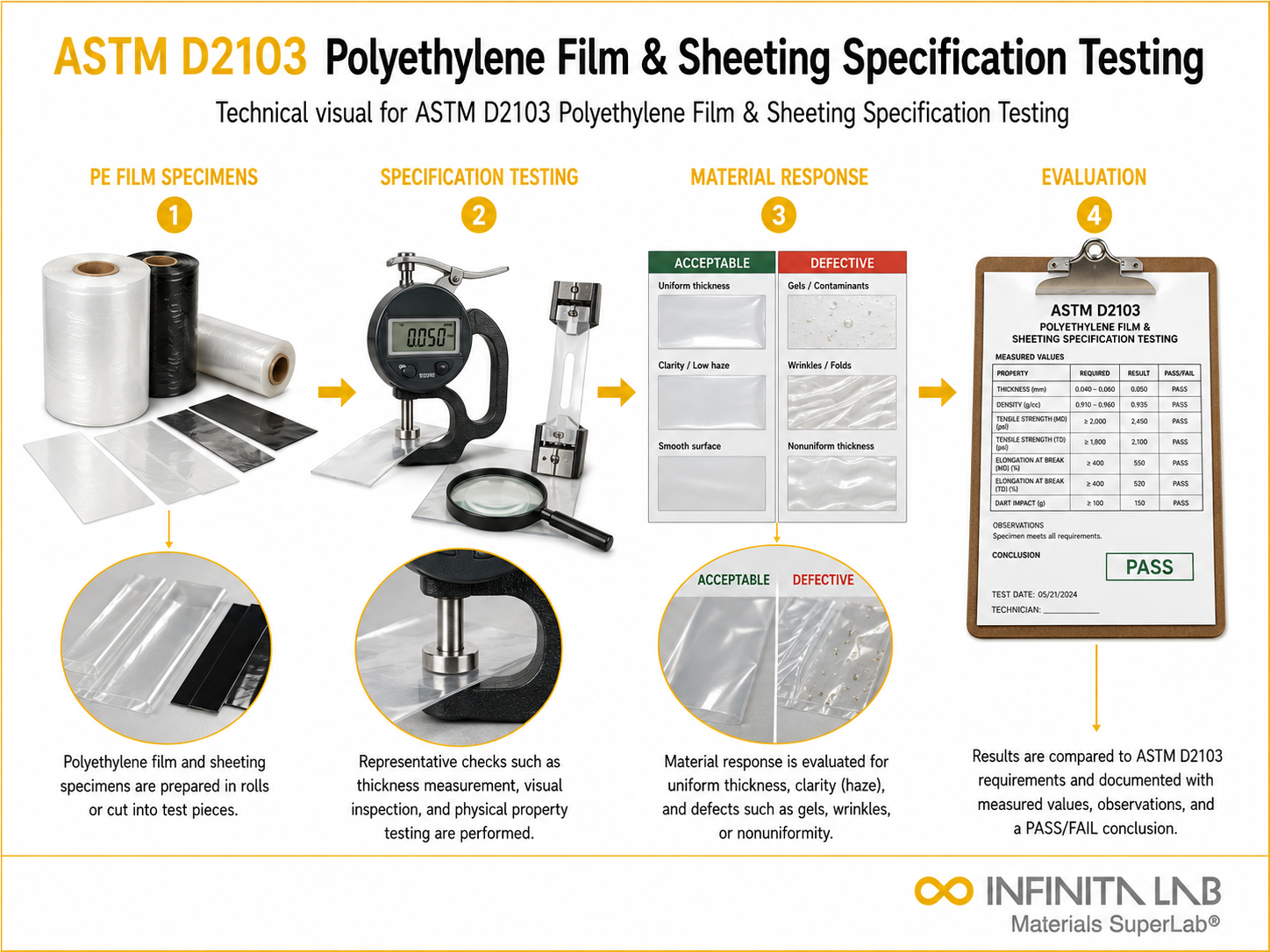
Because D2103 describes what to classify rather than how to measure it, verifying compliance means pairing the specification with a suite of companion ASTM test methods. Tensile properties get evaluated under methods like D882, dart-drop impact resistance under D1709, tear resistance under D1922, and haze or light transmission under D1003, along with additional checks for thickness uniformity and visual defects such as gels, streaks, and pinholes. That’s the part that trips people up when they request “D2103 testing” as if it were one machine, one procedure, one number.
At Infinita Lab, we treat D2103 evaluation as the coordinated, multi-method effort it actually is. We route each film sample through the right combination of companion methods, correlate the results back to the applicable type designation, and hand back a report that speaks plainly about where the material lands – not just a stack of raw data. Whether the film is destined for food packaging, greenhouse covers, or protective sheeting on a job site, the goal is the same: give you a defensible answer on compliance, fast enough to keep production moving.

Applications and Benefits of ASTM D2103 Polyethylene Film Sheeting Specification Testing
Scope
- Covers polyethene film and sheeting manufactured from low-density, linear low-density, or high-density polyethene resin.
- Applies to film and sheeting up to roughly 0.25–0.3 mm (about 10–12 mils) in thickness, with the exact upper limit varying slightly by edition of the standard.
- Establishes a five-digit type classification system built around density, impact strength, coefficient of friction, haze, and nominal thickness.
- Permits the inclusion of pigments, stabilisers, and other additives intended to enhance surface or performance properties.
- Allows recycled polyethene resin or film as feedstock, provided the finished material still meets all applicable requirements.
- Requires the finished film to be reasonably free of gels, streaks, pinholes, foreign particles, and undispersed raw material.
- Sets appearance and edge-quality expectations, ruling out visible tears, holes, blisters, and ragged or nicked edges.
- Recognises surface treatments such as corona discharge or flame treatment as acceptable means of improving printability and adhesion.
- References terminology and definitions from other plastics standards to keep classification language consistent across the industry.
- Leaves the actual test procedures to referenced companion methods rather than specifying measurement technique within the document itself.
Applications
- Food and general packaging film, including bags, pouches, and shrink wrap that need predictable strength and clarity.
- Agricultural film such as greenhouse covers, mulch film, and silage or bale wrap exposed to sun, wind, and handling stress.
- Construction and vapour-barrier sheeting used under slabs, behind walls, or as temporary jobsite protection.
- Industrial applications like pallet covers, equipment wraps, and interleaving or protective sheeting during shipping and storage.
- Converting operations that print, laminate, seal, or thermoform polyethene film into finished products.
- Resin and film producers who need to classify output against a recognised type designation for customers and specifiers.
- Quality assurance programs for blown-film and cast-film lines that need a documented basis for accept/reject decisions
Benefits
- Gives buyers and converters a common classification language instead of vague marketing descriptions of “heavy-duty” or “premium” film.
- Reduces disputes between resin suppliers, film converters, and end users by anchoring performance claims to a documented type number.
- Supports material substitution decisions, since two films carrying comparable type designations can often be evaluated as interchangeable.
- Helps manufacturers catch process drift – thickness variation, haze creep, or falling impact strength – before it reaches the customer.
- Provides documentation that specifiers, auditors, and procurement teams can reference when qualifying a new film source.
- Makes recycled-content film easier to validate, since the specification explicitly allows recycled feedstock when requirements are still met.
Our ASTM D2103 Testing Procedure
Sample Preparation
Film specimens are cut to required dimensions.
1Conditioning
Samples are conditioned under controlled environmental conditions.
2Property Evaluation
Thickness, mechanical, and physical tests are conducted.
3Data Recording & Evaluation
Results are analyzed for classification and compliance.
4ASTM D2103 Test Parameters and Requirements
| Parameter | Details |
|---|---|
| Applicable Materials | Polyethylene films and sheets |
| Thickness Range | ~0.01 mm to 1 mm |
| Density Range | ~0.91 to 0.96 g/cm³ |
| Tensile Strength | ~10 MPa to 30 MPa |
| Elongation at Break | ~100% to 600% |
| Measured Outputs | Thickness, strength, elongation |


- Dead-weight or motorised thickness gauge – Measures film gauge and checks thickness uniformity across the sample.
- Universal tensile testing machine – Applies controlled load to determine tensile strength and elongation at break.
- Free-falling dart impact tester – Drops a weighted dart from set heights to determine impact resistance per D1709.
- Elmendorf or trouser-tear tester – Measures the force needed to propagate a tear through the film.
- Haze meter or spectrophotometer – Quantifies haze and light transmission for optical clarity assessment.
- Coefficient of friction tester – Measures how film sledge surfaces slide against themselves or other substrates.
- Density gradient column or densitometer – Confirms resin density falls within the claimed classification band.
Equipment and Instrumentation Used for ASTM D2103 Testing
What You Receive: Test Report, Data, and Certification
- A detailed test report mapping every measured property back to the ASTM D2103 five-digit classification it supports.
- Pass/fail determinations against the requested type designation, clearly flagged where results fall outside expected ranges.
- Raw data tables covering thickness, density, tensile, impact, tear, friction, and optical measurements for full traceability.
- Photographic or written notes on any visual defects observed during inspection, such as gels, pinholes, or edge irregularities.
- Guidance on which companion test method drove a given result, so engineering and QA teams can trace findings back to source data.
- A summary suitable for sharing with suppliers, customers, or auditors as documented proof of specification compliance.
ASTM D2103 Polyethylene Film Sheeting Specification FAQs
ASTM D2103 provides classification and specification for polyethylene films and sheets. It defines material requirements to ensure consistent performance in packaging, agricultural, and industrial applications requiring flexibility and durability.
Key parameters include thickness, density, tensile strength, elongation, tear resistance, and impact strength. These properties influence processing behavior and end-use performance.
The test provides classification based on physical and mechanical properties. Results indicate suitability of polyethylene films for specific applications and performance requirements.
ASTM D2103 applies to polyethylene films and sheeting, including low-density and high-density variants used in packaging, construction, and agricultural products.
ASTM D2103 provides material classification but may not fully represent performance under all environmental conditions. Additional testing may be required for weathering, chemical exposure, or long-term durability.
ASTM D2103 specifies requirements for polyethylene film and sheeting, including thickness, density, impact strength, haze, and coefficient of friction. Testing verifies that the material meets the specified classification and quality requirements.
Why Choose Infinita Lab for Polyethylene Film Sheeting Specification Testing
When your Polyethylene Film Sheeting Specification results have to hold up - for compliance, a customer audit, or an engineering decision - ASTM D2103 accuracy and an unbiased third-party report matter more than price. Infinita Lab routes your ASTM D2103 polyethylene film sheeting specification testing to ISO/IEC 17025-accredited U.S. partner labs with hands-on method experience, so you get defensible data, transparent reporting, and turnaround times built around your project deadline - not ours.

Need ASTM D2103 Polyethylene Film Sheeting Specification Testing You Can Rely On?
Send query us at hello@infinitalab.com or call us at (888) 878-3090 to learn more about our services and how we can support you.



Request a Quote
Submit your material details and receive testing procedures, pricing, and turnaround time within 24 hours.
 Quick Turnaround and Hasslefree process
 Confidentiality Guarantee
 Free, No-obligation Consultation
 100% Customer Satisfaction
