


ASTM D7514 Ink Stain Blocking & ASTM D7723 Filler Macro-Dispersion Testing
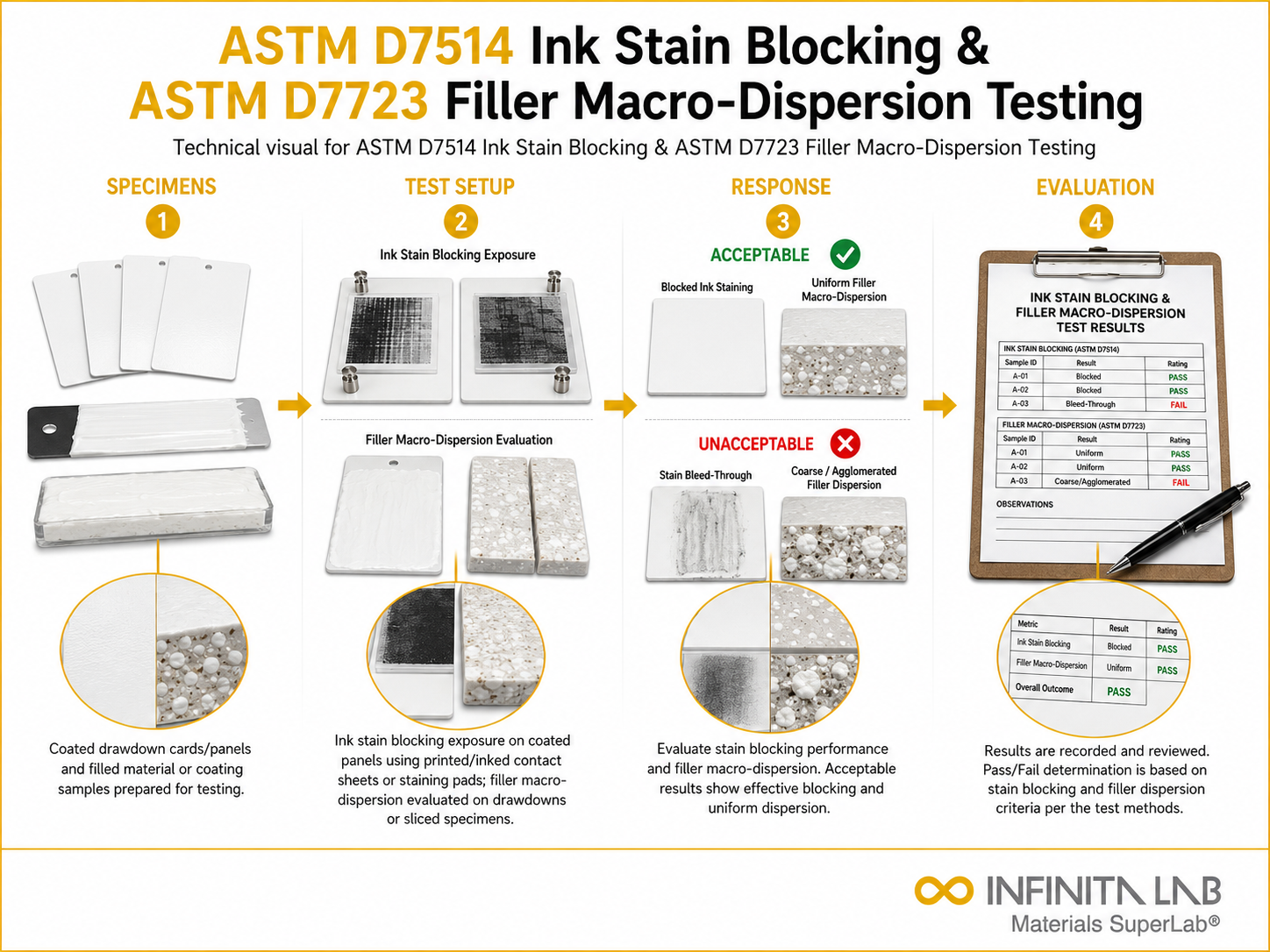
ASTM D7514 gives a procedure for assessing the capacity of a structural paint framework to impede ink stains from markers and writing instruments from seeping through a primer into a topcoat. The qualities expressed in SI units are considered as standard.
TRUSTED BY


Precision-driven testing for dimensional accuracy and compliance
- Overview
- Scope, Applications, and Benefits
- Test Process
- Specifications
- Instrumentation
- Results and Deliverables
Overview
ASTM D7514 evaluates the ability of architectural paint systems to block stains from penetrating and discoloring the coating surface. It assesses how effectively a paint resists common staining agents such as ink, dyes, or markers that can migrate through the film.
This method is widely used in coatings and construction industries to ensure surface cleanliness and durability in interior and exterior applications. It helps manufacturers develop high-performance paints with improved stain resistance, ensuring long-term aesthetic quality and reduced maintenance requirements.

Scope, Applications, and Benefits
Scope
This method determines stain-blocking performance of paint systems against ink-type contaminants.
- Evaluation of stain resistance in architectural coatings
- Assessment of ink and dye penetration through paint films
- Applicable to interior and exterior paint systems
- Measurement of discoloration and stain visibility
- Comparison of coating performance under controlled conditions
- Supports formulation development and quality control
Applications
- Interior wall and ceiling coatings
- Exterior architectural paint systems
- Commercial and residential buildings
- High-traffic areas requiring stain resistance
- Maintenance and repainting applications
- Coating formulation and product development
Benefits
- Improves stain resistance performance
- Enhances long-term aesthetic appearance
- Reduces maintenance and repainting frequency
- Supports high-quality coating development
- Enables product differentiation in the market
- Provides reliable performance evaluation
Test Process
Coating Application
Paint is uniformly applied on a standardized substrate and allowed to dry under controlled conditions.
1Stain Application
Ink or staining agent is applied to the coated surface in a defined manner.
2Exposure and Drying
The stained specimen is conditioned to allow stain interaction with the coating film.
3Evaluation of Stain Blocking
The degree of stain penetration or discoloration is visually or instrumentally assessed.
4Technical Specifications
| Parameter | Details |
|---|---|
| Test parameter | Ink stain blocking performance |
| Substrate | Standardized test panel or surface |
| Coating type | Architectural paint systems |
| Stain agent | Ink or dye-based contaminants |
| Application method | Controlled coating thickness |
| Drying conditions | Defined temperature and humidity |
| Evaluation method | Visual rating or color measurement |
| Measurement scale | Stain intensity or discoloration level |


- Coating applicator (drawdown bar or brush)
- Standard test panels
- Controlled drying chamber
- Ink or stain applicator tools
- Colorimeter or spectrophotometer
- Lighting evaluation cabinet
- Sample preparation tools
Instrumentation Used for Testing
Results and Deliverables
- Stain blocking rating or score
- Visual comparison results
- Color difference data (ΔE values)
- Coating performance assessment
- Test conditions and observations
- Detailed evaluation report
Frequently Asked Question
The method applies controlled ink stains to coated substrates and evaluates penetration and discoloration after exposure. This simulates common household or commercial staining scenarios, enabling realistic assessment of coating resistance to persistent and migrating contaminants.
Stain-blocking paints rely on dense polymer networks, pigment volume concentration, and barrier additives that prevent stain migration. These mechanisms reduce permeability and trap staining agents at the surface, limiting their ability to diffuse through the coating film.
Thicker films generally provide better barrier properties by increasing diffusion resistance. However, excessive thickness can introduce defects or cracking, so optimal film build is critical for consistent stain-blocking effectiveness.
Visual inspection identifies obvious discoloration, while instrumental measurements quantify color differences. Combining both ensures subjective perception aligns with objective data, improving reliability of stain-blocking evaluation.
The test focuses on specific stain types and controlled conditions, which may not represent all real-world contaminants or environmental exposures.
Why Choose Infinita Lab for Advanced Materials Testing and Characterization?
At the core of this breadth is our network of 2,000+ accredited laboratories across the USA, offering access to over 10,000 testing methods and analytical services. From advanced materials characterization (SEM, TEM, RBS, XPS) to mechanical, chemical, environmental, biological, and standardized ASTM/ISO-compliant testing, we deliver unmatched flexibility, specialization, and scale. You are never limited by geography, facility, or methodology — Infinita Lab connects you to the right expertise and testing solution, every time.

Looking for a Trusted Partner for Accurate and Reliable Testing Services?
Send query us at hello@infinitalab.com or call us at (888) 878-3090 to learn more about our services and how we can support you.



Request a Quote
Submit your material details and receive testing procedures, pricing, and turnaround time within 24 hours.
 Quick Turnaround and Hasslefree process
 Confidentiality Guarantee
 Free, No-obligation Consultation
 100% Customer Satisfaction
