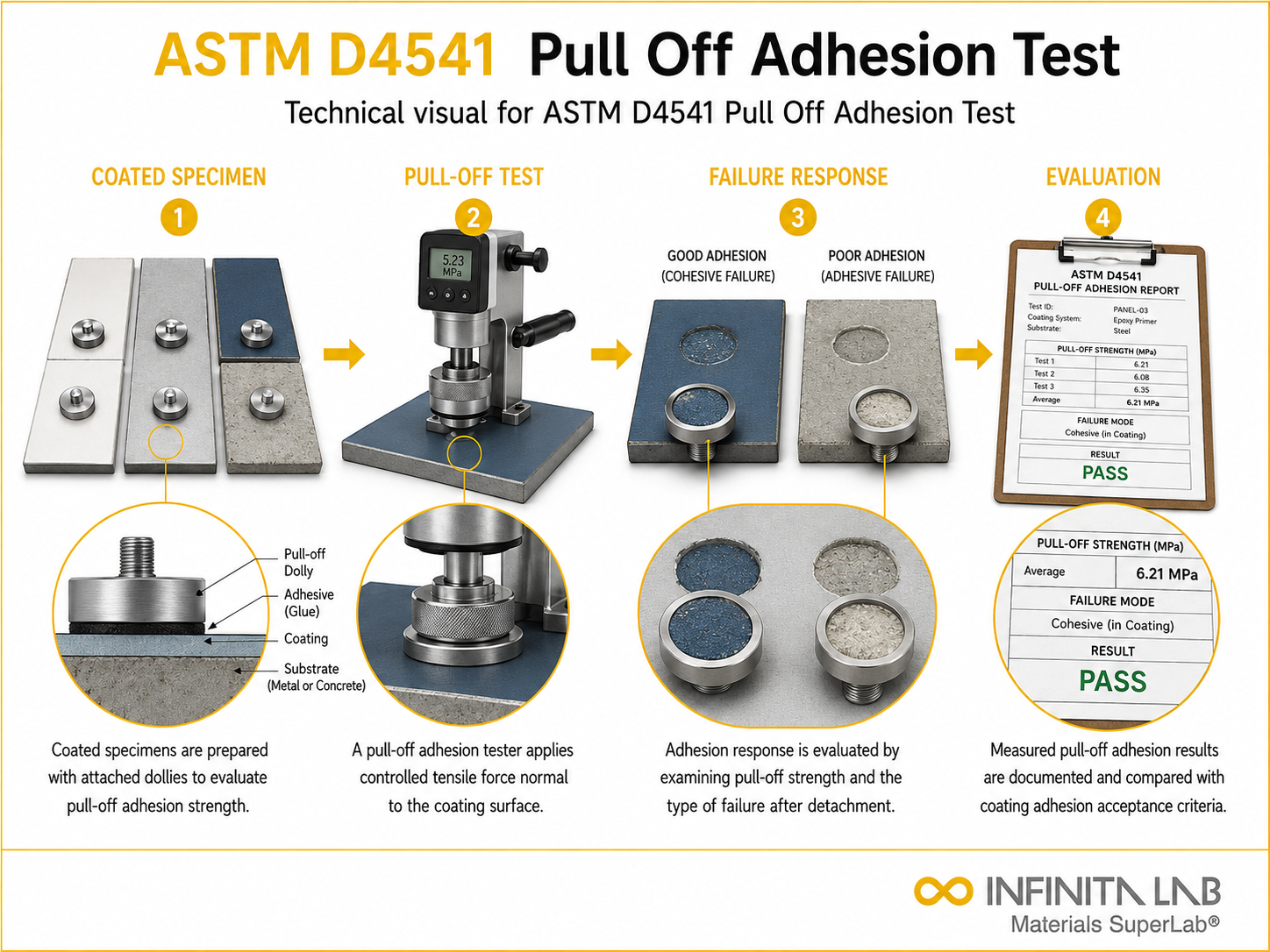


What Is ASTM D4541 Pull Off Adhesion?
ASTM D4541 defines the method for measuring the pull-off strength of a coating from its substrate using a portable adhesion testing instrument. The test bonds a cylindrical loading fixture (dolly) to the coating surface with an adhesive, then applies a perpendicular tensile force to the dolly until the coating separates. The force at separation divided by the bonded area gives the pull-off strength in pressure units. The key feature of ASTM D4541 is that the test can be performed in the field on installed coatings, not just on laboratory specimens – a portable instrument applies force by hydraulic, mechanical, or pneumatic means without requiring the structure to be removed from service.
ASTM D4541 covers five types of adhesion testers, ranging from fixed-alignment instruments that self-align during loading to manually operated devices. Type IV and Type V instruments with self-aligning capability are generally preferred for flat surfaces because they minimize eccentric loading that would reduce the measured pull-off strength. For curved or irregular surfaces, manual instruments may be the only practical option. The standard specifies dolly diameter, adhesive selection and preparation, surface preparation procedures, and the criteria for scoring failures as valid or invalid based on the failure plane location.
Pull-off adhesion testing is used across industries to verify that protective coatings, primers, thermal spray coatings, and other surface treatments have adequate bond strength to their substrate. It is a routine quality control method during coating application, a specification conformance test on delivered structures, and a condition assessment tool for coatings already in service. The failure mode – adhesive failure at the substrate interface, cohesive failure within the coating, or glue failure between the dolly and the coating – determines whether the measured value represents the true coating adhesion or a lower bound limited by an external factor.

Applications and Benefits of ASTM D4541 Pull Off Adhesion Testing
Scope
ASTM D4541 applies to organic coatings, inorganic coatings, thermal spray coatings, and other surface treatments on metal, concrete, wood, and other solid substrates. Both laboratory specimens and in-situ installed coatings can be tested. Evaluation areas include:
- Pull-off adhesion strength of primer and topcoat systems
- Adhesion of thermal spray and cold spray metallic coatings
- Bond strength of concrete repair materials and overlay systems
- Adhesion of protective coatings to steel structures (pipelines, tanks, bridges)
- Effect of surface preparation method on coating adhesion
- Adhesion retention after weathering, immersion, or thermal exposure
Applications
- Protective coating quality control during application on structures
- Specification conformance testing for coating contractors
- Coating condition assessment on in-service structures
- Thermal spray coating qualification for aerospace and wear applications
- Concrete coating and overlay bond strength verification
- Surface preparation qualification for critical coating applications
Benefits
- Portable instrument allows in-situ testing on installed structures without destructive removal
- Direct measurement of adhesion rather than inference from peel or cross-cut tests
- Failure mode classification distinguishes substrate adhesion failure from coating cohesive failure
- Applicable to a wide range of coating types and substrate materials
- Reproducible test geometry with standardized dolly diameter and loading geometry
- Widely specified in protective coating project specifications globally
Our ASTM D4541 Testing Procedure
Dolly Preparation and Bonding
The coating surface is lightly abraded in the test area.
1Score Cutting (optional)
A circular score cut may be made around the dolly perimeter to isolate the test area from surrounding coating
2Load Application
The adhesion tester is attached to the dolly and load is applied perpendicularly to the surface
3Failure Mode Assessment
The failure plane is examined and classified as adhesive failure (at substrate interface), cohesive failure
4ASTM D4541 Test Parameters and Requirements
| Parameter | Details |
|---|---|
| Standard | ASTM D4541 |
| Instrument Types | Type I through Type V (fixed and self-aligning designs) |
| Standard Dolly Diameter | 20 mm or 50 mm |
| Loading Mode | Perpendicular tensile force applied at specified rate |
| Applicable Substrates | Steel, concrete, wood, aluminum, and other rigid substrates |
| Output Units | MPa or psi (force per unit dolly area) |


- Portable adhesion tester (Type I through V per ASTM D4541)
- Dollies of specified diameter
- Two-part bonding adhesive for dolly attachment
- Score cutter for circular isolation cut around dolly
- Surface preparation abrasives and cleaning materials
- Photographic system for failure mode documentation
Equipment and Instrumentation Used for ASTM D4541 Testing
What You Receive: Test Report, Data, and Certification
- Pull-off strength in MPa or psi
- Failure mode classification with percentage of each failure type
- Photographic documentation of failure surfaces
- Surface preparation method and dolly adhesive used
- Pass/fail determination against specification requirements where applicable
- Quality assurance documentation
ASTM D4541 Pull Off Adhesion FAQs
According to ASTM D 4541 and BS EN ISO 4624, the tensile pull-off method for adhesion testing is adhering a test dolly to the coated surface and then pulling the dolly with the coating from the substrate by applying force perpendicular to the surface.
ASTM D4541 provides guidelines for preparing, testing, and evaluating the coated systems' results to assess the sample's pull-off strength.
The pull-off strength of a material is its ability to withstand applied tension stress without failure.
Coatings applied to concrete are evaluated according to ASTM D7234, while coatings applied to metal are evaluated using ASTM D4541.
ASTM D4541 measures the pull-off strength of coatings applied to metal substrates using a portable adhesion tester. A loading fixture, known as a dolly, is bonded to the coating surface, and tensile force is applied perpendicular to the substrate. The maximum force required to detach the coating is recorded, and the failure location is examined to assess coating adhesion and system performance.
An adhesion pull-off test measures the force required to detach a coating from its substrate. A metal loading fixture, called a dolly, is bonded to the coated surface and connected to a pull-off tester. Tensile force is applied perpendicular to the surface until the coating separates or a specified load is reached. The results indicate coating adhesion strength and the location of failure.
The latest edition listed by ASTM is ASTM D4541-22, Standard Test Method for Pull-Off Strength of Coatings Using Portable Adhesion Testers. It evaluates the pull-off strength of coating systems on metal substrates using portable adhesion testers. The method measures the maximum force before separation or determines whether the coating withstands a specified load. For coatings on concrete, ASTM D7234 is the relevant standard.
Why Choose Infinita Lab for Pull Off Adhesion Testing
When your Pull Off Adhesion results have to hold up - for compliance, a customer audit, or an engineering decision - ASTM D4541 accuracy and an unbiased third-party report matter more than price. Infinita Lab routes your ASTM D4541 pull off adhesion testing to ISO/IEC 17025-accredited U.S. partner labs with hands-on method experience, so you get defensible data, transparent reporting, and turnaround times built around your project deadline - not ours.

Need ASTM D4541 Pull Off Adhesion Testing You Can Rely On?
Send query us at hello@infinitalab.com or call us at (888) 878-3090 to learn more about our services and how we can support you.





