


ASTM D1489: Adhesive Nonvolatile Content Testing Services
The nonvolatile content of aqueous adhesives can be determined using ASTM D1489 test method. A 1 L aliquot of extract from a sample was used in the gravimetric test. The extract is boiled at 105 °C after being evaporated below the solvent's boiling point. The leftover residue is weighed, and the results are compared to the pass/fail criteria that were discovered. This nonvolatile content can be expressed in terms of percentage. For adhesive selection and product uniformity, this test method can be used to compare the nonvolatile content of various adhesives
TRUSTED BY


Get ASTM D1489 compliant results — request your adhesive nonvolatile content testing quote
- Overview
- Scope, Applications, and Benefits
- Test Process
- Specifications
- Instrumentation
- Results and Deliverables
What Is ASTM D1489 Adhesive Nonvolatile Content?
ASTM D1489 is the standard test method for determining the nonvolatile content of aqueous and solvent-based adhesive formulations. The test measures the percentage of an adhesive sample that remains after volatile components — primarily water and/or organic solvents — are driven off under controlled heating conditions. The remaining nonvolatile residue represents the resin solids, fillers, and other non-volatile formulation constituents that form the actual bonding film once the adhesive dries or cures.
Nonvolatile content (also referred to as total solids content) is a fundamental quality control and formulation parameter for adhesive manufacturers and end users, since it directly affects coating weight, bond line thickness, applied adhesive cost, and consistency of the finished bonded product.

Applications and Benefits of ASTM D1489 Adhesive Nonvolatile Content Testing
Scope
ASTM D1489 applies to liquid adhesive formulations, including:
- Aqueous resin adhesives — water-based emulsion and dispersion adhesives such as PVA, acrylic, and latex-based systems
- Solvent-based adhesives — formulations relying on organic solvents as the carrier vehicle
- Hot melt and reactive adhesive precursors — where applicable formulation chemistry permits nonvolatile content determination by this method
Applications
- Formulation development — quantifying how resin concentration, filler loading, and solvent/water ratio affect nonvolatile content during adhesive development
- Incoming raw material verification — confirming that received adhesive lots match specified solids content before use in production
- Production quality control — verifying batch-to-batch consistency of nonvolatile content during adhesive manufacturing
- Coating weight and cost calculations — supporting calculation of dry film weight and material usage based on measured solids content
- Specification and certification — generating nonvolatile content data required for technical data sheets and customer specifications
Benefits
- Simple, reliable gravimetric method — nonvolatile content is determined directly by mass loss, requiring no specialized instrumentation beyond an oven and analytical balance
- Direct relevance to end-use performance — nonvolatile content correlates directly with the amount of bonding resin delivered per unit of applied adhesive
- Rapid quality control turnaround — results are typically available within hours, supporting fast production release decisions
- Applicable across adhesive chemistries — the method accommodates both aqueous and solvent-based adhesive systems
- Supports batch consistency verification — enables detection of formulation drift or dilution issues between production lots
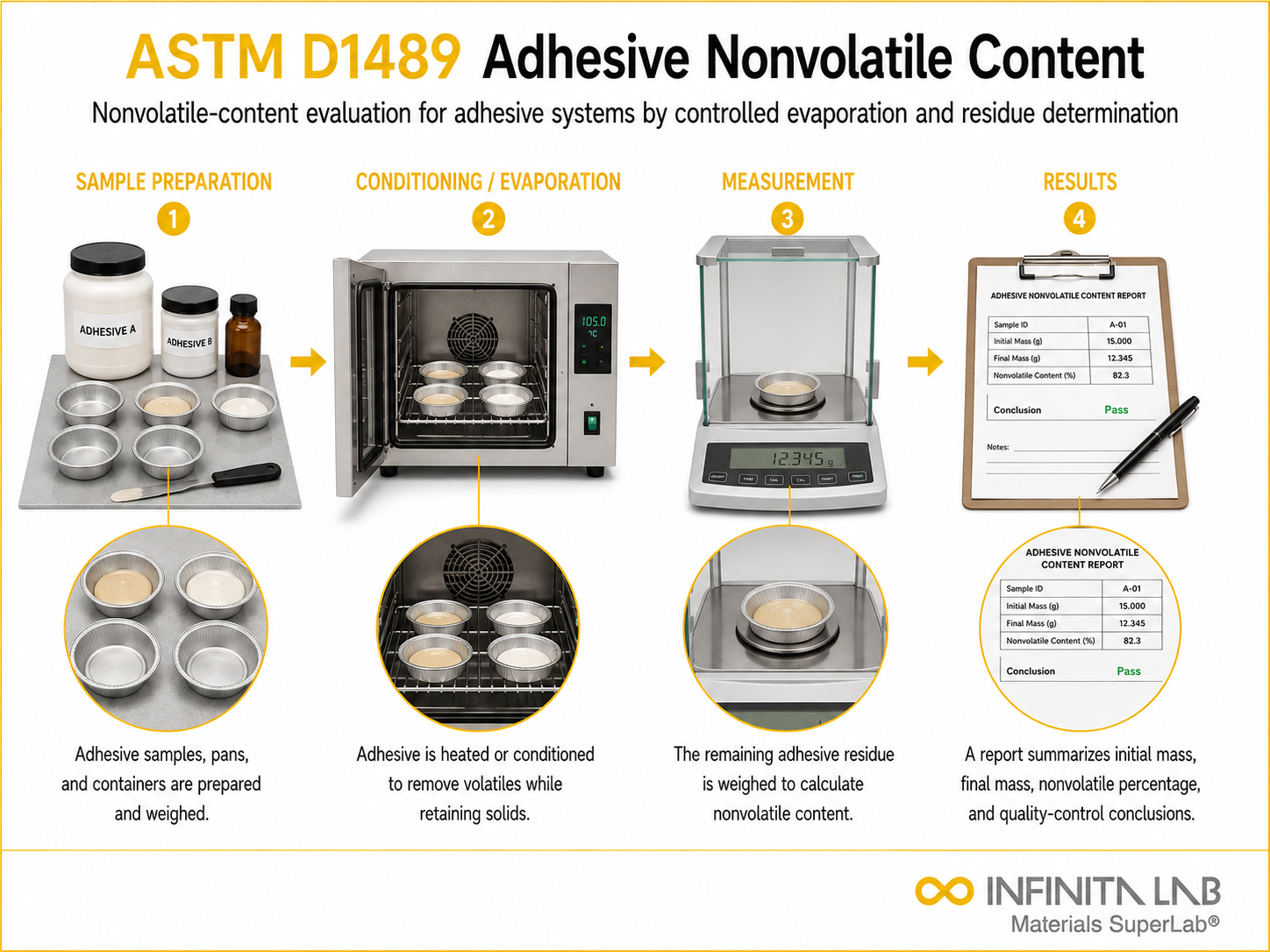
Our ASTM D1489 Testing Procedure
Prepare and Weigh
Place a representative adhesive sample in a tared dish and record the initial wet mass.
1Heat the Sample
Dry the specimen in a forced-draft oven at the specified temperature and duration.
2Cool and Reweigh
Cool the dried residue in a desiccator and record the final mass.
3Calculate and Report
Calculate the nonvolatile content percentage and report the average result with test conditions.
4ASTM D1489 Test Parameters and Requirements
| Parameter | Details |
|---|---|
| Typical Oven Temperature | 105°C to 150°C (formulation dependent, per governing specification) |
| Typical Heating Duration | Specified time sufficient to reach constant mass (commonly 1–3 hours) |
| Result Parameter | Nonvolatile content (percent by weight) |
| Minimum Specimens | Typically two to three replicates per sample |
| Related Standards | ASTM D2369 (solids content of coatings), ASTM D4017 (moisture content) |


- Analytical balance readable to at least 0.1 mg for initial and final mass measurement
- Forced-draft laboratory oven with temperature control
- Tared aluminum or glass weighing dishes/pans
- Desiccator for controlled cooling of dried specimens prior to final weighing
- Timer for heating duration control
Equipment and Instrumentation Used for ASTM D1489 Testing
What You Receive: Test Report, Data, and Certification
- Test report — documentation of sample identification, oven temperature and duration used, and individual specimen results
- Nonvolatile content values — percent nonvolatile content for each specimen and the mean value for the replicate set
- Batch conformance assessment — comparison of measured nonvolatile content against specification limits, where applicable
- Pass/fail determination — compliance assessment against acceptance criteria defined in a product specification
ASTM D1489 Adhesive Nonvolatile Content FAQs
The method applies to water-based adhesives such as dextrin, starch, casein and animal-gelatin adhesives. It is not intended as a general method for every solvent-based or reactive adhesive.
The solids level can influence adhesive cost, coverage, viscosity, drying behaviour and bond performance. Testing also helps compare adhesive products and verify consistency between production batches.
A representative quantity of adhesive is weighed and dried under the conditions specified by the method. The remaining residue is cooled and weighed to determine the amount of nonvolatile material.
The mass of the dried adhesive residue is divided by the original wet sample mass and multiplied by 100. The result is reported as the percentage of nonvolatile content by mass.
Poor sample mixing, inaccurate weighing, incomplete drying and incorrect oven conditions can affect the result. Moisture absorption during cooling or loss of adhesive during handling may also introduce errors.
Why Choose Infinita Lab for Adhesive Nonvolatile Content Testing?
At the core of this breadth is our network of 2,000+ accredited laboratories across the USA, offering access to over 10,000 testing methods and analytical services. From advanced materials characterization (SEM, TEM, RBS, XPS) to mechanical, chemical, environmental, biological, and standardized ASTM/ISO-compliant testing, we deliver unmatched flexibility, specialization, and scale. You are never limited by geography, facility, or methodology — Infinita Lab connects you to the right expertise and testing solution, every time.

Looking for an Accredited Partner for ASTM D1489 Adhesive Nonvolatile Content Testing?
Send query us at hello@infinitalab.com or call us at (888) 878-3090 to learn more about our services and how we can support you.



Request a Quote
Submit your material details and receive testing procedures, pricing, and turnaround time within 24 hours.
 Quick Turnaround and Hasslefree process
 Confidentiality Guarantee
 Free, No-obligation Consultation
 100% Customer Satisfaction
