


ASTM C920: Elastomeric Joint Sealant Testing Services
Accredited ASTM C920 elastomeric joint sealant testing from Infinita Lab, performed to the exact standard requirements - accurate, reproducible results with full documentation for compliance, R&D, and quality control programs.
TRUSTED BY


Get ASTM C920 compliant results - request your elastomeric joint sealant testing quote
- Overview
- Scope, Applications, and Benefits
- Test Process
- Specifications
- Instrumentation
- Results and Deliverables
What Is ASTM C920 Elastomeric Joint Sealant?
ASTM C920, Standard Specification for Elastomeric Joint Sealants, is the primary industry benchmark for qualifying one-part and multi-part elastomeric sealants used to seal joints in buildings and other structures. Because joints in a building envelope open and close continuously as structures expand, contract, and settle, the sealants installed in them must retain adhesion and flexibility over years of thermal cycling, structural movement, ultraviolet exposure, and weathering. ASTM C920 establishes the performance requirements and test methods manufacturers, specifiers, and building professionals rely on to confirm that a sealant can do exactly that.
At a high level, the specification organizes elastomeric sealants through a four-part classification system: Type describes how the product is packaged and cures (single-component Type S or multi-component Type M), Grade describes its application consistency (pourable, self-levelling Grade P or non-sag Grade NS for vertical and overhead work), Class defines the movement capability the sealant is qualified for as a percentage of joint width, and Use identifies the substrates and service conditions the sealant is suited for, such as traffic-bearing joints, non-traffic joints, mortar, glass, aluminium, or other surfaces. Around this classification framework, the standard specifies a battery of physical property tests, including extension-compression movement capability, adhesion and cohesion under cyclic movement, tensile properties, hardness, staining potential on porous substrates, weight loss and shrinkage during cure and heat ageing, low-temperature flexibility, and resistance to accelerated weathering.
Testing to ASTM C920 matters because a sealant that fails prematurely can allow water intrusion, air leakage, and cosmetic damage well before surrounding building materials reach the end of their service life. Architects, specifiers, contractors, and sealant manufacturers use ASTM C920 test data and classification to qualify products for curtain wall glazing, expansion joints, and concrete joints where long-term watertightness and movement accommodation are essential to building performance.

Applications and Benefits of ASTM C920 Elastomeric Joint Sealant Testing
Scope
- ASTM C920 covers cold-applied, one-part and multi-part elastomeric joint sealants intended for sealing joints in buildings and other structures, including both field-molded and factory-produced formulations.
- The standard classifies sealants by Type (S for single-component, M for multi-component), reflecting how the material is packaged, mixed, and cured before use.
- Grade designations (P for pourable/self-levelling, NS for non-sag) describe the sealant’s application consistency and suitability for horizontal versus vertical or overhead joints.
- Class designations define the sealant’s rated movement capability as a percentage of the original joint width, with common classes including 25, 35, 50, and 100/50 for extension and compression.
- Use designations to identify the intended substrates and exposure conditions, including T for traffic-bearing joints, NT for non-traffic joints, M for mortar and masonry, G for glass, A for aluminium, and O for other substrates.
- Key properties evaluated under the standard include movement (extension-compression) capability, adhesion and cohesion after cyclic movement, tensile strength and elongation, hardness, staining of adjacent porous materials, weight loss and shrinkage, low-temperature flexibility, and the effects of heat aging and accelerated weathering.
- Substrates commonly addressed in qualification testing include concrete, masonry and mortar, glass, aluminium and other metal framing, and other construction materials specified by the sealant manufacturer.
- The specification serves manufacturers developing new sealant formulations, specifiers and architects selecting products for building envelope details, and contractors and testing laboratories verifying that installed or supplied sealants meet the claimed classification.
- Testing under ASTM C920 supports product listings, technical data sheets, specification compliance submittals, and quality control programs used throughout the building products supply chain.
- Because the standard’s classification system is referenced throughout building codes and architectural specifications, accredited testing to ASTM C920 provides an objective, third-party basis for comparing sealants across manufacturers and product lines.
Applications
- Building envelope construction, including perimeter and control joints in exterior walls
- Curtain wall systems and window glazing, where sealants accommodate structural movement while maintaining a weathertight seal
- Expansion and control joints in concrete slabs, sidewalks, plazas, and parking structures
- Precast concrete panel joints and tilt-up wall connections
- Masonry and stone joints subject to thermal and moisture-related movement
- Traffic-bearing joints in parking decks and pedestrian plazas
- Manufacturer qualification testing and quality assurance for new or reformulated sealant products
Benefits
- Confirms a sealant’s movement capability so it can be matched to the actual joint design and anticipated structural movement
- Verifies adhesion and cohesion performance under realistic cyclic movement rather than static conditions alone
- Supports accurate Type, Grade, Class, and Use classification for specification writing and product selection
- Reduces the risk of premature sealant failure, water intrusion, and costly remediation on completed buildings
- Provides objective, accredited data that specifiers, code officials, and owners can rely on for compliance documentation
- Helps manufacturers benchmark formulations against competitors and support technical literature with defensible test data
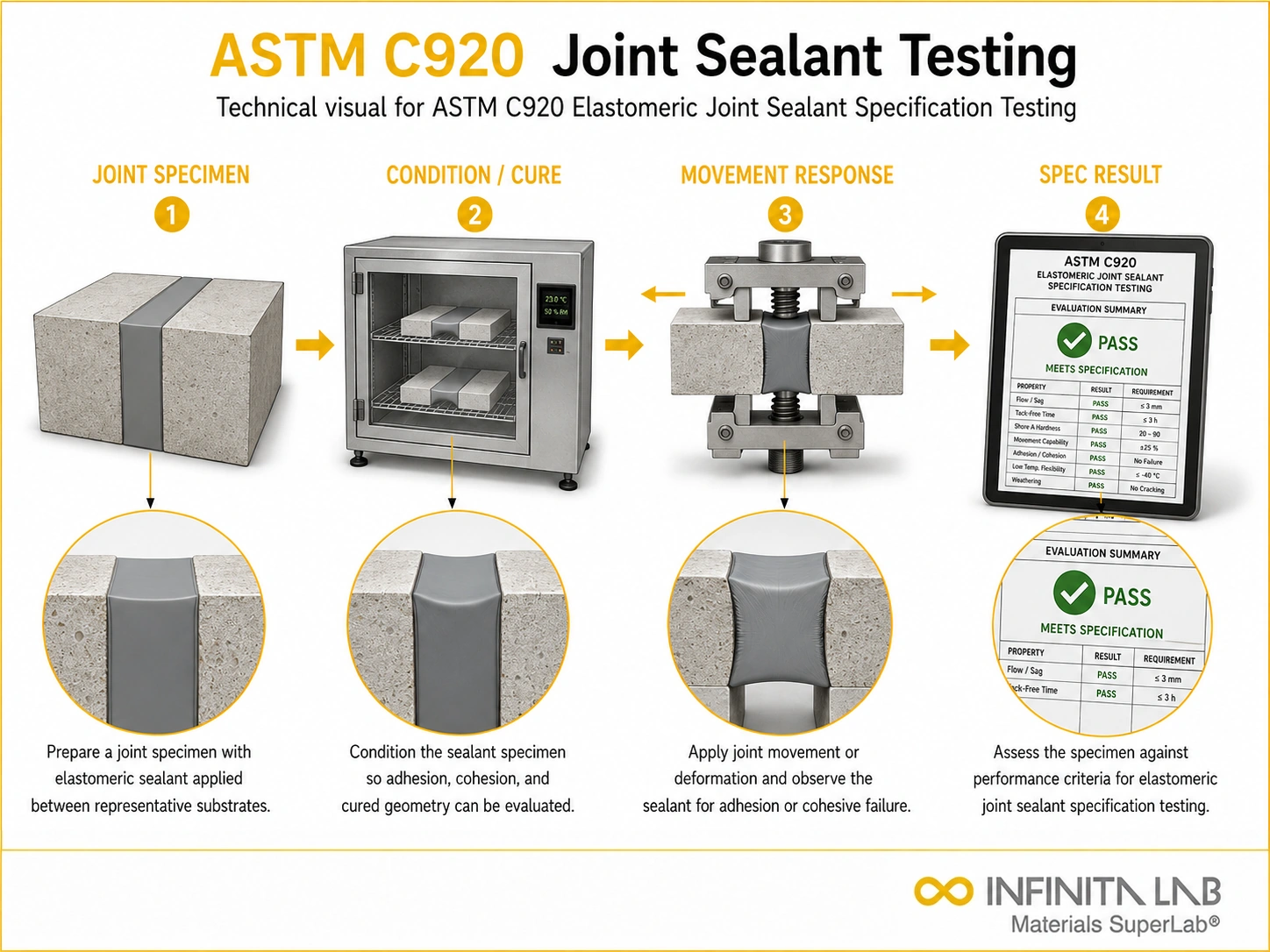
Our ASTM C920 Testing Procedure
Sample Preparation
Sealant specimens are prepared and conditioned according to specified dimensions and curing conditions.
1Application and Curing
Sealant is applied to substrates and allowed to cure under controlled environmental conditions.
2Performance Testing
Samples are subjected to adhesion, cohesion, and movement capability tests as per standard requirements.
3Evaluation and Classification
Results are analyzed to classify sealant based on movement, durability, and performance characteristics.
4ASTM C920 Test Parameters and Requirements
| Parameter | Details |
|---|---|
| Material Type | Elastomeric sealants (silicone, polyurethane, etc.) |
| Classification | Type, Grade, Class, and Use |
| Movement Capability | Typically ±12.5% to ±50% |
| Application Mode | Single-component or multi-component |
| Adhesion Requirement | Strong bond to specified substrates |
| Durability | Resistance to weathering and aging |
| Test Conditions | Controlled laboratory environments |
| Cure Mechanism | Moisture cure or chemical cure |


- Tensile/extension-compression testing machine – applies controlled cyclic extension and compression to sealant joint specimens to evaluate movement capability
- Environmental/weathering chamber – exposes specimens to accelerated weathering conditions to assess long-term durability
- Durometer – measures the hardness (Shore A) of cured sealant specimens
- Substrate test panels and adhesion fixtures – provide standardised mortar, glass, aluminium, and other substrate surfaces for bonding and adhesion/cohesion evaluation
- Low-temperature test chamber – conditions specimens to assess flexibility and performance at reduced temperatures
- Heat ageing oven – subjects specimens to elevated temperature exposure to evaluate weight loss, shrinkage, and cracking resistance
- Analytical balance – measures specimen weight before and after aging to quantify weight loss
Equipment and Instrumentation Used for ASTM C920 Testing
What You Receive: Test Report, Data, and Certification
- Determination of Type, Grade, Class, and Use classification for the tested sealant
- Measured movement (extension-compression) capability results against the claimed Class rating
- Adhesion and cohesion performance data following cyclic movement testing
- Tensile properties, hardness, staining, weight loss/shrinkage, and low-temperature flexibility results as applicable
- A detailed test report suitable for specification compliance submittals, technical data sheets, and quality assurance records
- Supporting documentation to assist with product listings and code compliance discussions
ASTM C920 Elastomeric Joint Sealant FAQs
ASTM C920-18 specifies performance requirements and classification for elastomeric joint sealants used in construction. It ensures sealants provide durability, flexibility, and resistance to environmental conditions, helping maintain effective sealing in joints exposed to movement, weather, and mechanical stress over time.
One-component elastomeric sealant (Type S) and multicomponent elastomeric sealants (Type M), respectively, each of which has different grades for non-sag (Grade NS) and pourable (Grade P) applications.
These sealants are typically used to seal joints in building facades, window frames, highways, bridges, and industrial facilities against the intrusion of water, air, and other contaminants that may cause damage.
It means the capability of movement regarding the sealant's ability to stretch and compress with the joint without losing any sealing effectiveness. It is very important in applications where joints are subject to considerable movement.
Elastomeric joint sealants are flexible materials used to seal joints and gaps in structures. They can stretch and recover, allowing them to accommodate movement caused by temperature changes, structural shifts, or vibrations without losing sealing performance.
ASTM C920 is the Standard Specification for Elastomeric Joint Sealants. It covers cold-applied, cured elastomeric sealants used for sealing, caulking, and glazing in building applications. Silicone sealants can qualify under ASTM C920 when they meet the applicable classification and performance requirements.
ASTM C920 evaluates sealants through specified performance tests, including extrusion, hardness, adhesion and cohesion, movement capability, weathering, and other durability properties. The sealant is classified by type, grade, class, and intended use based on the applicable requirements.
Type S under ASTM C920 refers to a single-component sealant. It is supplied as a uniform, ready-to-use material that can be applied directly by hand, caulking gun, or hand tool without mixing multiple components.
Why Choose Infinita Lab for Elastomeric Joint Sealant Testing
When your Elastomeric Joint Sealant results have to hold up - for compliance, a customer audit, or an engineering decision - ASTM C920 accuracy and an unbiased third-party report matter more than price. Infinita Lab routes your ASTM C920 elastomeric joint sealant testing to ISO/IEC 17025-accredited U.S. partner labs with hands-on method experience, so you get defensible data, transparent reporting, and turnaround times built around your project deadline - not ours.

Need ASTM C920 Elastomeric Joint Sealant Testing You Can Rely On?
Send query us at hello@infinitalab.com or call us at (888) 878-3090 to learn more about our services and how we can support you.



Request a Quote
Submit your material details and receive testing procedures, pricing, and turnaround time within 24 hours.
 Quick Turnaround and Hasslefree process
 Confidentiality Guarantee
 Free, No-obligation Consultation
 100% Customer Satisfaction
