


ASTM D1653: Water Vapor Transmission Organic Coating Testing Services
Accredited ASTM D1653 water vapor transmission organic coating testing from Infinita Lab, performed to the exact standard requirements - accurate, reproducible results with full documentation for compliance, R&D, and quality control programs.
TRUSTED BY


Get ASTM D1653 compliant results - request your water vapor transmission organic coating testing quote
- Overview
- Scope, Applications, and Benefits
- Test Process
- Specifications
- Instrumentation
- Results and Deliverables
What Is ASTM D1653 Water Vapor Transmission Organic Coating?
ASTM D1653, Standard Test Methods for Water Vapour Transmission of Organic Coating Films, establishes standardised cup-method procedures for measuring how readily water vapour passes through free films of paint, varnish, lacquer, and other organic coatings. Water vapour transmission (WVT) is a core performance property for any coating expected to protect a substrate from moisture-related degradation, and D1653 gives formulators, manufacturers, and specifiers a repeatable way to quantify it.
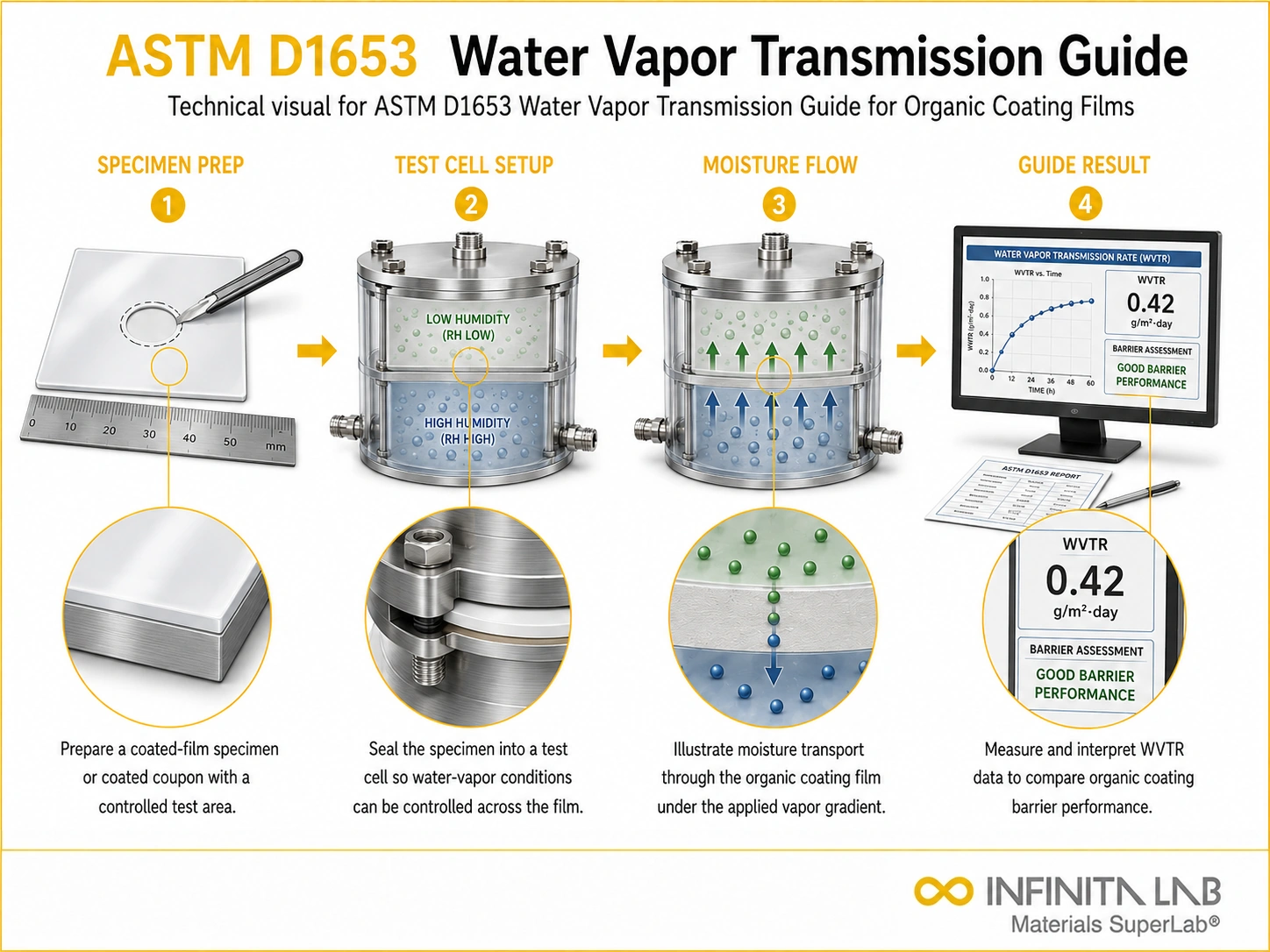
The standard’s cup method works by sealing a free film of the coating over the mouth of a test dish, creating a controlled vapour barrier between two distinct humidity environments. In the Dry Cup method (Method A), the dish contains a desiccant that keeps the air beneath the film dry, while the assembly sits in a chamber held at fixed temperature and relative humidity; moisture migrates inward through the film toward the desiccant. In the Wet Cup method (Method B), the dish instead holds water, and vapour migrates outward through the film into the drier surrounding air. In both cases, the sealed cup assembly is weighed at regular intervals, and the resulting weight change over time is used to calculate the water vapour transmission rate and permeance of the film.
The choice between dry cup and wet cup conditions reflects the service environment the coating will actually face: dry cup testing approximates conventional interior or dwelling conditions where high humidity gradients are not expected, while wet cup testing better represents high-humidity or wet-side exposure. Because coating permeability directly influences blistering, adhesion loss, and corrosion of the underlying substrate, D1653 data helps determine whether a coating will function as an effective moisture barrier or as a breathable film that allows trapped vapour to escape – a critical distinction for architectural, protective, and industrial coating systems.

Applications and Benefits of ASTM D1653 Water Vapor Transmission Organic Coating Testing
Scope
- ASTM D1653 measures the water vapour transmission rate (WVT) and water vapour permeance (WVP) of organic coating films.
- The standard includes two cup methods: Method A (Dry Cup), which uses a desiccant to create a low-humidity condition beneath the film, and Method B (Wet Cup), which uses water to create a high-humidity condition beneath the film.
- Testing is performed on free (unsupported) films that have been cast, cured, and conditioned to a controlled thickness before mounting in the test dish.
- Coatings are typically applied to a release surface and stripped after curing to produce the free film used in testing.
- The standard applies to paints, varnishes, lacquers, and other organic coating films regardless of their intended end-use substrate.
- Test specimens are sealed over permeability cups using wax or an equivalent moisture-impermeable sealant to prevent vapour leakage around the film edges.
- Testing is conducted under closely controlled temperature and relative humidity conditions, since results are only comparable when generated under identical environmental conditions and film thickness.
- The method serves coating manufacturers, applicators, and specifiers across architectural, industrial, marine, and protective coatings industries.
- Results support formulation development, quality control, and comparison of competing coating systems on a common permeability basis.
- D1653 data is used to evaluate whether a coating will function as a vapour barrier or as a moisture-permeable, breathable film.
Applications
- Protective coatings for steel, concrete, and other structures exposed to moisture and humidity cycling.
- Architectural paints and exterior coatings for wood, masonry, and stucco substrates.
- Vapour barrier coatings used in building envelopes, roofing systems, and below-grade waterproofing.
- Marine and industrial coatings applied to tanks, pipelines, and offshore structures.
- Wood finishes and sealers where controlled vapour permeability helps prevent trapped-moisture damage.
- Coil coatings and metal finishes requiring corrosion-resistant moisture barriers.
- Quality control and formulation comparison for coating manufacturers developing new resin systems.
Benefits
- Provides a standardised, repeatable measurement of coating permeability for direct comparison across products.
- Helps predict a coating’s contribution to blistering, adhesion failure, and substrate corrosion before field deployment.
- Supports selection of the correct method (dry cup vs. wet cup) to match actual service humidity conditions.
- Generates objective WVT and permeance data usable in technical data sheets and marketing claims.
- Reduces field failure risk by validating moisture-barrier or breathability performance during formulation development.
- Delivers accredited, third-party test data suitable for specification compliance and customer qualification.
Our ASTM D1653 Testing Procedure
Specimen Preparation
Coated specimen is prepared and sealed over a test cup containing desiccant or water.
1Conditioning
Assembly is placed in a controlled temperature and humidity environment.
2Measurement Cycle
Periodic weight changes are recorded due to vapor transmission.
3WVTR Calculation
Water vapor transmission rate is calculated based on weight change over time.
4ASTM D1653 Test Parameters and Requirements
| Parameter | Details |
|---|---|
| Material Type | Organic coating films on substrates |
| Measurement Parameter | WVTR (g/m²/day) |
| Environment | Controlled temperature and humidity |
| Test Assembly | Cup method with sealed specimen |
| Duration | Multiple hours to days depending on permeability |
| Output | Moisture transmission rate |
| Substrate Type | Metal or rigid backing materials |


- Permeability test cups/dishes – hold the desiccant (dry cup) or water (wet cup) beneath the mounted free film.
- Analytical balance – provides precise, repeatable periodic weight measurements of the sealed cup assembly.
- Environmental/humidity-controlled chamber – maintains constant temperature and relative humidity throughout the exposure period.
- Film casting equipment – applies the coating at a controlled, uniform wet-film thickness for free film preparation.
- Release substrate – a surface such as glass or tin used to cast and later strip the free film.
- Thickness gauge – confirms the cured free film meets thickness requirements before testing.
- Sealing wax/adhesive – secures the film to the cup mouth and prevents vapour leakage around the edges.
Equipment and Instrumentation Used for ASTM D1653 Testing
What You Receive: Test Report, Data, and Certification
- Water vapour transmission rate (WVT) and water vapour permeance (WVP) values for each tested specimen.
- Method-specific results clearly identified as Dry Cup (Method A) or Wet Cup (Method B).
- Documented film thickness, test conditions, and weighing schedule used to generate the results.
- A formal, accredited test report suitable for specification compliance, customer submittal, or internal R&D records.
- Comparative data across multiple formulations or film thicknesses when requested.
- Technical consultation on result interpretation and coating selection for target service environments.
ASTM D1653 Water Vapor Transmission Organic Coating FAQs
ASTM D1653 determines the amount of water vapor that passes through an organic coating film under controlled temperature and humidity conditions. It helps evaluate a coating’s resistance to moisture penetration and its ability to protect substrates from corrosion or degradation.
The WVT represents the amount of water vapor that passes through a coating film over time. A low WVT value indicates a sound moisture barrier, while a high WVT suggests the coating allows more vapor to pass through, which may reduce long-term protection.
Wet Cup Method: The test cup contains water, and vapor moves from the inside (high humidity) to the outside (low humidity). Dry Cup Method: The cup contains a desiccant, and vapor moves from the outside (high humidity) into the cup (low humidity). These methods simulate real-world exposure to both humid and dry environments.
The standard conditions are 23°C ± 2°C and 50% ± 5% relative humidity. The test continues until steady-state vapor transmission is achieved, ensuring the collection of reliable and reproducible data.
Water vapor transmission determines how effectively a coating prevents moisture ingress. High permeability can lead to corrosion, blistering, or degradation, while low transmission indicates strong protective performance in humid environments.
ASTM D1653 measures the water vapor transmission (WVT) rate through organic coating films using either the Dry Cup Method (A) or Wet Cup Method (B). The coating is sealed over a cup, and the change in moisture passing through the film is measured under controlled temperature and humidity conditions.
A coating specimen is mounted over a test cup containing either a dry or wet condition, depending on the method. Water vapor passes through the coating, and the change in cup mass over time is used to determine the water vapor transmission rate and, when applicable, water vapor permeance.
Electronic coatings can be compared by measuring dielectric properties such as dielectric strength, insulation resistance, dielectric constant, and dissipation factor, together with moisture resistance or water vapor transmission. For ASTM D1653 comparisons, coatings should be tested at the same thickness and under closely controlled temperature and relative humidity conditions.
Why Choose Infinita Lab for Water Vapor Transmission Organic Coating Testing
When your Water Vapor Transmission Organic Coating results have to hold up - for compliance, a customer audit, or an engineering decision - ASTM D1653 accuracy and an unbiased third-party report matter more than price. Infinita Lab routes your ASTM D1653 water vapor transmission organic coating testing to ISO/IEC 17025-accredited U.S. partner labs with hands-on method experience, so you get defensible data, transparent reporting, and turnaround times built around your project deadline - not ours.

Need ASTM D1653 Water Vapor Transmission Organic Coating Testing You Can Rely On?
Send query us at hello@infinitalab.com or call us at (888) 878-3090 to learn more about our services and how we can support you.



Request a Quote
Submit your material details and receive testing procedures, pricing, and turnaround time within 24 hours.
 Quick Turnaround and Hasslefree process
 Confidentiality Guarantee
 Free, No-obligation Consultation
 100% Customer Satisfaction
