


ASTM D7709: Pharmaceutical Bottle Water Vapor Transmission Testing Services
Accredited ASTM D7709 pharmaceutical bottle water vapor transmission testing from Infinita Lab, performed to the exact standard requirements - accurate, reproducible results with full documentation for compliance, R&D, and quality control programs.
TRUSTED BY


Get ASTM D7709 compliant results - request your pharmaceutical bottle water vapor transmission testing quote
- Overview
- Scope, Applications, and Benefits
- Test Process
- Specifications
- Instrumentation
- Results and Deliverables
What Is ASTM D7709 Pharmaceutical Bottle Water Vapor Transmission?
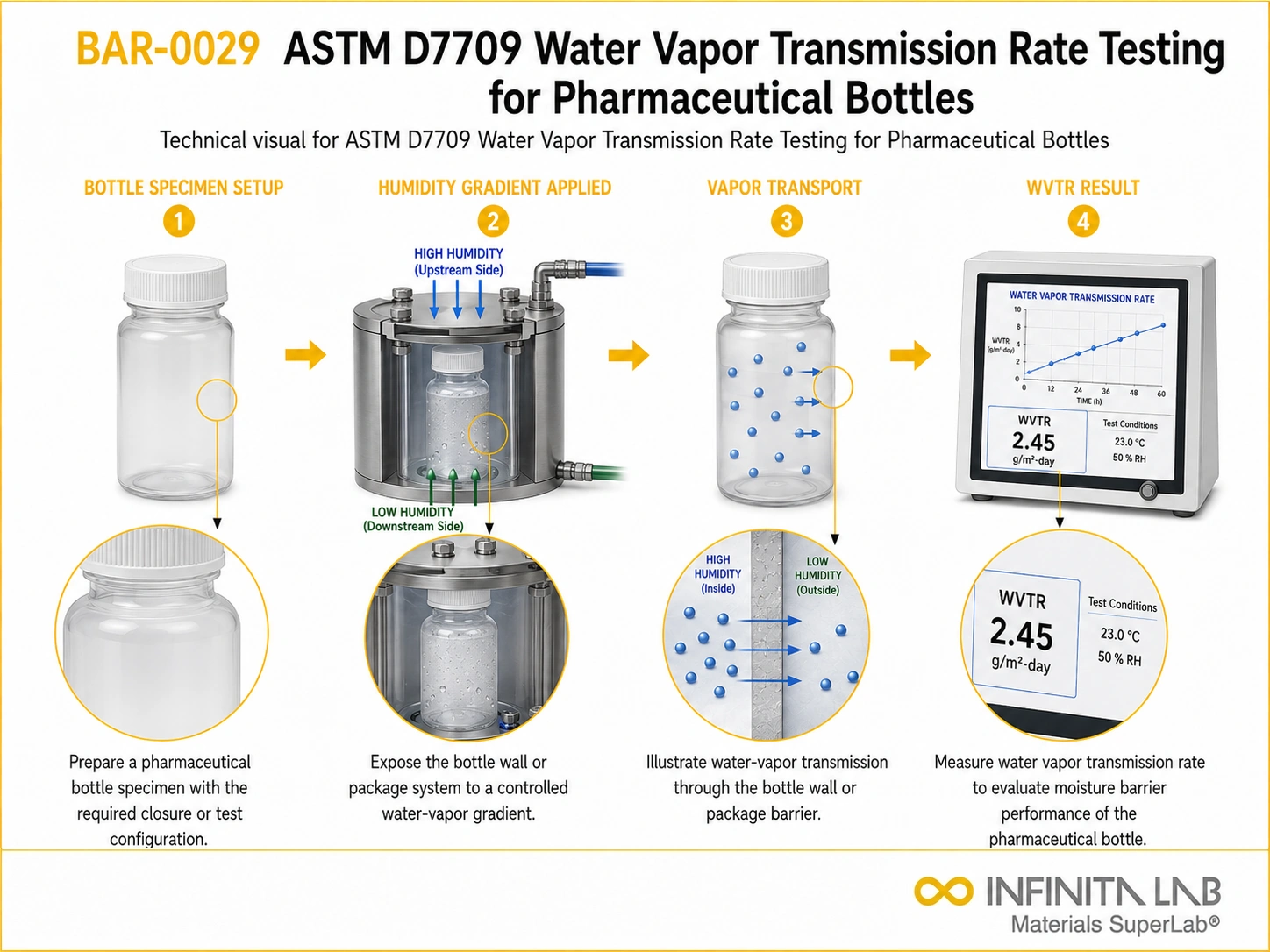
ASTM D7709, titled “Standard Test Methods for Measuring Water Vapor Transmission Rate (WVTR) of Pharmaceutical Bottles and Blisters,” is the ASTM International standard governing how moisture ingress into finished pharmaceutical packaging is measured under accelerated conditions. It’s not a flat-film method. Unlike ASTM E96 or ASTM F1249, which look at a sheet of packaging material on its own, D7709 evaluates the complete, closed, sealed container-closure system just as it would reach a patient: a bottle with its cap fitted, or a blister pack with its lidding sealed in place. The standard sets out three related gravimetric test methods: Method A governs high-barrier, multiple-unit containers, principally rigid bottles; Method B addresses formed, high-barrier single-unit blister packages; and Method C covers formed quasi-barrier single-unit blisters, with both B and C adaptable to flexible pouch constructions. In each method, a measured quantity of desiccant gets sealed inside the test article. That specimen then sits in a controlled environment held at conditions typical of accelerated pharmaceutical stability testing, usually around 40°C and 75% relative humidity. Periodic weighing tracks the mass the package gains as ambient water vapor diffuses through the container wall, the closure interface, and any seams or seals, before being absorbed by the desiccant inside. The resulting WVTR gets reported in mass-based units suited to the container type: milligrams per bottle per day for Method A, milligrams per blister cavity per day for Methods B and C. That gives formulators and packaging engineers a direct, whole-package measure of moisture ingress, something they can use to compare closure systems, liner materials, and container geometries.

Applications and Benefits of ASTM D7709 Pharmaceutical Bottle Water Vapor Transmission Testing
Scope
ASTM D7709 evaluates:
- Three gravimetric test methods make up ASTM D7709 – A, B, and C – each aimed at the water vapor transmission rate of finished pharmaceutical packaging systems.
- Method A targets high-barrier, multiple-unit containers, mainly rigid pharmaceutical bottles tested with their closures fitted.
- With Method B, transmission is measured per cavity on formed, high-barrier single-unit blister packages.
- Method C steps down a tier, covering formed quasi-barrier single-unit blisters, a lower-barrier construction common in cost-sensitive unit-dose packaging.
- Both B and C can also be adapted for flexible pouches, not just thermoformed blister cavities.
- Complete, closed, sealed container-closure systems get tested here, not flat sheets of packaging material in isolation.
- Conditioning happens in environments built to mirror accelerated pharmaceutical stability protocols, commonly cited near 40°C and 75% relative humidity.
- An internal desiccant absorbs moisture diffusing through the package wall, closure, or seal, and that weight gain is tracked gravimetrically over time.
- Results come out as the mass of water vapor transmitted per container or per cavity per day, so closure and container designs can be compared directly.
- These methods build on principles from ASTM E96/E96M, adapted specifically for whole pharmaceutical packages rather than isolated material coupons.
Applications
- Qualifying rigid HDPE, PP, and other plastic bottles meant for moisture-sensitive oral solid dosage forms.
- Evaluating induction-sealed, child-resistant, and desiccant-integrated closures used on bottled tablets and capsules.
- Comparing barrier performance across thermoformed PVC, PVDC-coated, and cold-form aluminum blister builds.
- Container-closure selection during formulation and packaging development leans on this data too, especially for hygroscopic or moisture-labile activities.
- Generating WVTR data that justifies shelf-life and expiry claims in stability program submissions.
- Benchmarking a new supplier’s bottles or blisters against the incumbent system during qualification or a cost-reduction push.
- When a packaged product shows unexpected moisture-related stability failures, this testing backs the root-cause investigation.
Benefits
- It measures the real, assembled container-closure system instead of an isolated film sample, closer to actual in-use moisture exposure.
- Data comes out ready to drop into regulatory stability and packaging qualification submissions.
- Differentiates barrier performance among competing bottle, cap, liner, and blister options, with real sensitivity.
- One standardized framework covers bottles, barrier blisters, and quasi-barrier blisters alike, so cross-comparison stays consistent.
- Built on well-established gravimetric principles, so results stay traceable and reproducible across labs.
- Packaging engineers get evidence-based decisions on closures, liners, and container geometry before commercial tooling gets locked in.
Our ASTM D7709 Testing Procedure
Standard & Test Setup
Testing is performed in accordance with ASTM D7709 using a gravimetric method.
1Conditioning
Samples are conditioned at 40 ± 2°C and 75 ± 5% RH.
2Measurement
The desiccant's weight gain indicates moisture transmission.
3Data Reporting
WVTR results are calculated and reported in g/day or g/m²/day.
4ASTM D7709 Test Parameters and Requirements
| Parameter | Details |
|---|---|
| Applicable Materials | Pharmaceutical bottles and closures |
| Conditioning Temperature | 40 ± 2°C |
| Relative Humidity | 75 ± 5% RH |
| Measurement Method | Weight gain of desiccant |
| Output Units | g/day or g/m²/day |


- Environmental/Stability Chambers – hold the temperature and relative humidity steady for however long conditioning runs.
- Analytical Balances: deliver the high-precision, repeatable mass readings needed to catch small weight gains.
- Pharmaceutical-Grade Desiccant – absorbs the water vapor that’s permeated into the sealed container; it’s the actual sensing medium for the whole gravimetric test.
- Heat-Sealing/Induction-Sealing Equipment: closes bottles and blisters to airtight, commercially representative specimen conditions.
- Calibrated Thermohygrometers – check and log the real temperature and humidity inside the chamber as the test runs.
- Specimen Racks/Holders: keep bottles and blister units oriented consistently through conditioning and each weighing.
- Data Logging Software – captures weight and environmental readings at every interval, feeding the rate calculation and final report.
Equipment and Instrumentation Used for ASTM D7709 Testing
What You Receive: Test Report, Data, and Certification
- A calculated water vapor transmission rate for each tested container, in mg/bottle-day or mg/cavity-day, as applicable.
- Raw weight-gain data at every measurement interval, so results stay traceable and open to independent recalculation.
- Across test replicates, a summary comparison shows how precise and repeatable the results are.
- A detailed test report covering specimen description, conditioning parameters, method used, and the calculated WVTR values.
- Documentation built to slot straight into stability study packages and packaging qualification files.
- Observations on relative barrier performance when several container-closure options are evaluated side by side.
ASTM D7709 Pharmaceutical Bottle Water Vapor Transmission FAQs
ASTM D7709 measures the Water Vapor Transmission Rate (WVTR) of pharmaceutical packaging by determining the rate at which water vapor enters a sealed package. For bottles, results are typically reported in mg/bottle-day.
The standard covers high-barrier pharmaceutical bottles, high-barrier blisters, and quasi-barrier blisters. Method A applies to bottles, while Methods B and C apply to barrier and quasi-barrier blisters, respectively.
The package is tested closed and sealed and exposed to a controlled environment, typically 40°C and 75% relative humidity. Water vapor entering the package is absorbed by a desiccant, and the resulting weight gain is measured over time to calculate WVTR.
WVTR testing helps determine how effectively a container-closure system protects moisture-sensitive pharmaceutical products. It can be used to compare alternative packaging systems and evaluate their moisture-barrier performance.
Testing provides a quantitative WVTR value representing moisture ingress through the complete container-closure system. For bottles, the result is expressed in milligrams per bottle per day, allowing different packaging designs or materials to be compared.
Why Choose Infinita Lab for Pharmaceutical Bottle Water Vapor Transmission Testing
When your Pharmaceutical Bottle Water Vapor Transmission results have to hold up - for compliance, a customer audit, or an engineering decision - ASTM D7709 accuracy and an unbiased third-party report matter more than price. Infinita Lab routes your ASTM D7709 pharmaceutical bottle water vapor transmission testing to ISO/IEC 17025-accredited U.S. partner labs with hands-on method experience, so you get defensible data, transparent reporting, and turnaround times built around your project deadline - not ours.

Need ASTM D7709 Pharmaceutical Bottle Water Vapor Transmission Testing You Can Rely On?
Send query us at hello@infinitalab.com or call us at (888) 878-3090 to learn more about our services and how we can support you.



Request a Quote
Submit your material details and receive testing procedures, pricing, and turnaround time within 24 hours.
 Quick Turnaround and Hasslefree process
 Confidentiality Guarantee
 Free, No-obligation Consultation
 100% Customer Satisfaction
