


Raman Spectroscopy for Water Pollution Monitoring
Raman spectroscopy is a versatile vibrational spectroscopic technique, used to identify and quantify molecular species, based on Raman Scattering. A promising application of Raman spectroscopy is for on-line monitoring of water pollution, including detecting complex dissolved contaminants. This case study illustrates the potential of Raman spectrometry for on-line analysis of water pollution, caused by dissolved pharmaceutical drugs, pesticides or salts coming from fertilisers.
TRUSTED BY


Raman Spectroscopy for Water Pollution Monitoring
- Overview
- Scope, Applications, and Benefits
- Test Process
- Specifications
- Instrumentation
- Results and Deliverables
Raman Spectroscopy for Water Pollution Monitoring Overview
Raman spectroscopy detects molecular species by measuring inelastic light scattering – a phenomenon where incident photons interact with molecular vibrations and are re-emitted at a shifted frequency. The frequency shift is unique to each chemical bond, which makes Raman a highly selective tool for identifying dissolved contaminants in water without requiring the sample to be separated, dried, or otherwise processed beforehand.
In water pollution monitoring, this translates to the ability to detect pharmaceutical residues, pesticides, and inorganic salts at trace concentrations in real time. The technique works in aqueous matrices where many other spectroscopic methods struggle, since water produces relatively weak Raman scattering and does not mask the signals from the target compounds.
Raman is increasingly used for online and continuous monitoring applications at water treatment facilities, industrial discharge points, and environmental sampling stations. The non-destructive nature of the measurement means the same sample can be retained for further testing, and the absence of sample preparation reduces both turnaround time and the risk of contamination during handling.

Raman Spectroscopy for Water Pollution Monitoring Scope, Applications, and Benefits
Scope
Raman spectroscopy for water pollution monitoring is used on aqueous samples to identify and quantify dissolved contaminants. The technique is suited for online, at-line, and laboratory-based analysis. Key evaluation areas include:
- Detection of dissolved pharmaceuticals and personal care products
- Identification of pesticides and herbicides in surface and groundwater
- Monitoring of inorganic salt contamination from agricultural runoff
- Detection of industrial chemicals and solvents in discharge streams
- Quantification of organic pollutants at trace and ultra-trace levels
- Real-time monitoring of water quality at process and environmental points
Applications
- Municipal water treatment and distribution monitoring
- Industrial wastewater discharge analysis
- Agricultural runoff and irrigation water quality assessment
- Pharmaceutical manufacturing effluent testing
- Environmental compliance monitoring at discharge points
- Research and development for contaminant detection methods
Benefits
- Non-destructive – sample integrity preserved for follow-up testing
- Minimal or no sample preparation required
- Capable of online and continuous monitoring configurations
- Selective identification of specific molecular species in complex matrices
- Detects multiple contaminants simultaneously in a single measurement
- Compatible with aqueous samples without interference from the water background
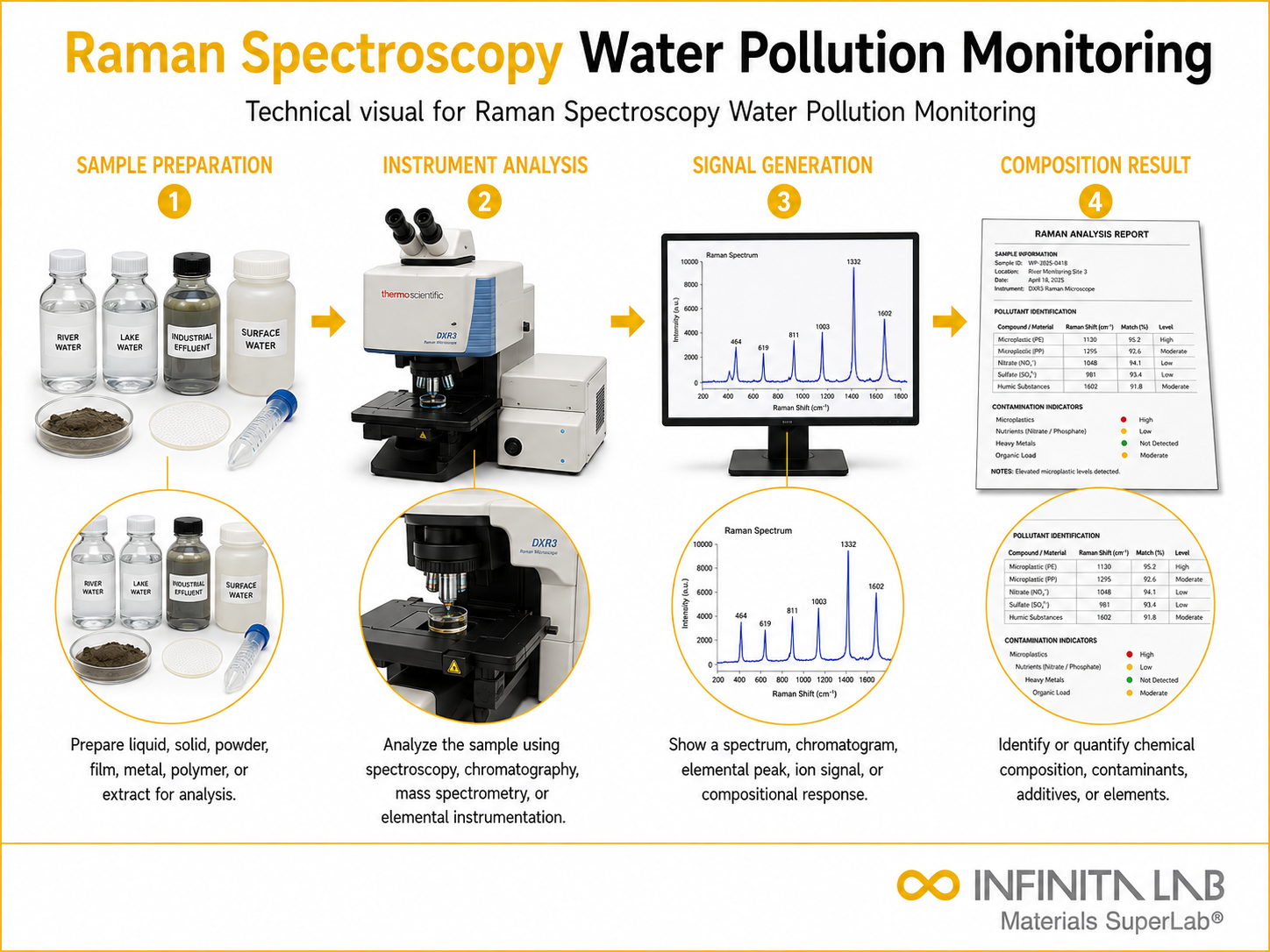
Raman Spectroscopy for Water Pollution Monitoring Process
Sample Collection and Handling
Water samples are collected and prepared according to the target contaminant and concentration range.
1Spectral Acquisition
Laser excitation is directed at the sample, and a spectrometer collects the scattered light.
2Spectral Analysis and Identification
Raman spectra are compared against reference libraries to identify molecular species present in the sample.
3Quantification and Reporting
Peak intensities are correlated to concentration using calibration standards.
4Raman Spectroscopy for Water Pollution Monitoring Technical Specifications
| Parameter | Details |
|---|---|
| Technique | Raman spectroscopy (vibrational spectroscopy) |
| Excitation Source | Laser (wavelength selected based on application) |
| Detection Principle | Inelastic scattering of monochromatic light |
| Sample Type | Aqueous solutions, surface water, wastewater, process water |
| Target Analytes | Pharmaceuticals, pesticides, fertilizer salts, and industrial chemicals |
| Analysis Mode | Laboratory, at-line, or on-line continuous monitoring |


Instrumentation Used for Raman Spectroscopy for Water Pollution Monitoring
- Raman spectrometer with a CCD detector
- Laser excitation source (typically 532 nm, 785 nm, or 1064 nm)
- Fiber optic probes for at-line and on-line configurations
- Flow cell accessories for continuous monitoring
- Reference spectral library and chemometric software
- Sample filtration equipment for turbid matrices
Raman Spectroscopy for Water Pollution Monitoring Results and Deliverables
- Raman spectral data for submitted samples
- Contaminant identification with molecular assignment
- Quantitative concentration data for target analytes
- Comparison against reference standards or regulatory limits
- Monitoring trend data for online configurations
- Quality assurance documentation
Frequently Asked Questions
Raman spectroscopy can identify a wide range of contaminants, including organic compounds, industrial chemicals, hydrocarbons, microplastics, and certain dissolved pollutants based on their unique molecular fingerprints.
Yes. One of the key advantages of Raman spectroscopy is that it often requires minimal sample preparation, allowing for rapid and non-destructive analysis of water samples.
Different substances produce distinct Raman spectra due to their molecular structures. These spectral signatures enable analysts to identify and differentiate multiple contaminants within a sample.
Raman spectroscopy can detect low concentrations of contaminants, particularly when enhanced techniques such as Surface-Enhanced Raman Spectroscopy (SERS) are used to improve sensitivity.
Why Choose Infinita Lab for Advanced Materials Testing and Characterization?
At the core of this breadth is our network of 2,000+ accredited laboratories across the USA, offering access to over 10,000 testing methods and analytical services. From advanced materials characterization (SEM, TEM, RBS, XPS) to mechanical, chemical, environmental, biological, and standardized ASTM/ISO-compliant testing, we deliver unmatched flexibility, specialization, and scale. You are never limited by geography, facility, or methodology — Infinita Lab connects you to the right expertise and testing solution, every time.

Looking for a Trusted Partner for Accurate and Reliable Testing Services?
Send query us at hello@infinitalab.com or call us at (888) 878-3090 to learn more about our services and how we can support you.



Request a Quote
Submit your material details and receive testing procedures, pricing, and turnaround time within 24 hours.
 Quick Turnaround and Hasslefree process
 Confidentiality Guarantee
 Free, No-obligation Consultation
 100% Customer Satisfaction
