

What Is Raman Spectroscopy?
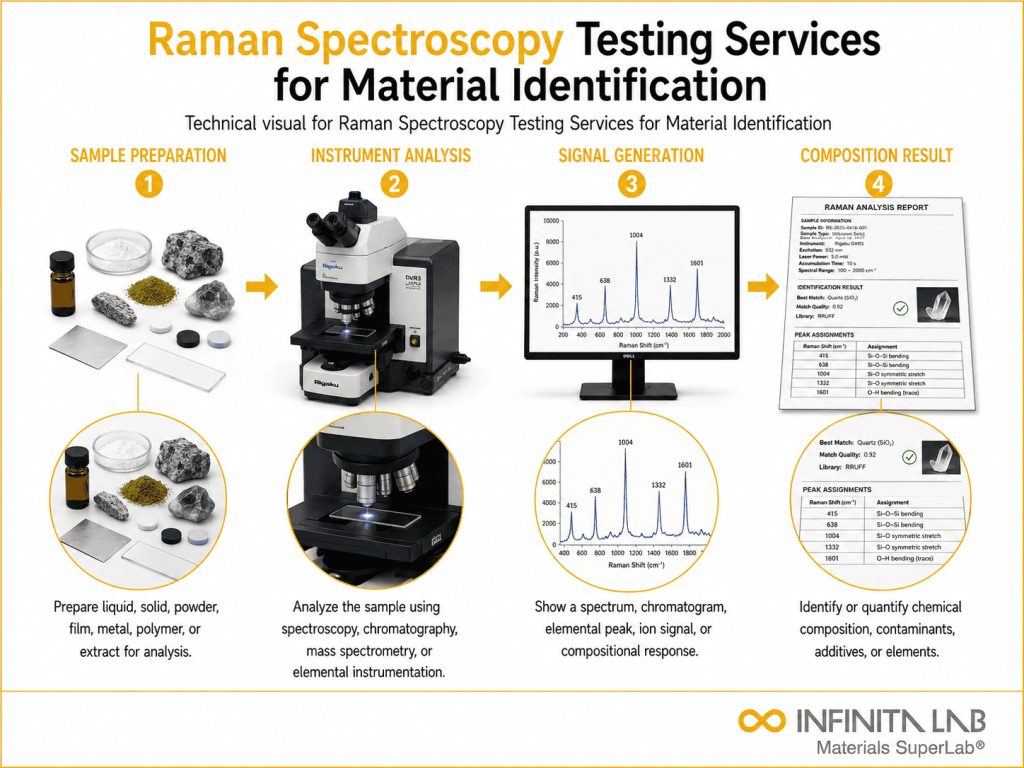
Raman Spectrometry is a spectroscopic analysis technique used to determine the molecular structure and chemical content of matter through the analysis of laser light scattering. A monochromatic laser beam passing through matter will scatter some light at different wavelengths, creating a Raman spectrum that is specific to the material.
Raman Spectrometry is used for analyzing and identifying chemical compounds, molecular structures, and material phases without damaging the material. Raman spectroscopy is used in several fields, such as polymers, pharmaceuticals, semiconductors, nanomaterials, and biomedical research.
Applications and Benefits of Raman Spectroscopy Testing
Scope
Raman spectrometry is used to determine the molecular structure, chemical composition, and phase identification of materials using laser-based spectroscopic analysis. The method enables rapid, non-destructive chemical characterization of solids, liquids, and powders.
The scope includes:
Molecular structure and compound identification
Chemical composition analysis
Phase and crystallinity determination
Detection of contaminants or impurities
Characterization of polymers, chemicals, and nanomaterials
Applications
Polymer and plastic material identification
Pharmaceutical compound verification
Semiconductor material analysis
Nanomaterials and carbon materials research
Chemical and forensic analysis
Benefits
Non-destructive testing method
Minimal or no sample preparation required
Provides molecular fingerprint of materials
Capable of analyzing solids, liquids, and powders
Rapid and highly accurate chemical identification
Our Testing Procedure
Sample Preparation
The sample is placed on a sample holder or microscope stage with minimal preparation required.
1Laser Excitation
A monochromatic laser beam is directed onto the sample surface to excite molecular vibrations.
2Raman Signal Collection
Scattered light from the sample is collected and separated from the incident laser light.
3Spectral Analysis
The Raman spectrum is analyzed to identify molecular bonds, chemical structures, and material composition.
4Test parameters and requirements
| Parameter | Details |
|---|---|
| Technique Type | Vibrational spectroscopy |
| Light Source | Monochromatic laser (commonly 532 nm, 633 nm, or 785 nm) |
| Spectral Range | Typically 100–4000 cm⁻¹ Raman shift |
| Resolution | ~1–2 cm⁻¹ spectral resolution |
| Sample Types | Solids, liquids, powders, thin films |
| Analysis Type | Non-destructive chemical identification |
| Output Data | Raman spectra and molecular fingerprint |


Raman Spectrometer
Laser Source
Optical Microscope (for micro-Raman analysis)
Spectrograph and Detector
Data Processing Software
Equipment and Instrumentation Used for Testing
What You Receive: Test Report, Data, and Certification
Raman spectral data report
Molecular structure identification
Chemical composition analysis
Phase and crystallinity evaluation
Detailed analytical report with spectral interpretation
Raman Spectroscopy FAQs
Raman spectrometry is an analytical technique that uses laser light scattering to study molecular vibrations and chemical bonds in materials. The resulting Raman spectrum provides a unique molecular fingerprint for identifying chemical compounds.
Raman spectroscopy can analyze solids, liquids, powders, polymers, pharmaceuticals, semiconductors, ceramics, and nanomaterials. It is particularly useful for identifying chemical structures and molecular compositions in complex materials.
Raman spectroscopy requires minimal sample preparation, provides rapid chemical identification, and can analyze a wide variety of materials. It also works well with aqueous samples where infrared spectroscopy may be limited.
Yes, Raman spectroscopy can detect impurities and contaminants present in materials by identifying additional peaks in the Raman spectrum that correspond to different chemical compounds.
Raman spectroscopy provides precise information about molecular structure and chemical composition. It helps researchers and industries identify materials, detect impurities, and understand structural properties of advanced materials.
Raman analysis identifies and characterizes materials by measuring how laser light scatters from a sample. A small portion of the scattered light changes energy through interactions with molecular vibrations, producing a Raman spectrum. The spectrum is compared with reference data to identify chemical compounds, characterize material structure, and detect impurities.
Raman spectroscopy companies provide analytical testing services to identify and characterize materials using laser-based spectroscopy. Specialists prepare or position samples, collect Raman spectra, and analyze characteristic peaks to determine chemical composition, molecular structure, or material phases. Testing services support applications in pharmaceuticals, polymers, chemicals, and advanced materials.
Spectroscopy methods analyze how matter interacts with electromagnetic radiation through absorption, emission, or scattering. Instruments measure the response at different wavelengths or energies to generate a spectrum. By interpreting characteristic spectral features, analysts can identify substances, determine chemical composition, and evaluate material properties. Common methods include Raman, infrared (IR), ultraviolet-visible (UV-Vis), and atomic absorption spectroscopy.
Why Choose Infinita Lab for Raman Spectroscopy Testing
When your Raman Spectroscopy results have to hold up - for compliance, a customer audit, or an engineering decision - accuracy and an unbiased third-party report matter more than price. Infinita Lab routes your raman spectroscopy testing to ISO/IEC 17025-accredited U.S. partner labs with hands-on method experience, so you get defensible data, transparent reporting, and turnaround times built around your project deadline - not ours.

Looking for an Accredited Partner for Raman Spectroscopy Testing?
Send query us at hello@infinitalab.com or call us at (888) 878-3090 to learn more about our services and how we can support you.



