


Pyrolysis Testing Guide – Methods, Applications & GC-MS Analysis
Pyrolysis is a technique used to study the composition of a material by applying heat to it in a non-oxidizing atmosphere. Using a CDS 5000 – Clarus 500 Gas Chromatograph System, it can be used to identify and quantify components, as well as provide information on structure and reactivity. This method is often used in industries such as rubber, food and agriculture, and forensics.
TRUSTED BY


Precision Testing Solutions for Accurate, Reliable, and Standards-Compliant Results
- Overview
- Scope, Applications, and Benefits
- Test Process
- Specifications
- Instrumentation
- Results and Deliverables
Pyrolysis–Gas Chromatography (Py-GC) – Overview
Pyrolysis–Gas Chromatography (Py-GC) is an advanced analytical technique used to identify and characterize complex polymeric materials by thermally decomposing them into smaller volatile compounds. These fragments are then separated and analyzed using gas chromatography for detailed compositional profiling.
The method is highly effective for studying synthetic polymers, additives, and unknown plastic materials. It provides precise molecular-level information, supporting material identification, contamination analysis, and failure investigation in polymer science and industrial quality control applications.

Scope, Applications, and Benefits
Scope
Pyrolysis–Gas Chromatography focuses on thermal decomposition and chromatographic separation of polymer-derived fragments to determine material composition and structural characteristics.
It enables qualitative and semi-quantitative analysis of complex organic materials that cannot be directly vaporized for conventional GC analysis.
- Identification of polymer types and blends
- Analysis of decomposition products
- Detection of additives and contaminants
- Characterization of unknown plastic materials
- Evaluation of material composition and structure
- Study of thermal degradation behavior
- Support for failure and forensic analysis
- Assessment of recycling and waste materials
Applications
- Polymer and plastic identification
- Forensic material analysis
- Failure investigation studies
- Packaging material evaluation
- Additive and contaminant detection
- Recycling and waste characterization
Benefits
- Enables analysis of non-volatile polymers
- Provides detailed molecular fingerprinting
- Supports accurate material identification
- Assists in failure root cause analysis
- Improves quality control in polymer industries
- Useful for unknown sample characterization
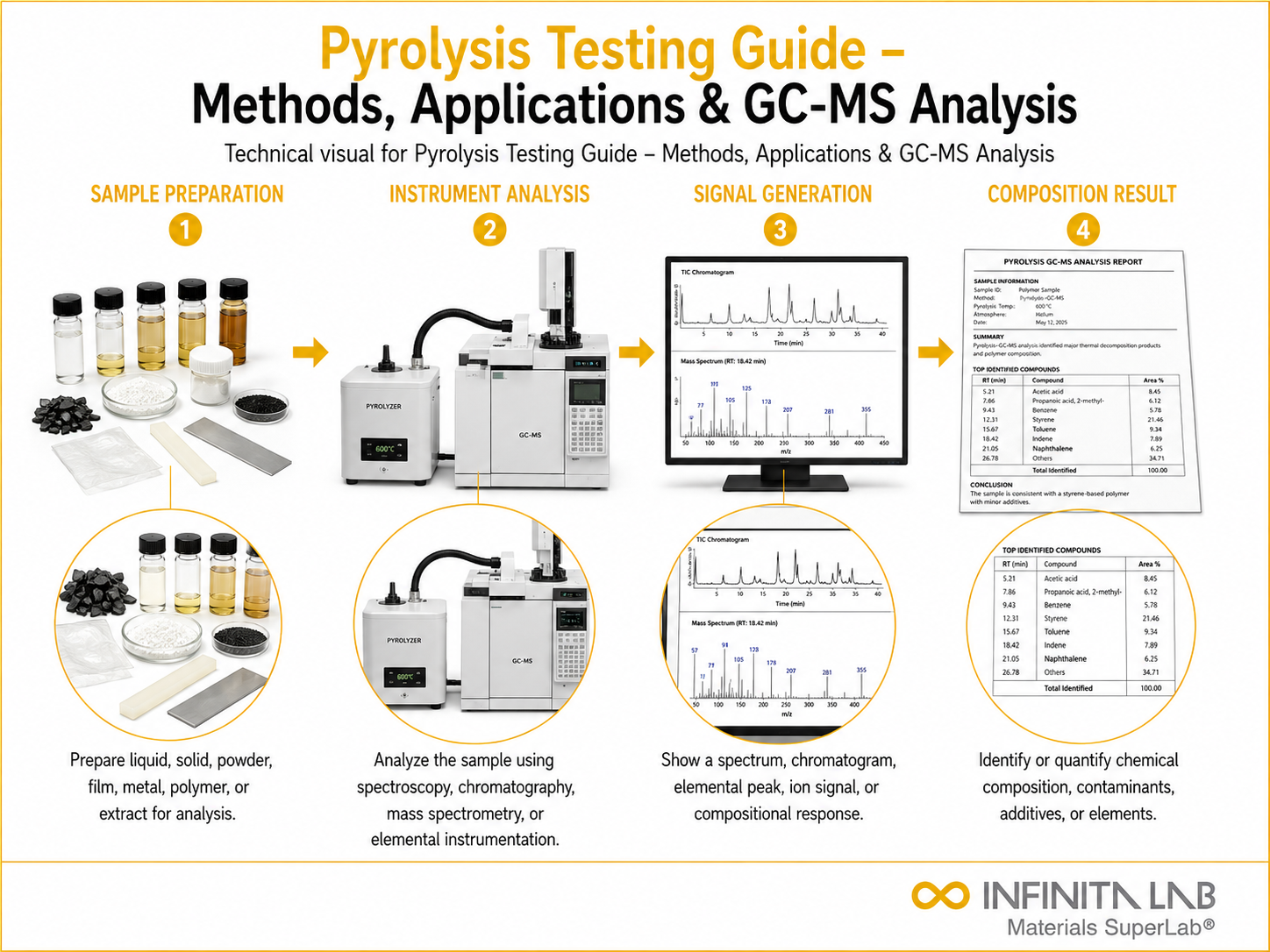
Pyrolysis–Gas Chromatography - Test Process
Sample Preparation & Micro-Sampling
A small representative sample is prepared and placed in the pyrolysis unit for controlled thermal decomposition.
1Pyrolysis & Thermal Decomposition
The sample is rapidly heated in an oxygen-free environment to break it into volatile fragments.
2Gas Chromatography Separation
Generated fragments are carried into the GC system where they are separated based on volatility and interaction.
3Detection & Data Interpretation
Separated compounds are detected and analyzed to identify polymer composition and degradation products.
4Pyrolysis–Gas Chromatography – Technical Specification
| Parameter | Details |
|---|---|
| Test Method | Thermal pyrolysis coupled with gas chromatography |
| Measurement Type | Volatile fragment and polymer composition analysis |
| Sample Type | Polymers, plastics, composites |
| Loading Type | Thermal decomposition under inert atmosphere |
| Units | Relative peak area %, retention time (min) |
| Test Conditions | Controlled high-temperature inert environment |


Instrumentation Used for Testing
- Pyrolyzer unit
- Gas chromatograph
- Flame ionization detector (FID) or mass spectrometer (MS)
- Inert gas supply system
- Data acquisition and analysis software
- Micro-sampling tools
Results and Deliverables
- Polymer identification profile
- Chromatographic fingerprint data
- Additive and contaminant detection report
- Thermal degradation analysis
- Material composition interpretation
- Detailed Py-GC analytical report
Frequently Asked Questions
Py-GC thermally decomposes high-molecular-weight polymers into smaller volatile fragments, which can then be separated and analyzed by gas chromatography, enabling detailed characterization of materials that cannot be directly vaporized.
An inert atmosphere prevents oxidation or combustion during thermal decomposition, ensuring that only thermal breakdown products are analyzed, leading to accurate representation of the polymer structure.
Each polymer produces a characteristic fragment pattern upon pyrolysis, creating a molecular fingerprint that can be matched with reference data to identify unknown plastic materials accurately.
Retention time helps identify compounds based on their interaction with the chromatographic column, enabling separation and classification of pyrolysis products.
Additives decompose into identifiable fragments during pyrolysis, allowing their detection and characterization within the chromatographic profile.
Why Choose Infinita Lab for Advanced Materials Testing and Characterization?
At the core of this breadth is our network of 2,000+ accredited laboratories across the USA, offering access to over 10,000 testing methods and analytical services. From advanced materials characterization (SEM, TEM, RBS, XPS) to mechanical, chemical, environmental, biological, and standardized ASTM/ISO-compliant testing, we deliver unmatched flexibility, specialization, and scale. You are never limited by geography, facility, or methodology — Infinita Lab connects you to the right expertise and testing solution, every time.

Looking for a Trusted Partner for Accurate and Reliable Testing Services?
Send query us at hello@infinitlab.com or call us at (888) 878-3090 to learn more about our services and how we can support you.



Request a Quote
Submit your material details and receive testing procedures, pricing, and turnaround time within 24 hours.
 Quick Turnaround and Hasslefree process
 Confidentiality Guarantee
 Free, No-obligation Consultation
 100% Customer Satisfaction
