


Nanoindentation Testing Services
Nanoindentation is a proven method for conducting mechanical indentation tests on very small samples (Nano-mechanical Testing). It uses a sharp indentation probe along with high precision instrumentation and analytical software for nano-scale measurements and computation of mechanical properties.
TRUSTED BY


Get compliant results — request your nanoindentation testing quote
- Overview
- Scope, Applications, and Benefits
- Test Process
- Specifications
- Instrumentation
- Results and Deliverables
What Is Nanoindentation?
Nanoindentation is an advanced materials testing technique used to determine the mechanical properties of materials at the micro- and nanoscale by applying a controlled force with a sharp indenter tip. It is widely used for thin films, coatings, and small-volume materials where conventional mechanical testing methods are not applicable.
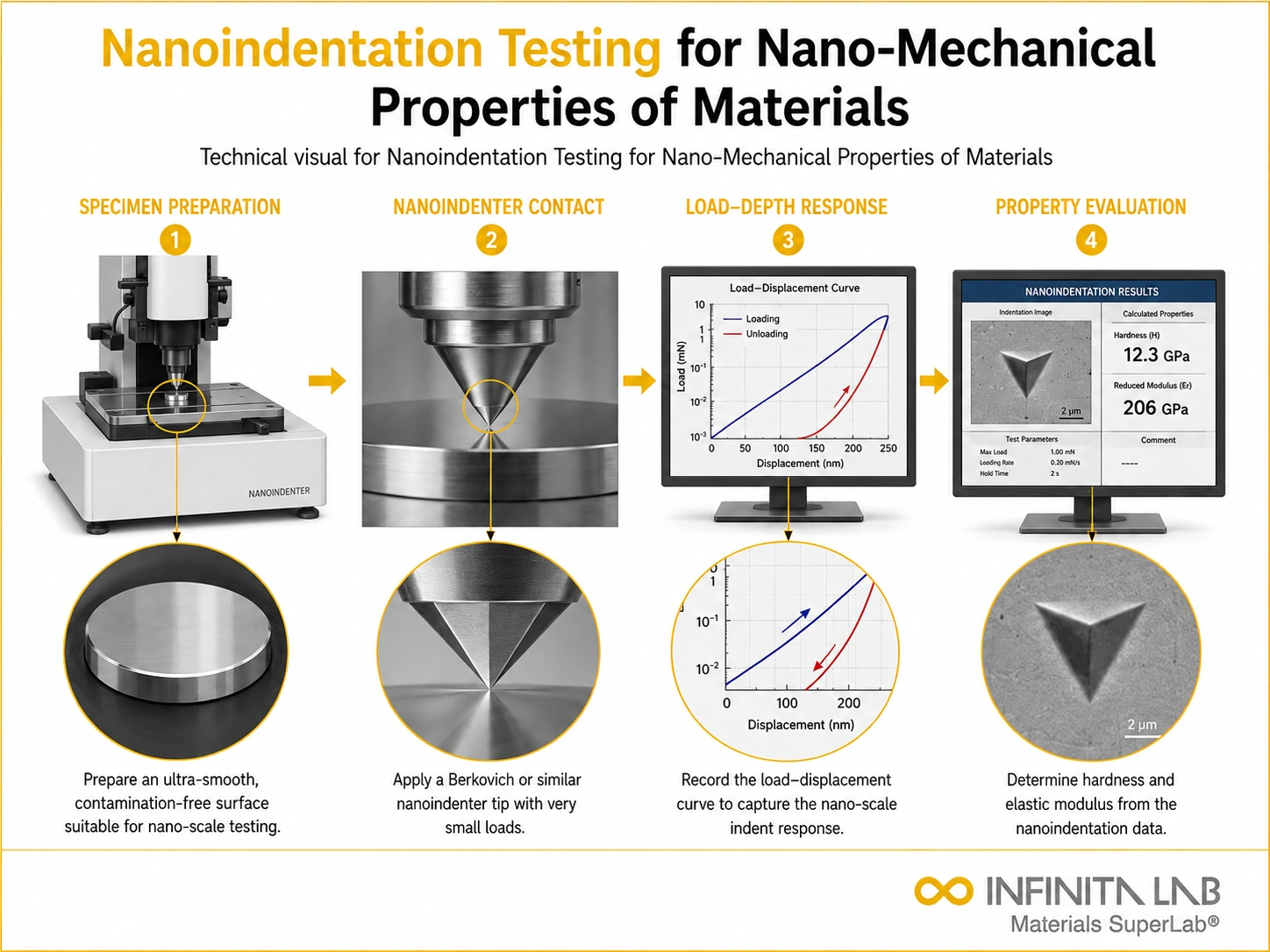
The test records load and displacement continuously as the indenter penetrates the surface, generating a load–depth curve. From this data, key properties such as hardness and elastic modulus are calculated with high precision, making nanoindentation a critical tool in materials science and nanotechnology.

Applications and Benefits of Nanoindentation Testing
Scope
Nanoindentation testing evaluates:
- Hardness at the nano-scale
- Elastic modulus (Young’s modulus)
- Load–displacement behavior
- Creep and time-dependent deformation
- Mechanical properties of thin films and coatings
Applications
- Thin films and coatings characterization
- Semiconductor and microelectronics materials
- Polymers and soft materials
- Metals, ceramics, and composites
- Nanotechnology and MEMS devices
Benefits
- Provides localized mechanical property measurement
- Suitable for very small volumes and thin layers
- High precision and repeatability
- Enables depth-dependent property analysis
- Supports advanced material development
Our Testing Procedure
Sample Preparation
Sample surface is prepared to be smooth and free from contamination.
1Indentation Loading
A controlled load (µN–mN range) is applied using a sharp indenter (e.g., Berkovich tip).
2Load–Displacement Recording
Penetration depth is continuously measured during loading and unloading cycles.
3Data Analysis
Hardness and elastic modulus are calculated from the load–depth curve.
4Test parameters and requirements
| Parameter | Details |
|---|---|
| Standard | ISO 14577, ASTM E2546 |
| Load Range | ~1 µN to several N |
| Indentation Depth | ≤0.2 µm (nano range) |
| Indenter Type | Berkovich, Vickers, spherical |
| Data Output | Load–depth (F–h) curve |
| Measured Outputs | Hardness, elastic modulus, creep |


- Nanoindenter system
- Diamond indenter tips (Berkovich, Vickers)
- High-resolution displacement sensors
- Load control system (µN range)
- Optical microscope (for positioning)
- Data acquisition and analysis software
Equipment and Instrumentation Used for Testing
What You Receive: Test Report, Data, and Certification
- Hardness (H) values
- Elastic modulus (E)
- Load–displacement curves
- Depth-dependent mechanical properties
- Creep and deformation behavior analysis
- Test report
Nanoindentation FAQs
Nanoindentation testing measures mechanical properties such as hardness and elastic modulus at very small scales by applying a controlled force and recording material response during indentation.
Common standards include ISO 14577 and ASTM E2546, which define procedures for instrumented indentation testing across nano, micro, and macro ranges.
Materials such as thin films, coatings, polymers, metals, ceramics, and nanostructured materials can be analyzed using nanoindentation techniques.
It is a graph showing the relationship between applied load and indentation depth, used to calculate hardness, modulus, and other mechanical properties.
It allows precise measurement of mechanical properties at small scales, which is essential for advanced materials, coatings, and microelectronic applications.
Why Choose Infinita Lab for Nanoindentation Testing
At the core of this breadth is our network of 2,000+ accredited laboratories across the USA, offering access to over 10,000 testing methods and analytical services. From advanced materials characterization (SEM, TEM, RBS, XPS) to mechanical, chemical, environmental, biological, and standardized ASTM/ISO-compliant testing, we deliver unmatched flexibility, specialization, and scale. You are never limited by geography, facility, or methodology — Infinita Lab connects you to the right expertise and testing solution, every time.

Looking for an Accredited Partner for Nanoindentation Testing?
Send query us at hello@infinitalab.com or call us at (888) 878-3090 to learn more about our services and how we can support you.



Request a Quote
Submit your material details and receive testing procedures, pricing, and turnaround time within 24 hours.
 Quick Turnaround and Hasslefree process
 Confidentiality Guarantee
 Free, No-obligation Consultation
 100% Customer Satisfaction
