


Mohs Hardness Testing Services
The Mohs scratch hardness test is a simple and widely used method to determine the relative hardness of different materials. It involves scratching a sample material with a set of reference minerals of known hardness and observing which mineral can scratch the material being tested.
TRUSTED BY


Get compliant results — request your mohs hardness testing quote
- Overview
- Scope, Applications, and Benefits
- Test Process
- Specifications
- Instrumentation
- Results and Deliverables
What Is Mohs Hardness?
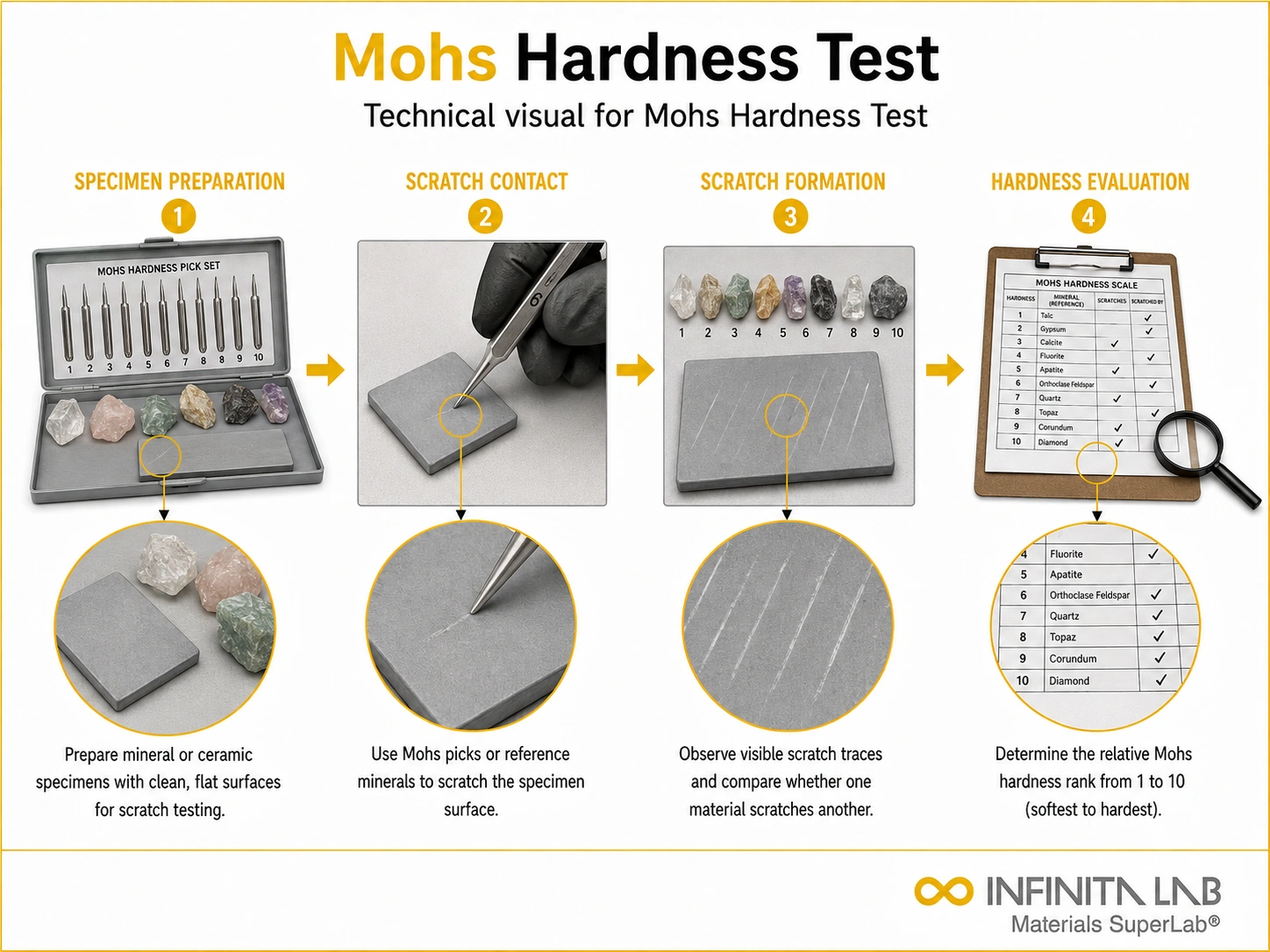
The Mohs hardness scale is a qualitative ordinal scale that characterizes the scratch resistance of a mineral or material by comparing it to ten reference minerals ranked from 1 (talc, the softest) to 10 (diamond, the hardest). The test is performed by attempting to scratch a specimen surface with each reference mineral or with tools of known Mohs hardness a fingernail (approximately 2.5), a copper coin (approximately 3.5), a steel file (approximately 6.5), and a hardened steel rod to bracket the material’s hardness between two reference points. The Mohs value assigned is between the hardest material that does not scratch the specimen and the softest that does.
Unlike quantitative hardness tests such as Brinell, Vickers, or Rockwell, which measure indentation depth or diameter under a defined load and can be converted between scales, Mohs hardness is not linear and does not directly convert to indentation hardness values. The intervals between Mohs values are not equal the difference in absolute hardness between 9 (corundum) and 10 (diamond) is far greater than between 1 and 2. Mohs hardness is therefore most useful as a rapid screening and classification tool rather than as a precision measurement for design calculations.
The test is widely used in mineralogy and geology for mineral identification, in ceramics and glass for surface hardness characterization, in abrasive materials evaluation, in gemology for stone identification and quality assessment, and in industrial applications where scratch resistance is a key surface property requirement. For more precise surface hardness characterization, Vickers or Knoop microhardness is used in combination with Mohs testing.

Applications and Benefits of Mohs Hardness Testing
Scope
Mohs hardness testing applies to minerals, ceramics, glasses, gemstones, hard coatings, and other materials where surface scratch resistance is a relevant property. The test determines a Mohs hardness value between 1 and 10 by systematic scratch comparison against the reference minerals (talc, gypsum, calcite, fluorite, apatite, orthoclase, quartz, topaz, corundum, diamond) or against standard tools of known approximate Mohs hardness. Testing is performed on polished or natural cleavage surfaces. The result is a qualitative hardness bracket rather than a precise single value. For materials with anisotropic hardness, the hardness may vary by crystallographic orientation. Related quantitative hardness methods include Vickers hardness (ASTM E92), Knoop microhardness (ASTM E384), and nanoindentation for thin films and coatings.
Applications
- Mineral and rock identification in geology, mining, and exploration
- Ceramic and technical ceramic hardness classification alumina, zirconia, silicon carbide, silicon nitride
- Glass hardness characterization for optical components, architectural glass, and display cover glass
- Gemstone identification and quality assessment in gemology and jewelry applications
- Abrasive material hardness evaluation for grinding media, lapping compounds, and abrasive papers
- Hard coating surface hardness screening DLC, TiN, CrN, and ceramic coatings on tools and components
- Raw material incoming inspection for refractories, abrasives, and ceramic raw materials
- Educational and reference use in mineralogy laboratories and materials characterization
Benefits
- Rapid, low-cost screening test requiring no specialized electronic instrumentation
- Applicable in the field as well as the laboratory portable reference minerals and tools
- Covers the full hardness range from talc to diamond in a single consistent scale
- Widely understood and referenced across mineralogy, ceramics, gemology, and materials science
- Useful for distinguishing material classes where precise indentation hardness is not required
- Complements quantitative methods used alongside Vickers or Knoop for complete hardness characterization
- No specimen preparation beyond a clean, flat surface required for most materials
Mohs Hardness Test Process
Surface Preparation and Specimen Inspection
The specimen surface is cleaned and examined.
1Scratch Testing with Reference Minerals or Tools
Starting from a reference mineral expected to be close to the specimen hardness, the reference mineral is drawn firmly across the specimen
2Hardness Bracketing
The testing progresses up and down the scale until the hardest reference mineral that does not scratch the specimen and the softest reference that does are identified.
3Reporting
The Mohs hardness value or range is recorded. Any observations about surface condition, directionality of scratch resistance
4Test parameters and requirements
| Parameter | Details |
|---|---|
| Method | Mohs scratch hardness qualitative ordinal scale |
| Scale Range | 1 (talc) to 10 (diamond) |
| Reference Materials | Talc, gypsum, calcite, fluorite, apatite, orthoclase, quartz, topaz, corundum, diamond |
| Auxiliary Tools | Fingernail (~2.5), copper coin (~3.5), steel file (~6.5), hardened steel rod (~7) |
| Applicable Materials | Minerals, ceramics, glass, gemstones, hard coatings, abrasives |
| Output | Mohs hardness value or range (e.g., 6 to 7) |


- Mohs hardness reference mineral set (talc through diamond)
- Auxiliary hardness tools fingernail, copper coin, steel file, hardened steel rod
- 10x to 30x magnifying glass or loupe for scratch observation
- Optical microscope for confirmation of scratch versus surface contamination displacement
- Cleaning materials for surface preparation and post-scratch observation
Equipment and Instrumentation Used for Testing
What You Receive: Test Report, Data, and Certification
- Mohs hardness value or bracket (e.g., harder than 6, softer than 7, therefore approximately 6 to 7)
- Reference mineral used at each hardness boundary
- Surface condition observations porosity, anisotropy, or friability noted
- Material identification and test surface description
- Recommendation for quantitative follow-on testing (Vickers, Knoop) where precision is required
- Test report suitable for mineral identification, material screening, or incoming quality records
Mohs Hardness FAQs
Mohs hardness testing evaluates a material’s resistance to scratching based on the ability of one material to scratch another. It is a comparative scale rather than an absolute measurement.
The Mohs scale of mineral hardness helps quickly classify materials for wear resistance, surface compatibility, and abrasion risk. It is often used as a screening tool before more advanced hardness testing.
Yes, but with limitations. It is more qualitative for metals and coatings, so it is usually supplemented with Vickers, Rockwell, or nanoindentation for precise engineering analysis.
Results can be influenced by surface roughness, tip geometry of the scratch tool, operator technique, and whether the material is homogeneous or coated. Thin coatings may also give misleading results if the substrate influences scratching.
Why Choose Infinita Lab for Mohs Hardness Testing
At the core of this breadth is our network of 2,000+ accredited laboratories across the USA, offering access to over 10,000 testing methods and analytical services. From advanced materials characterization (SEM, TEM, RBS, XPS) to mechanical, chemical, environmental, biological, and standardized ASTM/ISO-compliant testing, we deliver unmatched flexibility, specialization, and scale. You are never limited by geography, facility, or methodology — Infinita Lab connects you to the right expertise and testing solution, every time.

Looking for an Accredited Partner for Mohs Hardness Testing?
Send query us at hello@infinitalab.com or call us at (888) 878-3090 to learn more about our services and how we can support you.



Request a Quote
Submit your material details and receive testing procedures, pricing, and turnaround time within 24 hours.
 Quick Turnaround and Hasslefree process
 Confidentiality Guarantee
 Free, No-obligation Consultation
 100% Customer Satisfaction
