


Rockwell Hardness Value
Superficial Rockwell Value
Test Scale Identification
Applied Load Details
Indenter Type Used
Specimen Details and Thickness
Calibration Verification Record
Complete Test Report as per ASTM / ISO standard
ASTM E18: Rockwell Superficial Hardness Testing Services
Rockwell Hardness Testing measures a material's resistance to permanent indentation using a defined load-indenter sequence, with results read directly as a Rockwell hardness number — used for incoming inspection, heat treatment verification, and production QC of metallic and non-metallic materials per ASTM E18, ISO 6508, and ASTM D785.
TRUSTED BY


Get ASTM E18 compliant results — request your rockwell superficial hardness testing quote
- Overview
- Scope, Applications, and Benefits
- Test Process
- Specifications
- Instrumentation
- Results and Deliverables
What Is ASTM E18 Rockwell Superficial Hardness?
Rockwell hardness testing is an indentation-based method that determines a material’s resistance to permanent deformation by applying a standardised indenter — either a spheroconical diamond Brale indenter or a hardened steel ball — under a defined minor-then-major load sequence. Unlike Vickers or Brinell methods, the hardness number is derived directly from the residual depth of indentation after the major load is removed, requiring no optical measurement and delivering an immediate numerical result. This makes it the preferred method for production-floor QC, incoming material inspection, and heat treatment verification where speed and repeatability take priority.
Standard Rockwell scales use major loads of 60, 100, or 150 kgf and cover the full hardness range from soft non-ferrous alloys to hardened tool steels. Superficial Rockwell scales (HR15N, HR30N, HR45N and their T/W/X variants) use reduced loads of 15, 30, or 45 kgf and are specifically designed for thin materials, case-hardened surfaces, nitrided layers, and small components where a standard-depth indentation would penetrate the case or deform the substrate. The process is governed by ASTM E18 and ISO 6508 for metallic materials, and ASTM D785 and ISO 2039 for plastics and polymer-based components.
Infinita Lab provides Rockwell hardness testing across all major scales through its nationwide accredited laboratory network. Testing is performed per ASTM E18 and ISO 6508, with reporting that includes hardness values, scale selection rationale, and comparison against applicable specification limits. Specialised services include hardness traverses for heat treatment and weld assessment, case depth profiling, and integration with failure analysis programmes.
Applications and Benefits of ASTM E18 Rockwell Superficial Hardness Testing
Scope
The Rockwell and Superficial Rockwell hardness tests measure the resistance of metals and plastics to indentation under given loading conditions. The standards establish the forces used to perform the tests, the type of indenter used, the specimen to be tested, and the manner in which the results are presented.
Applicable to metals (ASTM E18 / ISO 6508).
Applicable to plastics (ASTM D785 / ISO 2039).
Covers regular and superficial Rockwell scales.
Defines indenter types and test forces.
Applications
- Heat treatment verification — Confirms hardness of through-hardened, case-hardened, nitrided, and carburised components against specification limits post-process.
- Incoming material inspection — Verifies hardness of steel bar, plate, forgings, and castings against mill certification values before machining or fabrication.
- Weld & HAZ hardness surveys — Hardness traverses across weld metal, fusion zone, and heat-affected zone to assess microstructural changes and hydrogen cracking susceptibility.
- Thin sections & surface layers — Superficial Rockwell scales for nitrided layers, thin case depths, coatings, and foil or sheet material where standard loads would bottom out.
- Plastics & polymer components — Rockwell R, L, and M scale hardness for rigid thermoplastics, thermosets, and composite polymer parts for incoming QC and material comparison.
- Aerospace & defence components — Hardness qualification of landing gear, turbine discs, fasteners, and structural alloys per OEM and MIL specifications requiring ASTM E18 or equivalent.
- Automotive & powertrain parts — Production-floor QC of gears, shafts, bearings, springs, and cam surfaces for hardness conformance and process control.
- Tool steels & cutting tools — HRC measurement of tool steel billets, inserts, and finished tooling — the dominant acceptance criterion for high-speed steels, carbide substrates, and die steels.
Benefits
Fast and direct hardness reading.
Minimal specimen preparation.
Suitable for production environments.
Wide range of hardness scales.
Standardized global acceptance.
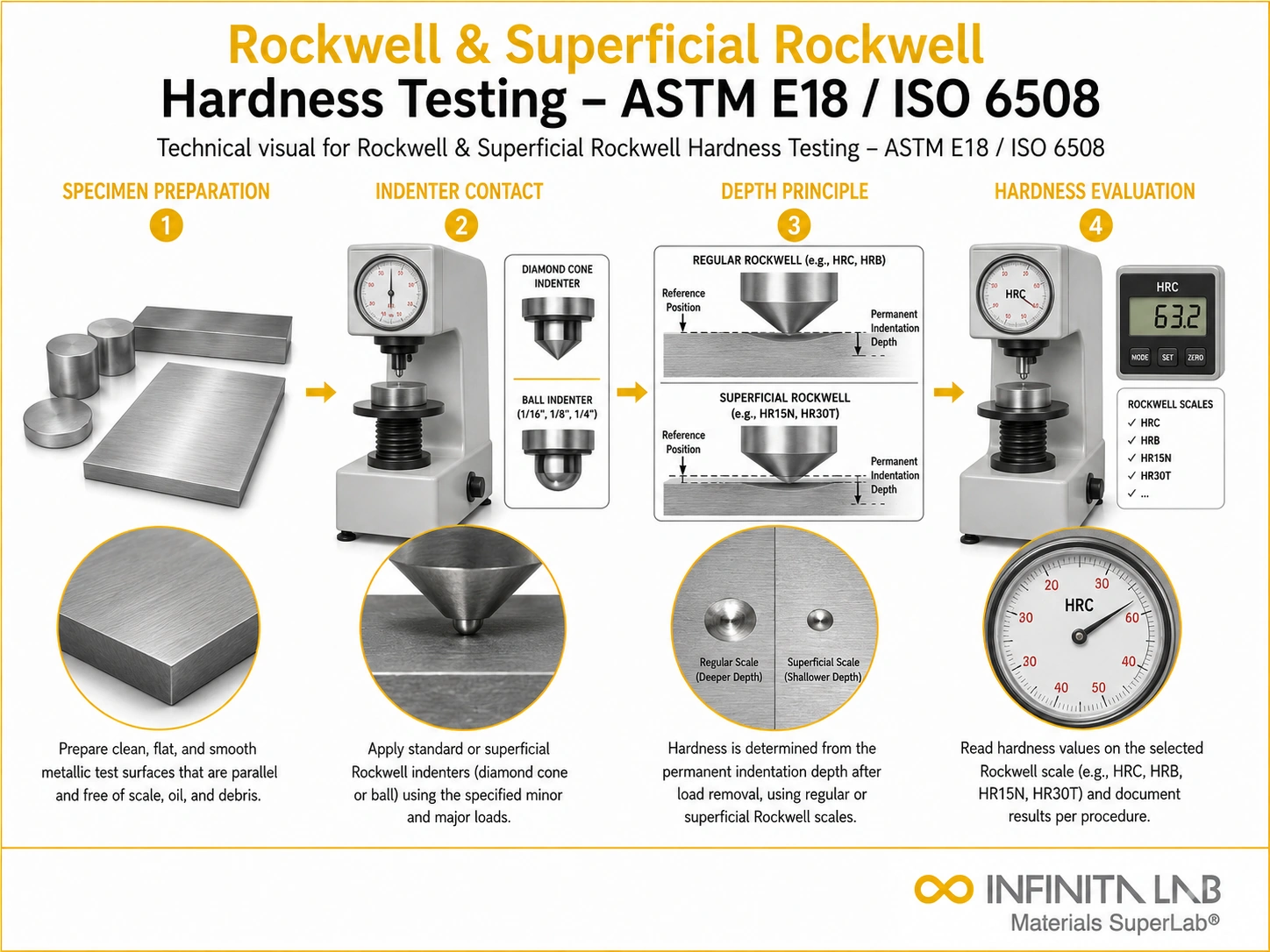
Our ASTM E18 Testing Procedure
Specimen Preparation
Ensure flat, clean surface with adequate thickness to prevent substrate influence.
1Minor Load Application
Apply minor load to seat the indenter and establish reference position.
2Major Load Application
Apply major load for specified dwell time, then remove it while maintaining minor load.
3Hardness Reading
Measure indentation depth difference and display hardness value directly.
4ASTM E18 Test Parameters and Requirements
| Parameter | Details |
|---|---|
| Indenter Types | Diamond cone (Brale) or hardened steel ball |
| Minor Load | Typically 10 kgf |
| Major Load | 60, 100, 150 kgf |
| Superficial Loads | 15, 30, 45 kgf |
| Dwell Time | Specified holding duration |
| Specimen Thickness | Minimum thickness per scale requirement |
| Hardness Scales | HRA, HRB, HRC, HR15N, HR30T, etc. |
| Measured Parameter | Indentation depth converted to hardness number |
| Environment | Room temperature testing |
Rockwell Hardness Testing Machine
Diamond Cone Indenter
Steel Ball Indenter
Anvil (Flat / V-type)
Calibration Test Blocks
Micrometer
Equipment and Instrumentation Used for ASTM E18 Testing
What You Receive: Test Report, Data, and Certification
ASTM E18 Rockwell Superficial Hardness FAQs
Rockwell hardness tests involve determining the resistance of a material to indentation by applying a small load followed by a major load, then determining the hardness through the depth of indentation with scales.
Superficial Rockwell uses lower test forces compared to standard Rockwell, making it suitable for thin materials, surface-treated components, and small parts where deeper indentation must be avoided.
Use Rockwell (ASTM E18) for fast, direct-readout QC of metallic components — no microscopy required, ideal for production inspection. Use Vickers (ASTM E92/E384) when testing small areas, welds, coatings, or case layers requiring a universal HV number. Use Brinell (ASTM E10) for coarse-grained castings and forgings where a large indentation is needed to average across microstructure. Use Shore Durometer (ASTM D2240) for rubbers and elastomers that are too soft for Rockwell or Vickers.
A sample with a flat, smooth surface. Ideally, the sample should be at least 10 times thicker than the depth of the expected indentation to avoid "anvil effects." For most parts, a small coupon or the actual finished part (if it has a flat area of at least 1/2 inch) is perfect.
Standard Rockwell uses a 10 kgf minor load and major loads of 60–150 kgf, producing indentation depths of 0.05–0.20 mm. Superficial Rockwell uses a 3 kgf minor load and reduced major loads of 15, 30, or 45 kgf for shallower indentations. Superficial scales are used for thin sheet, case-hardened or nitrided surfaces, plated components, and small parts where a standard indent would penetrate the surface layer into the softer core below.
Why Choose Infinita Lab for Rockwell Superficial Hardness Testing
At the core of this breadth is our network of 2,000+ accredited laboratories across the USA, offering access to over 10,000 testing methods and analytical services. From advanced materials characterization (SEM, TEM, RBS, XPS) to mechanical, chemical, environmental, biological, and standardized ASTM/ISO-compliant testing, we deliver unmatched flexibility, specialization, and scale. You are never limited by geography, facility, or methodology — Infinita Lab connects you to the right expertise and testing solution, every time.

Looking for an Accredited Partner for ASTM E18 Rockwell Superficial Hardness Testing?
Send query us at hello@infinitalab.com or call us at (888) 878-3090 to learn more about our services and how we can support you.



Request a Quote
Submit your material details and receive testing procedures, pricing, and turnaround time within 24 hours.
 Quick Turnaround and Hasslefree process
 Confidentiality Guarantee
 Free, No-obligation Consultation
 100% Customer Satisfaction
