

What Is GC Analysis?
Applications and Benefits of GC Analysis Testing
Our Testing Procedure


Equipment and Instrumentation Used for Testing
What You Receive: Test Report, Data, and Certification
GC Analysis FAQs
Gas chromatography (GC) is used to separate, identify, and quantify volatile or semi-volatile compounds in a sample. Depending on the detector and method, GC can provide information on composition, purity, residual solvents, impurities, and individual chemical concentrations.
GC is suitable for many volatile and thermally stable organic compounds, including solvents, hydrocarbons, fragrances, fuels, chemical intermediates, polymers-related volatiles, and pharmaceutical residual solvents. Gases and gaseous mixtures can also be analyzed using appropriate GC methods.
Common GC detectors include FID, TCD, ECD, and mass spectrometry (GC-MS). Detector selection depends on the target compounds and whether the primary objective is quantitative measurement, compound identification, or trace-level impurity analysis.
Yes. GC-MS is particularly useful for identifying unknown or unexpected volatile compounds by combining chromatographic separation with mass-spectral information. Retention times and spectral data can be compared with reference standards or spectral libraries to support identification.
A GC report may include chromatograms, retention times, compound identification, peak areas, concentrations, purity, and detected impurities, depending on the analytical objective. Quantitative results are typically obtained using calibration standards and an appropriate validated or established analytical procedure.
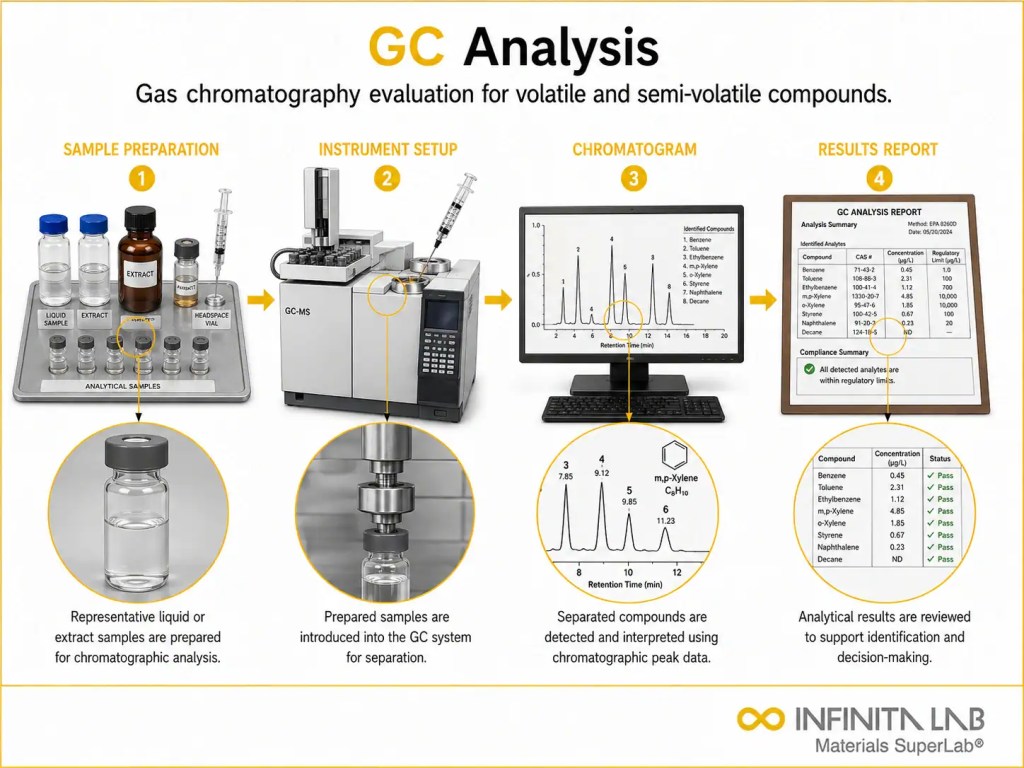
Gas Chromatography (GC) analysis is an analytical technique used to separate, identify, and quantify volatile and semi-volatile compounds in a sample. A prepared sample is injected into a heated inlet, where its components are vaporized and carried through a chromatographic column by an inert gas, such as helium or nitrogen. Inside the column, compounds separate based on their volatility and interactions with the stationary phase. As each component exits the column, a detector measures its response and generates a chromatogram. The retention times and peak areas are analyzed to identify compounds and determine their concentrations. GC analysis is widely used in chemical, pharmaceutical, environmental, food, and materials testing.
Why Choose Infinita Lab for GC Analysis Testing?
When your GC Analysis results have to hold up - for compliance, a customer audit, or an engineering decision - accuracy and an unbiased third-party report matter more than price. Infinita Lab routes your GC analysis testing to ISO/IEC 17025-accredited U.S. partner labs with hands-on method experience, so you get defensible data, transparent reporting, and turnaround times built around your project deadline - not ours.

Looking for an Accredited Partner for GC Analysis Testing?
Send query us at hello@infinitalab.com or call us at (888) 878-3090 to learn more about our services and how we can support you.



