


Electrochemical Impedance Spectroscopy Testing Services
Read more about electrochemical impedance spectroscopy to simple voltage measurements.
TRUSTED BY


Get compliant results — request your electrochemical impedance spectroscopy testing quote
- Overview
- Scope, Applications, and Benefits
- Test Process
- Specifications
- Instrumentation
- Results and Deliverables
What Is Electrochemical Impedance Spectroscopy?
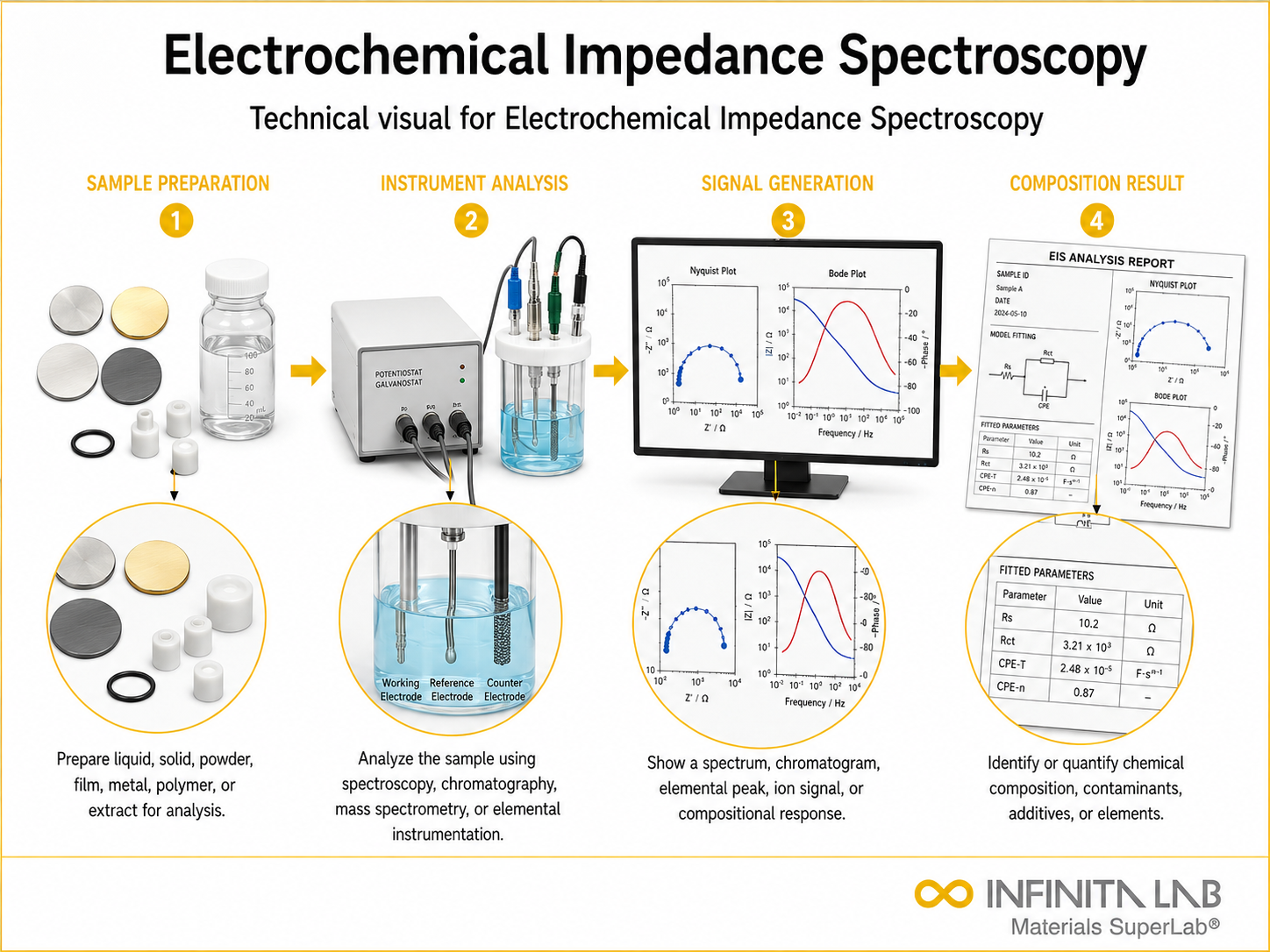
Electrochemical Impedance Spectroscopy (EIS) is a technique that characterizes an electrochemical system by measuring its impedance – its opposition to current flow – across a wide range of frequencies. A small sinusoidal voltage (or current) signal is applied to the system, and the resulting current (or voltage) response is measured at each frequency. Because different electrochemical processes respond on different timescales, sweeping the frequency separates these processes, allowing each to be characterized individually from a single set of measurements.
Unlike a simple DC resistance or voltage measurement, which gives a single number, EIS resolves a system into its component behaviors – solution resistance, charge-transfer resistance, double-layer capacitance, diffusion, and coating or film properties – by fitting the frequency response to an equivalent electrical circuit model. The results are typically presented as Nyquist and Bode plots, from which these individual parameters are extracted.
EIS is widely used in batteries, fuel cells, corrosion science, coatings, and sensors because it is non-destructive, highly sensitive to interfacial processes, and able to separate phenomena that a single DC measurement would lump together. It is one of the most powerful tools available for understanding what is happening at electrodes, interfaces, and within coatings and electrochemical devices.

Applications and Benefits of Electrochemical Impedance Spectroscopy Testing
Scope
EIS covers the measurement and analysis of the frequency-dependent impedance of electrochemical systems and materials, with the results interpreted through equivalent circuit modeling to extract individual electrochemical parameters. The frequency range, signal amplitude, and cell configuration are selected to suit the system under study.
Key aspects of the technique include:
- Measurement principle – a small-amplitude AC signal is applied across a range of frequencies (often from sub-mHz to MHz), and the magnitude and phase of the impedance are recorded at each frequency
- Data presentation – results plotted as Nyquist (imaginary vs. real impedance) and Bode (impedance magnitude and phase vs. frequency) plots
- Equivalent circuit modeling – the impedance spectrum is fitted to a circuit model (resistors, capacitors, constant-phase elements, Warburg elements) representing the physical processes in the system
- Extracted parameters – solution/electrolyte resistance, charge-transfer resistance, double-layer capacitance, coating capacitance and resistance, and diffusion (Warburg) behavior
- Cell configurations – two-, three-, or four-electrode arrangements depending on whether a full cell, a single electrode, or a membrane/material is being studied
- Conditions – measurements can be made at controlled potential (potentiostatic) or current (galvanostatic), and under various states of charge, temperature, or environment
Applications
- Battery characterization – measuring internal resistance, charge-transfer resistance, and diffusion behavior of lithium-ion and other cells to assess performance, state of health, and degradation across cycling and aging
- Fuel cells and electrolyzers – characterizing membrane resistance, charge-transfer, and mass-transport losses to understand and improve performance
- Corrosion evaluation – assessing corrosion rate and mechanism by extracting polarization resistance and interfacial behavior, a non-destructive alternative to weight-loss methods
- Coatings and protective films – evaluating the barrier performance and degradation of organic coatings, paints, and anti-corrosion films through their capacitance and resistance over exposure time
- Sensors and biosensors – characterizing electrode-electrolyte interfaces and detecting binding or surface changes in electrochemical sensing applications
- Supercapacitors – measuring capacitance, equivalent series resistance, and frequency response of capacitive energy storage devices
- Materials and electrode development – comparing electrode materials, surface treatments, and electrolytes by their interfacial and transport properties
Benefits
- Separates processes a single DC measurement combines – by sweeping frequency, EIS resolves solution resistance, charge transfer, double-layer capacitance, and diffusion individually, where a single resistance or voltage measurement would merge them
- Non-destructive and sensitive to interfaces – the small-signal measurement does not disturb the system and is highly sensitive to electrode and interfacial behavior, allowing repeated measurements over time
- Quantifies parameters through circuit modeling – fitting the spectrum to an equivalent circuit yields numerical values for the individual physical processes, supporting quantitative comparison and analysis
- Tracks degradation and state of health over time – repeated EIS measurements reveal how internal resistance, charge transfer, and coating properties evolve with cycling, aging, or exposure
- Broadly applicable – the same technique characterizes batteries, fuel cells, corrosion systems, coatings, and sensors, making it a versatile tool across electrochemical applications
Our Testing Procedure
Prepare the Cell
Assemble the electrode system, add the electrolyte, and allow it to reach stable operating conditions.
1Set Measurement Parameters
Define the frequency range, AC amplitude, DC bias, temperature, and state of charge.
2Run the Impedance Sweep
Apply the AC signal and record impedance magnitude and phase across the frequency range.
3Model and Report
Analyse Nyquist and Bode plots, fit an equivalent circuit, and report the extracted parameters.
4Test parameters and requirements
| Parameter | Details |
|---|---|
| Measured Quantity | Complex impedance (magnitude and phase) vs. frequency |
| Frequency Range | Typically sub-mHz to MHz (instrument-dependent) |
| Signal Mode | Potentiostatic or galvanostatic, small-amplitude AC |
| Data Presentation | Nyquist and Bode plots |
| Analysis | Equivalent circuit modeling and parameter extraction |
| Extracted Parameters | Solution resistance, charge-transfer resistance, double-layer capacitance, coating R/C, Warburg diffusion |
| Cell Configurations | Two-, three-, or four-electrode |


- Potentiostat/galvanostat with frequency response analyzer (FRA) / impedance module
- Electrochemical cell with appropriate electrode configuration
- Reference and counter electrodes
- Temperature-controlled cell or environment (where required)
- Faraday cage / shielding for low-noise measurement
- Equivalent circuit modeling and data analysis software
Equipment and Instrumentation Used for Testing
What You Receive: Test Report, Data, and Certification
- EIS report – measured impedance spectra presented as Nyquist and Bode plots, with the measurement conditions documented
- Equivalent circuit model – the fitted circuit model representing the system, with the goodness of fit
- Extracted parameters – numerical values for solution resistance, charge-transfer resistance, double-layer capacitance, coating properties, and diffusion behavior as applicable
- Comparative analysis (where applicable) – comparison across samples, states of charge, exposure times, or conditions
- Raw impedance data – tabulated impedance magnitude and phase across the frequency range
- Test conditions – cell configuration, electrolyte, frequency range, signal amplitude, DC bias, temperature, and electrode details
Electrochemical Impedance Spectroscopy FAQs
A low-amplitude AC voltage or current is applied to an electrochemical cell at different frequencies. The resulting response is used to calculate impedance, phase angle and frequency-dependent electrochemical properties.
EIS is commonly used for batteries, fuel cells, supercapacitors, coatings, metals, sensors and corrosion-resistant materials. It can also evaluate electrolytes, electrodes and biomedical implants.
Impedance is the resistance a system presents to alternating electrical current. It includes both resistive and reactive effects caused by processes such as charge transfer, capacitance and diffusion.
A Nyquist plot displays the imaginary component of impedance against the real component. Semicircles, lines and other features can indicate charge-transfer resistance, diffusion behaviour and coating performance.
EIS can measure coating resistance, corrosion rate and changes at the metal–electrolyte interface. Repeated measurements can track coating degradation, water absorption and corrosion development over time.
Why Choose Infinita Lab for Electrochemical Impedance Spectroscopy Testing
At the core of this breadth is our network of 2,000+ accredited laboratories across the USA, offering access to over 10,000 testing methods and analytical services. From advanced materials characterization (SEM, TEM, RBS, XPS) to mechanical, chemical, environmental, biological, and standardized ASTM/ISO-compliant testing, we deliver unmatched flexibility, specialization, and scale. You are never limited by geography, facility, or methodology — Infinita Lab connects you to the right expertise and testing solution, every time.

Looking for an Accredited Partner for Electrochemical Impedance Spectroscopy Testing?
Send query us at hello@infinitalab.com or call us at (888) 878-3090 to learn more about our services and how we can support you.



Request a Quote
Submit your material details and receive testing procedures, pricing, and turnaround time within 24 hours.
 Quick Turnaround and Hasslefree process
 Confidentiality Guarantee
 Free, No-obligation Consultation
 100% Customer Satisfaction
