


Coefficient Of Moisture Expansion CME Testing Services
Accredited coefficient of moisture expansion CME testing from Infinita Lab, performed to the exact standard requirements - accurate, reproducible results with full documentation for compliance, R&D, and quality control programs.
TRUSTED BY


Get compliant results - request your coefficient of moisture expansion CME testing quote
- Overview
- Scope, Applications, and Benefits
- Test Process
- Specifications
- Instrumentation
- Results and Deliverables
What Is Coefficient Of Moisture Expansion CME?
Coefficient of moisture expansion (CME) testing measures how much a material changes size as its moisture content changes. It is a measurement technique, not a single ASTM test method, and no single ASTM designation covers it for every material. The result is normally a dimensionless ratio of dimensional strain to the change in absorbed moisture, with both terms expressed in percent. It’s often reported separately for each material axis. ASTM publishes some moisture-related methods, but they sit in different committees and address different questions. ASTM C370, Standard Test Method for Moisture Expansion of Fired Whiteware Products, covers the elongation of whiteware bodies caused by rehydration after autoclave treatment. ASTM D5229/D5229M, Standard Test Method for Moisture Absorption Properties and Equilibrium Conditioning of Polymer Matrix Composite Materials, covers moisture uptake and conditioning of composite coupons. Its public summary doesn’t describe a swelling or CME measurement. That’s why Infinita Lab builds each CME program around the material and its end use. First, we dry a specimen to a stable reference state and record its dimensions and mass. Then it’s conditioned in a controlled humid environment or subjected to a controlled desorption step. Dimensional change is read at intervals alongside mass change, and the two are plotted against each other. The slope gives the CME for the chosen axis. Moisture moves slowly through most solids, so thick or low-permeability specimens can need long conditioning times. Each test is planned around the material’s diffusion behavior and a defined equilibrium criterion. When a customer specification names a method, the workflow follows it. The report states any departure.

Applications and Benefits of Coefficient Of Moisture Expansion CME Testing
Scope
The Coefficient of Moisture Expansion, or CME, test is applicable across a wide range of different materials, including polymer resins, composites, PCBs, electronic packaging, coatings, and laminates. The test is crucial for determining how these materials perform in humid environments, especially when maintaining dimensional stability is critical.
What we measure:
- CME testing covers the dimensional response of a solid material to a change in absorbed moisture, usually reported per axis.
- It’s a general technique. No single ASTM test method defines it across all material classes.
- One verified, related ASTM method is C370, which addresses the autoclave-driven moisture expansion of fired whiteware bodies rather than a general CME value.
- ASTM D5229/D5229M is another verified, related method for moisture absorption and equilibrium conditioning of polymer matrix composites; it’s often used to bring coupons to a defined moisture state before measurement.
- Materials commonly tested include composite laminates, polymers, adhesives, encapsulants, ceramics, and wood-based products.
- Before any expansion is recorded, specimens must be conditioned to a known dry reference state.
- Anisotropic materials such as fiber-reinforced laminates get measured along each principal direction, because swelling differs between the fiber and through-thickness axes.
- Strain and moisture content are recorded on the same specimen, so the CME reflects the actual relationship between the two.
- Test temperature, humidity, and exposure time come from the governing specification or from the in-service environment being simulated.
- The technique doesn’t replace thermal expansion testing, though moisture and temperature effects are often studied together.
Applications
- Predicting dimensional drift of aerospace composite structures that spend years in humid service.
- Hygroscopic swelling stress in encapsulated microelectronics and printed circuit board laminates, estimated from measured data.
- Fired ceramic and whiteware bodies: assessing moisture stability, since expansion can contribute to glaze crazing.
- Support for finite element models that couple moisture diffusion with structural strain.
- Comparing resin systems, fiber types and coatings during material selection.
- Warping or delamination in bonded assemblies after humidity exposure, which can be investigated too.
Benefits
- Designers get a measured CME instead of a handbook estimate for the exact material and lot in use.
- Swelling behavior is separated by axis, which improves the accuracy of structural and warpage models.
- Because strain is paired with mass change, the result is traceable to the moisture content actually reached.
- Field failures such as warpage, cracking, and loss of fit after humid exposure become easier to explain.
- Candidate materials can be compared directly under the same conditioning history.
- Stress analysis and qualification documents can use the data it produces.
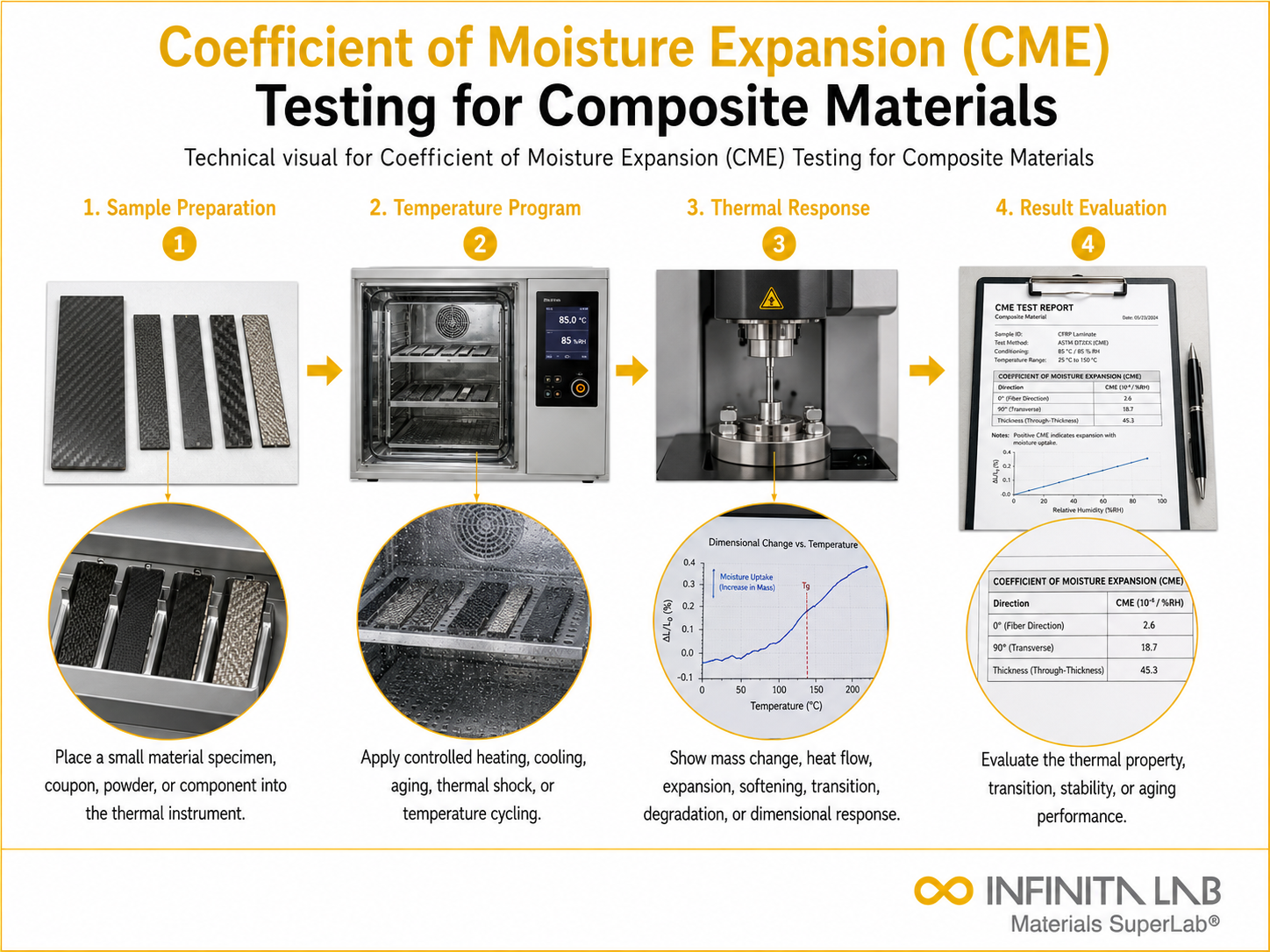
Our Testing Procedure
Sample Preparation & Baseline Measurement
Specimens are prepared, dried, and initial dimensions are accurately measured.
1Conditioning & Moisture Absorption
Samples are exposed to controlled humidity and temperature to absorb moisture.
2Dimensional Measurement
Changes in specimen dimensions are measured after conditioning.
3Calculation & Reporting
CME is calculated from dimensional change data and reported.
4Test parameters and requirements
| Parameter | Details |
|---|---|
| Applicable Materials | Polymers, composites, PCBs, coatings |
| Environmental Conditions | Controlled humidity and temperature (e.g., 85% RH, 85°C) |
| Measurement Direction | X, Y, and Z axes (depending on material anisotropy) |
| Output Units | ppm/% moisture or ppm/% RH |
| Analysis Type | Dimensional and hygroscopic behaviour analysis |


- Environmental Chamber – Holds specimens at a set temperature and relative humidity during conditioning.
- Analytical Balance – Specimen mass is recorded here to track moisture uptake or loss.
- Drying Oven or Vacuum Oven – Gets specimens to the dry reference state before testing.
- Micrometers and Dial or Digital Gauges – For length and thickness changes on suitable specimens.
- Laser Interferometer or Dilatometer – Picks up very small length changes where contact gauges lack the sensitivity.
- Autoclave – Supplies the elevated-pressure steam exposure used for whiteware moisture expansion work.
Equipment and Instrumentation Used for Testing
What You Receive: Test Report, Data, and Certification
- A report identifying the material, specimen axes, preparation, and the method or protocol followed.
- The CME value for each tested axis, with the moisture content range over which it applies.
- Plots of dimensional strain against moisture content, and mass change against time.
- Conditioning temperature, humidity, and duration, plus any deviations from the agreed plan.
- Raw data tables and calibration references for the instruments used.
Coefficient Of Moisture Expansion CME FAQs
The Coefficient of Moisture Expansion (CME) refers to the change in strain due to moisture absorption or desorption per unit mass variation. The moisture content and strain changes between two moisture equilibrium states are used to calculate the CME.
The significance of CME is that it allows insight into material behavior under conditions of variable moisture level exposure. In general, this occurs in construction, aerospace, the automotive industry, and electronics when the dimensional stability of materials becomes crucial.
CME is commonly used in the determination of polymers, composites, wood, ceramics, and perhaps textiles under conditions of variable humidity.
Common test conditions include elevated temperature and humidity environments such as 85°C and 85% relative humidity, although conditions may vary depending on the application.
Moisture expansion can cause stress between different materials in electronic assemblies, leading to solder joint failure, delamination, or cracking of components.
Moisture expansion testing measures dimensional changes in fired ceramic materials after exposure to high-pressure steam in an autoclave. The specimen’s length is measured before and after treatment to determine expansion caused by moisture absorption. ASTM C370 covers moisture expansion testing of fired whiteware products.
Why Choose Infinita Lab for Coefficient Of Moisture Expansion CME Testing
When your Coefficient Of Moisture Expansion CME results have to hold up - for compliance, a customer audit, or an engineering decision - accuracy and an unbiased third-party report matter more than price. Infinita Lab routes your coefficient of moisture expansion CME testing to ISO/IEC 17025-accredited U.S. partner labs with hands-on method experience, so you get defensible data, transparent reporting, and turnaround times built around your project deadline - not ours.

Looking for an Accredited Partner for Coefficient Of Moisture Expansion CME Testing?
Send query us at hello@infinitalab.com or call us at (888) 878-3090 to learn more about our services and how we can support you.



Request a Quote
Submit your material details and receive testing procedures, pricing, and turnaround time within 24 hours.
 Quick Turnaround and Hasslefree process
 Confidentiality Guarantee
 Free, No-obligation Consultation
 100% Customer Satisfaction
