


ASTM E384: Microhardness Guide Testing Services
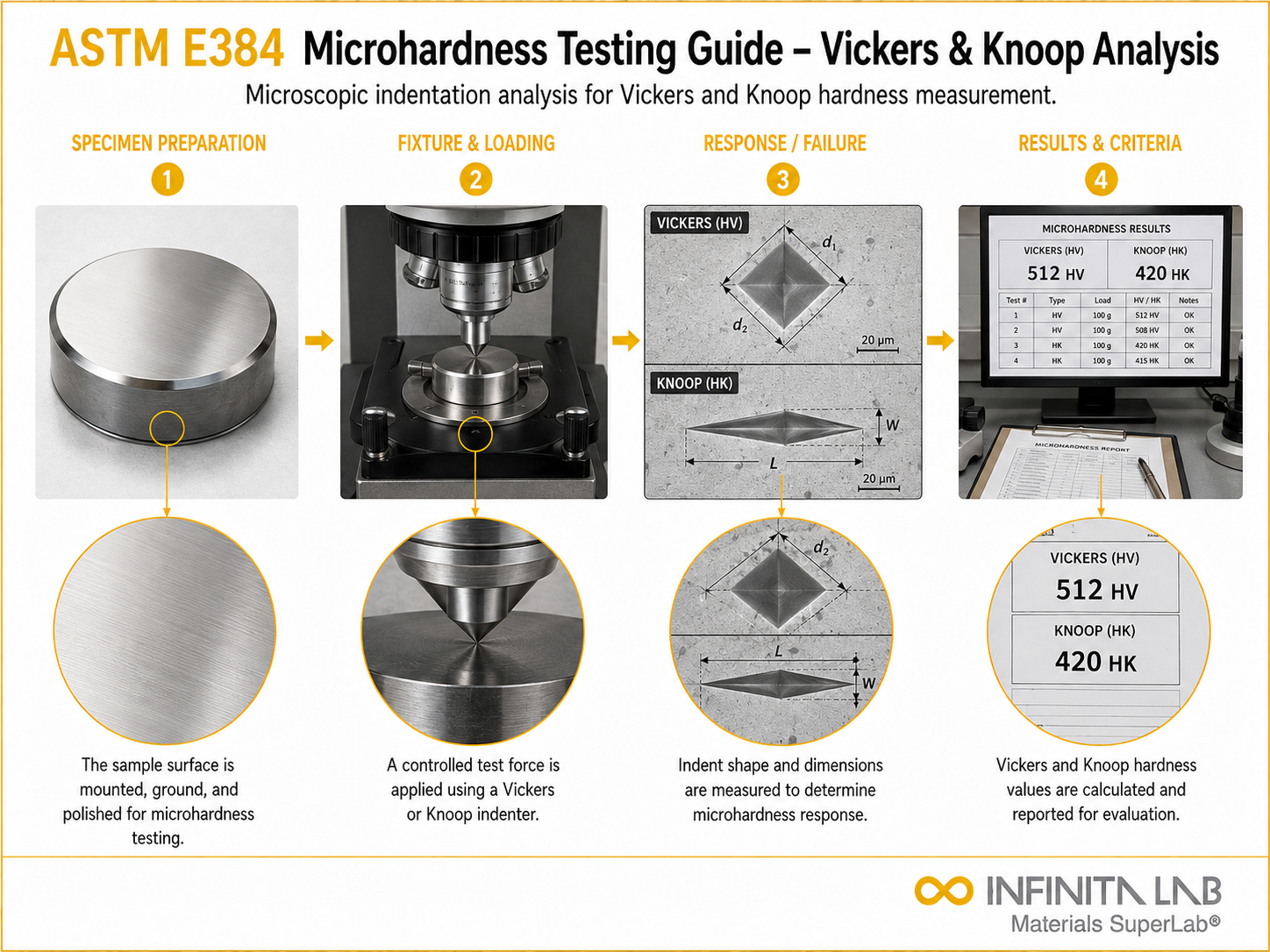
ASTM E384 defines the procedure for measuring microhardness of materials using the Vickers (HV) or Knoop (HK) diamond indentation methods with loads from 1 to 1000 gram-force. Because the indentations are microscopic, this test is used where conventional Rockwell or Brinell hardness testing cannot — thin PVD/CVD coatings, individual weld zones, carburized and nitrided case layers, individual grains or phases in a microstructure, and electronic components. Infinita Lab performs ASTM E384 microhardness testing with metallographic sample preparation, automated stage traverses for case depth profiling, and full indentation imaging, delivering HV or HK values with measurement uncertainty per ASTM E384 requirements.
TRUSTED BY


Get ASTM E384 compliant results — request your microhardness guide testing quote
- Overview
- Scope, Applications, and Benefits
- Test Process
- Specifications
- Instrumentation
- Results and Deliverables
What Is ASTM E384 Microhardness Guide?
ASTM E384 is a standard test method for determining the microhardness of materials using indentation techniques such as the Vickers and Knoop tests. It is designed to evaluate small volumes, thin sections, coatings, and microstructural phases for which conventional hardness testing is unsuitable.
The test applies very low loads (typically in grams or kilograms) to produce small indentations that can be measured under a microscope. It provides detailed hardness information at the micro-scale, making it valuable for analyzing material properties at specific regions or phases.

Applications and Benefits of ASTM E384 Microhardness Guide Testing
Scope
ASTM E384 evaluates:
- Microhardness of materials using the Vickers and Knoop methods
- Hardness of thin coatings and surface layers
- Phase-specific hardness in microstructures
- Case depth and hardness gradients
- Small or delicate material samples
Applications
- Metallurgical and materials research
- Coatings and thin films
- Heat-treated and case-hardened materials
- Electronics and micro-components
- Quality control and failure analysis
Benefits
- Enables hardness measurement at the micro-scale
- Suitable for thin or small samples
- Provides localized hardness information
- Supports microstructural analysis
- High precision and repeatability
Our ASTM E384 Testing Procedure
Sample Preparation
Surface is polished to a smooth, mirror-like finish.
1Indentation
Low load is applied using Vickers or Knoop indenter.
2Measurement
Indentation size is measured using optical microscope.
3Data Analysis
Hardness value is calculated based on indentation dimensions.
4ASTM E384 Test Parameters and Requirements
| Parameter | Details |
|---|---|
| Test Principle | Micro-indentation hardness measurement |
| Indenter Types | Vickers (diamond pyramid), Knoop (elongated diamond) |
| Load Range | ~1 gf to 1000 gf |
| Dwell Time | ~10–15 seconds (typical) |
| Sample Type | Metals, coatings, ceramics |
| Measured Outputs | Vickers hardness (HV), Knoop hardness (HK) |


- Microhardness tester (Vickers/Knoop)
- Diamond indenter (Vickers or Knoop)
- Optical microscope with measurement system
- Polishing and sample preparation tools
- Load application system
- Data acquisition and analysis software
Equipment and Instrumentation Used for ASTM E384 Testing
What You Receive: Test Report, Data, and Certification
- Microhardness values (HV or HK)
- Indentation images and measurements
- Hardness distribution across the sample
- Case depth or coating hardness analysis
- Material performance evaluation
- Test report
ASTM E384 Microhardness Guide FAQs
ASTM E384 is a standardized method for determining the microindentation hardness of materials using small applied loads and optical measurement of indentation size. It measures hardness using either a Vickers or Knoop diamond indenter under controlled conditions.
This test is essential for evaluating hardness on a microscopic scale, especially in thin coatings, small components, or microstructures. It helps ensure material quality, uniformity, and performance in precision-engineered products.
A small load is applied using a diamond indenter for a specific dwell time (usually 10–15 seconds). After unloading, the indentation size is measured microscopically. Hardness is calculated based on the applied load divided by the surface area of the indentation.
Vickers uses a symmetrical diamond pyramid indenter, while Knoop uses an elongated indenter, making it more suitable for very thin materials and brittle samples requiring shallow indentation.
The test uses low loads typically ranging from 1 gram-force to 1000 gram-force, allowing precise indentation measurement without damaging small or delicate samples.
Why Choose Infinita Lab for Microhardness Guide Testing
At the core of this breadth is our network of 2,000+ accredited laboratories across the USA, offering access to over 10,000 testing methods and analytical services. From advanced materials characterization (SEM, TEM, RBS, XPS) to mechanical, chemical, environmental, biological, and standardized ASTM/ISO-compliant testing, we deliver unmatched flexibility, specialization, and scale. You are never limited by geography, facility, or methodology — Infinita Lab connects you to the right expertise and testing solution, every time.

Looking for an Accredited Partner for ASTM E384 Microhardness Guide Testing?
Send query us at hello@infinitalab.com or call us at (888) 878-3090 to learn more about our services and how we can support you.



Request a Quote
Submit your material details and receive testing procedures, pricing, and turnaround time within 24 hours.
 Quick Turnaround and Hasslefree process
 Confidentiality Guarantee
 Free, No-obligation Consultation
 100% Customer Satisfaction
