


ASTM D2369: Coating Volatile Content Oven Testing Services
Accredited ASTM D2369 coating volatile content oven testing from Infinita Lab, performed to the exact standard requirements - accurate, reproducible results with full documentation for compliance, R&D, and quality control programs.
TRUSTED BY


Get ASTM D2369 compliant results - request your coating volatile content oven testing quote
- Overview
- Scope, Applications, and Benefits
- Test Process
- Specifications
- Instrumentation
- Results and Deliverables
What Is ASTM D2369 Coating Volatile Content Oven?
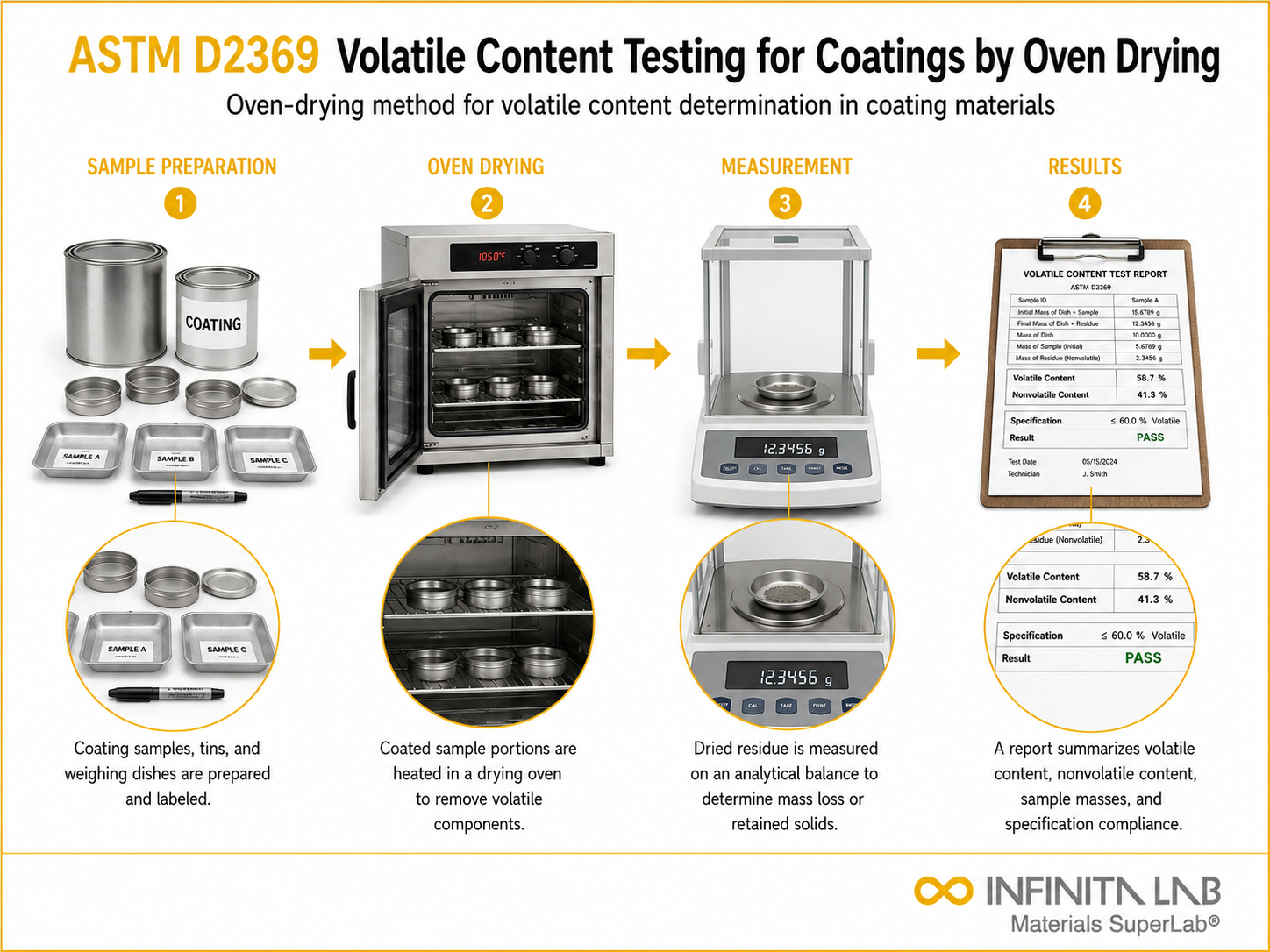
ASTM D2369, Standard Test Method for Volatile Content of Coatings, is a gravimetric oven-drying method that tells you the weight per cent of volatile material-solvents, water, and anything else that evaporates under heat-present in a paint, coating, or related formulation. The mechanics are simple enough: a small, accurately weighed specimen goes into a tared aluminium foil dish, the dish goes into a forced-draft oven held at 110°C ± 5°C, and it sits there for 60 minutes. Once the heating period ends, the dish moves to a desiccator to cool without picking up ambient moisture, then gets reweighed. Subtract the final weight from the initial, express that difference as a percentage of the original specimen mass, and you have your volatile content; non-volatile (solids) content falls out by difference from there.
The method covers a lot of ground- solvent-borne and waterborne coatings, air-dried and oxidising systems, heat-cured baking formulations, even multicomponent products that need to be premixed and left to stand before testing. Because the heating conditions in ASTM D2369 line up with those used in U.S. EPA Reference Method 24, data generated under this standard is routinely used to support VOC compliance reporting across architectural, industrial, and product coatings. It also pairs well with ISO 3251, a related non-volatile matter standard built on similar gravimetric principles, though ISO 3251’s temperature and time conditions shift depending on material classification rather than sticking to one fixed set of parameters.
For formulators, QC labs, and regulatory affairs teams, ASTM D2369 offers a dependable, standardised way to check solvent content claims, feed VOC emission calculations, and confirm that formulations stay consistent from batch to batch. Infinita Lab connects manufacturers with accredited partner laboratories set up to run this test accurately and efficiently, with full documentation behind every result for regulatory and quality assurance purposes.

Applications and Benefits of ASTM D2369 Coating Volatile Content Oven Testing
Scope
- This test method determines the weight percentage volatile content of solvent-borne and waterborne coatings through a controlled gravimetric oven-drying procedure.
- Specimens are heated at 110°C ± 5°C for 60 minutes in a forced-draft oven.
- It applies to air-dried, oxidising, and heat-cured (baking) coating systems.
- Multicomponent coatings can be tested after the components are premixed and given a specified induction period before heating.
- Non-volatile (solids) content isn’t measured directly-it’s calculated by difference from the measured weight loss.
- Not every coating type is a fit for this method; the standard notes that decomposition or unusual degradation during heating may call for an alternative, agreed-upon procedure instead.
- Results are reported in weight per cent, with SI mass units used consistently through sample preparation and reweighing.
- Because the heating conditions align with those used in U.S. EPA Reference Method 24 for VOC determination, the two methods support comparable regulatory outcomes.
- Related standards, ASTM D3960 for VOC content calculation among them, are often paired with this method to round out a full regulatory data package.
- The method serves producers, purchasers, and regulatory bodies who need to evaluate coating composition and emissions potential.
Applications
- Verifying volatile and nonvolatile (solids) content of paints, coatings, primers, and related architectural or industrial formulations.
- Supporting VOC emissions calculations and regulatory compliance reporting under frameworks that reference or align with EPA Method 24.
- Confirming raw-material and finished-formulation consistency during product development and batch-to-batch quality control.
- Evaluating solvent-borne and waterborne coatings destined for concrete, industrial floor, and protective coating applications.
- Cross-referencing results against complementary standards like ISO 3251 when a market or spec calls for both.
- Screening multicomponent and heat-cured coating systems where solvent release behaviour shapes application and drying performance.
- Providing documented technical data that backs up product labelling, technical data sheets, and customer or regulatory inquiries.
Benefits
- The result is straightforward and reproducible-no complex instrumentation needed to interpret it.
- Data comes out ready to plug into VOC compliance calculations tied to EPA Method 24 expectations.
- Flags solvent or water content deviations between production batches, which keeps formulation quality control honest.
- Runs on oven and balance equipment that’s already common across accredited laboratories, so accessibility isn’t a barrier.
- Gives you a documented, standardised basis for technical claims made to customers, regulators, or specifying bodies.
- Makes side-by-side comparison with related methods, such as ISO 3251, easy when products ship into multiple regulatory markets.
Our ASTM D2369 Testing Procedure
Sample Preparation
The coating sample is collected as per ASTM D3925, placed in a pre-weighed aluminum dish (W₁), accurately weighed, and prepared in duplicate.
1Oven Heating
The dish is heated at 110 ± 5 °C for 60 minutes in a forced draft oven.
2Cooling and Weighing
The dish is cooled in a desiccator and reweighed (W₂).
3Calculation
Percent volatile and non-volatile matter are calculated from the recorded weights.
4ASTM D2369 Test Parameters and Requirements
| Parameter | Details |
|---|---|
| Applicable Materials | Solvent-borne and waterborne coatings |
| Heating Temperature | 110 ± 5 °C |
| Heating Duration | 60 minutes |
| Units Reported | Weight percent (%) in SI units |
| Measured Output | % Volatile matter (V) % Non-volatile matter (N) |


- Forced-Draft Oven – Provides the controlled, uniform heating at 110°C ± 5°C that consistent volatile removal depends on.
- Analytical Balance – Handles the accurate initial and final weighing that the whole gravimetric calculation rests on.
- Aluminium Foil Dishes – Lightweight, inert containers that hold the specimen through heating and weighing alike.
- Desiccator – Keeps the cooling environment dry so atmospheric moisture doesn’t skew the final weight reading.
- Calibrated Thermometer or Oven Temperature Monitor – Confirms the oven stays within the required tolerance for the full run.
- Laboratory Timer – Keeps the 60-minute heating duration precise, exactly as the method specifies.
- Sample Mixing Equipment – Needed to homogenise multicomponent or settled coating formulations before a specimen is pulled.
Equipment and Instrumentation Used for ASTM D2369 Testing
What You Receive: Test Report, Data, and Certification
- A formal test report stating the calculated weight per cent volatile content and non-volatile (solids) content for each specimen tested.
- Documentation of the test conditions used for the run, including oven temperature, heating duration, and cooling procedure.
- Specimen identification and chain-of-custody information that ties results back to the submitted sample.
- Data suitable for supporting VOC compliance calculations under EPA Method 24 or related regulatory frameworks.
- Guidance on how the results relate to complementary methods, such as ISO 3251, for teams that need cross-market comparison.
- Raw weighing data and calculation details, available on request for internal quality assurance or regulatory review.
ASTM D2369 Coating Volatile Content Oven FAQs
ASTM D2369 determines the weight percent of volatile content in solvent borne and waterborne coatings. The test can also be used to determine the non-volatile or solids content by difference.
Coating specimens are heated in an oven at 110 ± 5°C for 60 minutes under the standard test conditions.
The method is applicable to a range of solvent borne and waterborne coatings, including air-dried, heat-cured, and certain multicomponent coating systems.
ASTM D2369 determines volatile content, which can be used as part of evaluating or calculating coating VOC characteristics. For complete VOC determination and related calculations, ASTM D3960 provides additional guidance.
The method may not be appropriate for every coating formulation. If the specimen undergoes unusual decomposition or degradation during heating, alternative time/temperature conditions may be considered by agreement between the producer and user.
Why Choose Infinita Lab for Coating Volatile Content Oven Testing
When your Coating Volatile Content Oven results have to hold up - for compliance, a customer audit, or an engineering decision - ASTM D2369 accuracy and an unbiased third-party report matter more than price. Infinita Lab routes your ASTM D2369 coating volatile content oven testing to ISO/IEC 17025-accredited U.S. partner labs with hands-on method experience, so you get defensible data, transparent reporting, and turnaround times built around your project deadline - not ours.

Need ASTM D2369 Coating Volatile Content Oven Testing You Can Rely On?
Send query us at hello@infinitalab.com or call us at (888) 878-3090 to learn more about our services and how we can support you.



Request a Quote
Submit your material details and receive testing procedures, pricing, and turnaround time within 24 hours.
 Quick Turnaround and Hasslefree process
 Confidentiality Guarantee
 Free, No-obligation Consultation
 100% Customer Satisfaction
