Product Sterility Testing in Cleanroom Environments: Methods & Standards
What Is Product Sterility Testing?
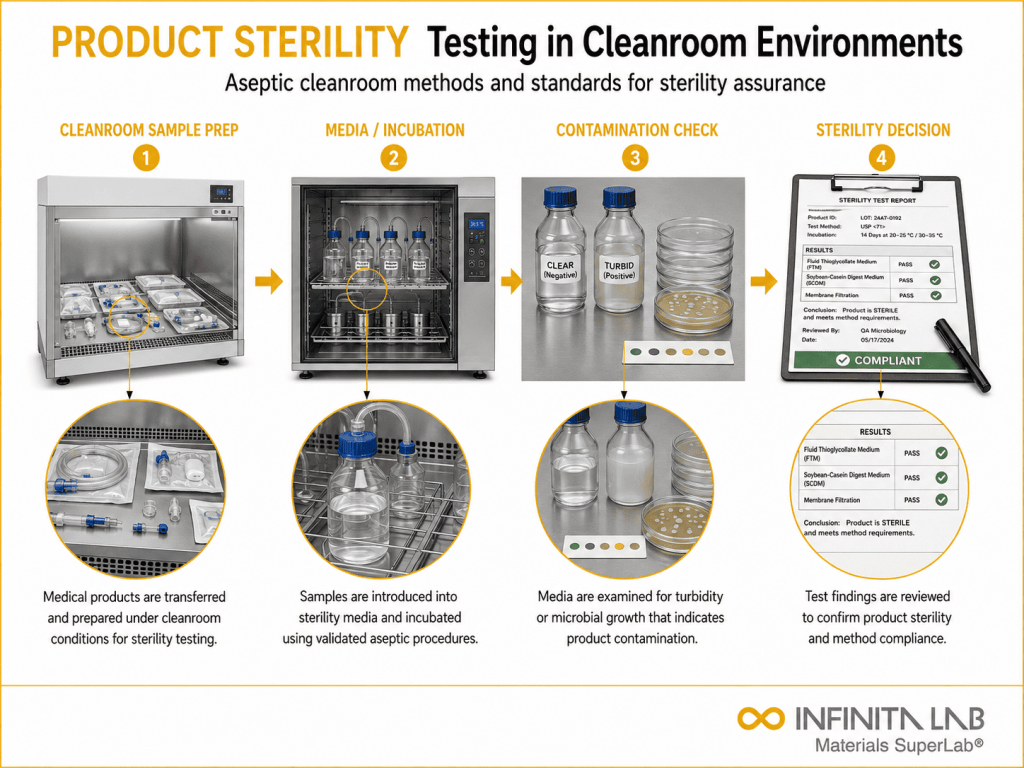
Product sterility testing is the definitive microbiological assay used to verify that a sterile product — whether a medical device, injectable drug, implant, or sterile packaging system — contains no viable microorganisms. A product that fails sterility testing cannot be released for patient use. The test is performed by inoculating the product directly or filtering it through a membrane, then incubating in nutrient broths for a minimum of 14 days while monitoring for turbidity that would indicate microbial growth.
Sterility testing is mandated by USP <71> (United States Pharmacopeia), EP 2.6.1 (European Pharmacopoeia), and ISO 11737-2 for medical devices — and represents the final biological quality assurance gate before sterile product release.
Cleanroom vs. Isolator: The Two Sterility Testing Environments
Sterility testing can be performed in two controlled environments — cleanroom and isolator — each offering different levels of environmental control and contamination risk management.
Cleanroom-Based Sterility Testing
A cleanroom is a specially constructed room that uses HEPA-filtered air and controlled positive-pressure laminar airflow to reduce airborne particulate and microbial contamination. ISO 14644-1 defines cleanroom classifications by maximum airborne particle counts — sterility testing requires ISO Class 5 (Grade A) conditions at the testing zone.
Key features of cleanroom sterility testing:
- Grade A zone (ISO Class 5, ≤3,520 particles/m³ at 0.5 µm) within a Grade B background (ISO Class 7) environment
- Gowned operators working within the Grade A laminar airflow zone
- Environmental monitoring: viable and non-viable particle monitoring, settle plates, contact plates
- Personnel qualification: training, gowning qualification, regular monitoring for contamination contribution
Method Suitability Testing
Before a sterility test method is applied to a specific product, it must be validated for method suitability (bacteriostasis/fungistasis, B/F testing). This demonstrates that the product itself — or its extractable components — does not inhibit or enhance microbial growth in the test system. Failure to perform B/F testing means that a negative sterility test result cannot be attributed to true product sterility rather than inhibition of microbial growth by the product matrix.
Also Read – Product Sterility Testing Using Isolator Technology: Methods & Benefits
Sterility Test Methods
Direct Inoculation
For small-volume or solid products. The product is aseptically immersed directly in both test media:
- Fluid Thioglycollate Medium (FTM): For aerobic and anaerobic bacteria
- Soybean-Casein Digest Medium (TSB): For aerobic bacteria and fungi
Incubation: FTM at 30–35°C; TSB at 20–25°C; both for 14 days minimum.
Membrane Filtration
For large-volume, turbid, or antimicrobially preserved products. The entire contents of the container are filtered through a 0.45 µm membrane that retains all microorganisms. The membrane is aseptically transferred to the culture media. This method is preferred for injectable drugs and large-volume parenterals — it tests the entire container contents rather than a sub-sample.
Environmental Monitoring in Cleanroom Sterility Testing
A robust environmental monitoring (EM) program is essential for cleanroom sterility testing — verifying that the aseptic environment remains continuously in control:
| Monitoring Parameter | Method | Frequency |
| Viable airborne particles | Active air sampling | Each test session |
| Non-viable particles | Particle counter | Continuous |
| Surface contamination | Contact plates / swabs | Each session |
| Operator gown contamination | Contact plates | Each session |
| Settle plates | Passive air exposure | Each session |
Industries and Applications
Cleanroom sterility testing is performed for: sterile injectable drugs, ophthalmic solutions, implantable medical devices, transcatheter heart valves, orthopedic implants, biological products (cell therapies, gene therapies), and sterile packaging validation.
Conclusion
Cleanroom-based product sterility testing is a precision microbiological service that demands rigorous environmental controls, validated methods, trained personnel, and continuous monitoring — all in service of a single critical quality objective: confirming that no viable microorganisms are present in a product that will be administered to patients. For any organization manufacturing or qualifying sterile products, sterility testing is not a procedural checkbox — it is the scientific assurance of patient safety.
Why Choose Infinita Lab for Product Sterility Testing Services?
Infinita Lab is a trusted USA-based testing laboratory offering product sterility testing — both cleanroom and isolator methods per USP <71> and ISO 11737-2 — across an extensive network of accredited facilities. Our advanced equipment and expert professionals deliver highly accurate and prompt test results, helping businesses achieve quality compliance and product reliability.
Looking for a trusted partner to achieve your research goals? Schedule a meeting with us, send us a request, or call us at (888) 878-3090 to learn more about our services and how we can support you. Request a Quote
Frequently Asked Questions (FAQs)
USP <71> requires a minimum 14-day incubation period — 7 days at 30–35°C for Fluid Thioglycollate Medium and 7 days at 20–25°C for Soybean-Casein Digest. The extended period ensures detection of slow-growing organisms including fungi and mycoplasma.
B/F testing demonstrates that the product matrix does not inhibit growth of defined microorganisms (USP challenge organisms) in the test system. Without confirmed B/F suitability, a negative sterility result cannot reliably indicate true product sterility rather than inhibition of microbial detection.
The cleanroom uses an open-room Grade A laminar flow zone with gowned operators — more intervention points. The isolator is a closed, hydrogen peroxide-decontaminated enclosure with glove-port manipulation — a higher sterility assurance level and reduced contamination risk from personnel, preferred for injectable drugs.
Grade A limits (EU GMP Annex 1, USP <1116>) define the maximum allowable viable and non-viable particle counts during sterility testing operations. Exceedances indicate loss of environmental control and may invalidate test results — triggering investigation, corrective action, and potential retest.
USP <71> specifies challenge organisms including Staphylococcus aureus, Bacillus subtilis, Clostridium sporogenes, Pseudomonas aeruginosa, Candida albicans, and Aspergillus brasiliensis — covering both aerobic/anaerobic bacteria and fungi representative of common contamination organisms.