


ASTM F1608: Microbial Barrier Packaging Guide Testing Services
TRUSTED BY


Get ASTM F1608 compliant results — request your microbial barrier packaging guide testing quote
- Overview
- Scope, Applications, and Benefits
- Test Process
- Specifications
- Instrumentation
- Results and Deliverables
What Is ASTM F1608 Microbial Barrier Packaging Guide?
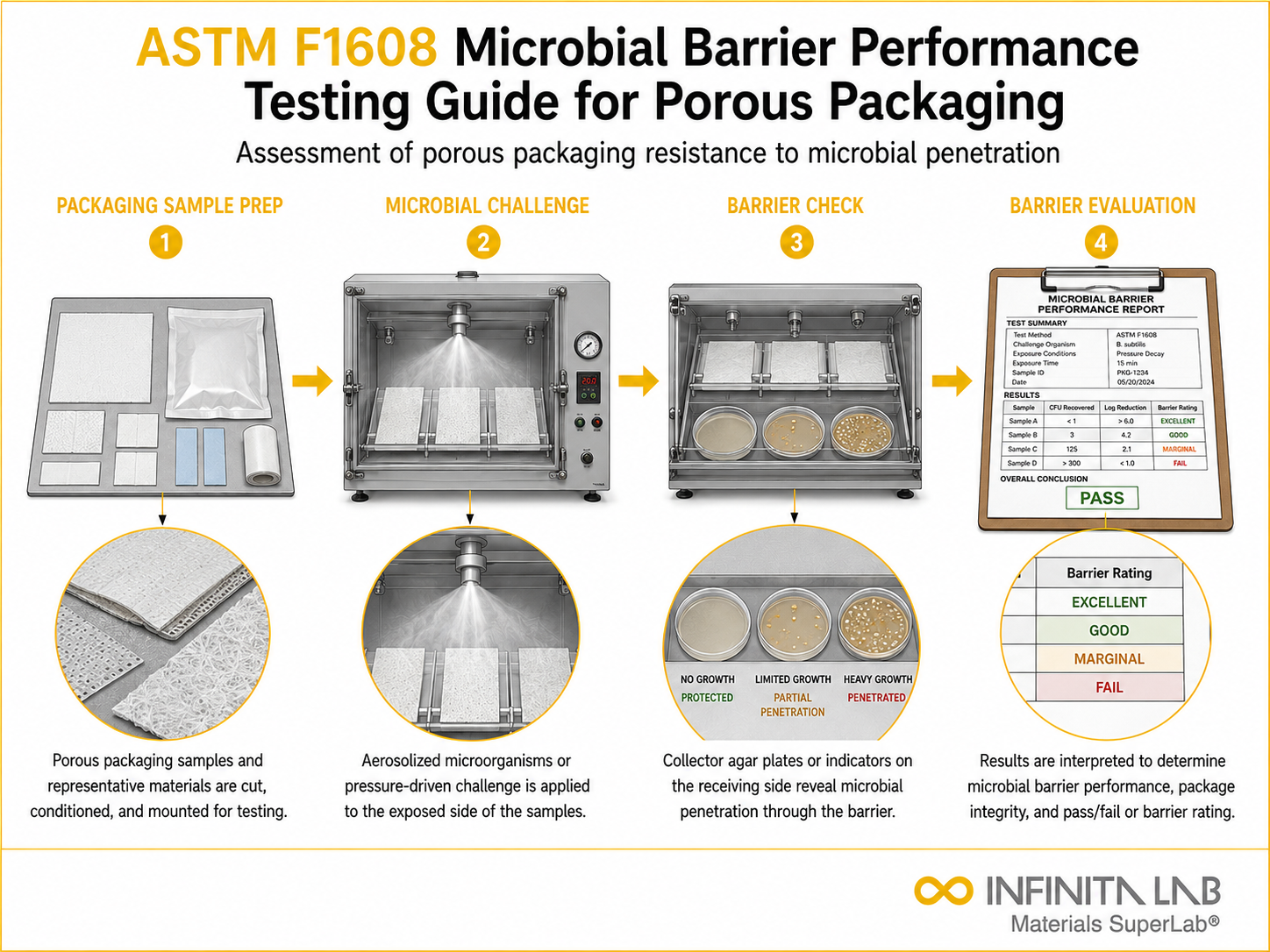
ASTM F1608 is a standardized method used to evaluate the microbial barrier performance of porous packaging materials by measuring their resistance to airborne bacterial penetration under controlled aerosol exposure. It is widely applied to medical packaging, sterile barrier systems, and nonwoven materials where contamination control is critical.
The test provides a comparative ranking of materials based on their ability to prevent microbial ingress, helping assess packaging integrity and long-term sterility assurance. It is essential for validating porous packaging used in healthcare environments where maintaining sterility during storage and handling is required.

Applications and Benefits of ASTM F1608 Microbial Barrier Packaging Guide Testing
Scope
ASTM F1608 establishes a controlled laboratory procedure for assessing microbial penetration through porous packaging materials using a bacterial aerosol challenge under defined airflow conditions. It focuses on comparative barrier performance rather than absolute sterility validation.
The method supports evaluation of filtration behavior, pore structure effectiveness, and microbial resistance of packaging systems.
- Measurement of microbial penetration through porous packaging materials
- Evaluation of bacterial filtration efficiency under aerosol exposure
- Comparative ranking of packaging barrier performance
- Assessment of pore structure impact on microbial transport
- Simulation of airborne contamination conditions
- Standardized performance evaluation for sterile barrier materials
Applications
- Medical sterile barrier packaging validation
- Surgical instrument packaging evaluation
- Pharmaceutical sterile packaging systems
- Nonwoven medical packaging material testing
- Cleanroom packaging and contamination control
- Healthcare infection prevention systems
- Packaging material development and optimization
Benefits
- Provides reliable microbial barrier performance ranking
- Supports sterility assurance in packaging systems
- Enhances infection control and contamination prevention
- Improves design of porous packaging materials
- Enables standardized comparison across materials
- Supports regulatory and quality compliance
Our ASTM F1608 Testing Procedure
Sample Mounting
Conditioned samples are securely sealed in a test fixture to ensure defined exposure area and prevent leakage.
1Aerosol Introduction
A standardized bacterial aerosol is generated and introduced into the airflow system.
2Filtration Exposure
Aerosol passes through the material under controlled airflow, and penetrated microbes are collected downstream.
3Analysis & Ranking
Microorganisms are cultured, counted as CFU, and used to determine filtration efficiency and barrier ranking.
4ASTM F1608 Test Parameters and Requirements
| Parameter | Details |
|---|---|
| Standard | ASTM F1608 microbial barrier test for porous packaging materials |
| Method | Bacterial aerosol challenge with controlled airflow |
| Measurement Type | Microbial penetration, filtration efficiency, barrier ranking |
| Sample Type | Porous packaging materials, nonwoven sterile barrier systems |
| Loading Type | Controlled airborne microbial exposure |
| Units | CFU count, log reduction value (LRV), percentage efficiency |


- Bacterial aerosol generation system
- Controlled airflow filtration apparatus
- Microbial sampling and collection filters
- Incubation chamber for culture growth
- Laminar flow cabinet for sterile handling
- Colony counting system
- Environmental monitoring instruments
- Sample sealing and mounting fixtures
Equipment and Instrumentation Used for ASTM F1608 Testing
What You Receive: Test Report, Data, and Certification
- Microbial penetration data (CFU counts)
- Filtration efficiency (%)
- Log reduction value (LRV)
- Comparative barrier performance ranking
- Sterile barrier integrity evaluation report
- ASTM-compliant test documentation
- Material suitability assessment
- Raw and analyzed microbiological data
ASTM F1608 Microbial Barrier Packaging Guide FAQs
ASTM F1608 is used to determine how effectively a porous packaging material prevents microorganisms from penetrating through it. The test provides a microbial ranking (Log Reduction Value) that indicates the material’s capability to maintain sterility.
Microbial barrier testing ensures that packaging used for sterile medical devices and pharmaceutical products maintains sterility during handling, transport, and storage. It helps prevent contamination that could compromise patient safety and regulatory compliance.
The test typically uses Bacillus atrophaeus (formerly Bacillus subtilis) spores, which are resistant, uniform, and well-characterized, making them suitable for standardized microbial challenge testing.
ASTM F1608 challenges porous materials with a controlled bacterial aerosol and quantifies viable microorganisms penetrating the structure. It evaluates barrier efficiency based on CFU recovery, reflecting the material’s ability to prevent airborne contamination under defined airflow conditions.
Microbial testing measures viable organisms capable of growth, whereas particle testing counts inert particles. ASTM F1608 provides biologically relevant data, making it more meaningful for healthcare packaging applications.
Why Choose Infinita Lab for Microbial Barrier Packaging Guide Testing
At the core of this breadth is our network of 2,000+ accredited laboratories across the USA, offering access to over 10,000 testing methods and analytical services. From advanced materials characterization (SEM, TEM, RBS, XPS) to mechanical, chemical, environmental, biological, and standardized ASTM/ISO-compliant testing, we deliver unmatched flexibility, specialization, and scale. You are never limited by geography, facility, or methodology — Infinita Lab connects you to the right expertise and testing solution, every time.

Looking for an Accredited Partner for ASTM F1608 Microbial Barrier Packaging Guide Testing?
Send query us at hello@infinitalab.com or call us at (888) 878-3090 to learn more about our services and how we can support you.



Request a Quote
Submit your material details and receive testing procedures, pricing, and turnaround time within 24 hours.
 Quick Turnaround and Hasslefree process
 Confidentiality Guarantee
 Free, No-obligation Consultation
 100% Customer Satisfaction
