


ASTM F1249: WVTR Packaging Film Moisture Barrier Guide Testing Services
TRUSTED BY


Get ASTM F1249 compliant results — request your WVTR packaging film moisture barrier guide testing quote
- Overview
- Scope, Applications, and Benefits
- Test Process
- Specifications
- Instrumentation
- Results and Deliverables
What Is ASTM F1249 WVTR Packaging Film Moisture Barrier Guide?
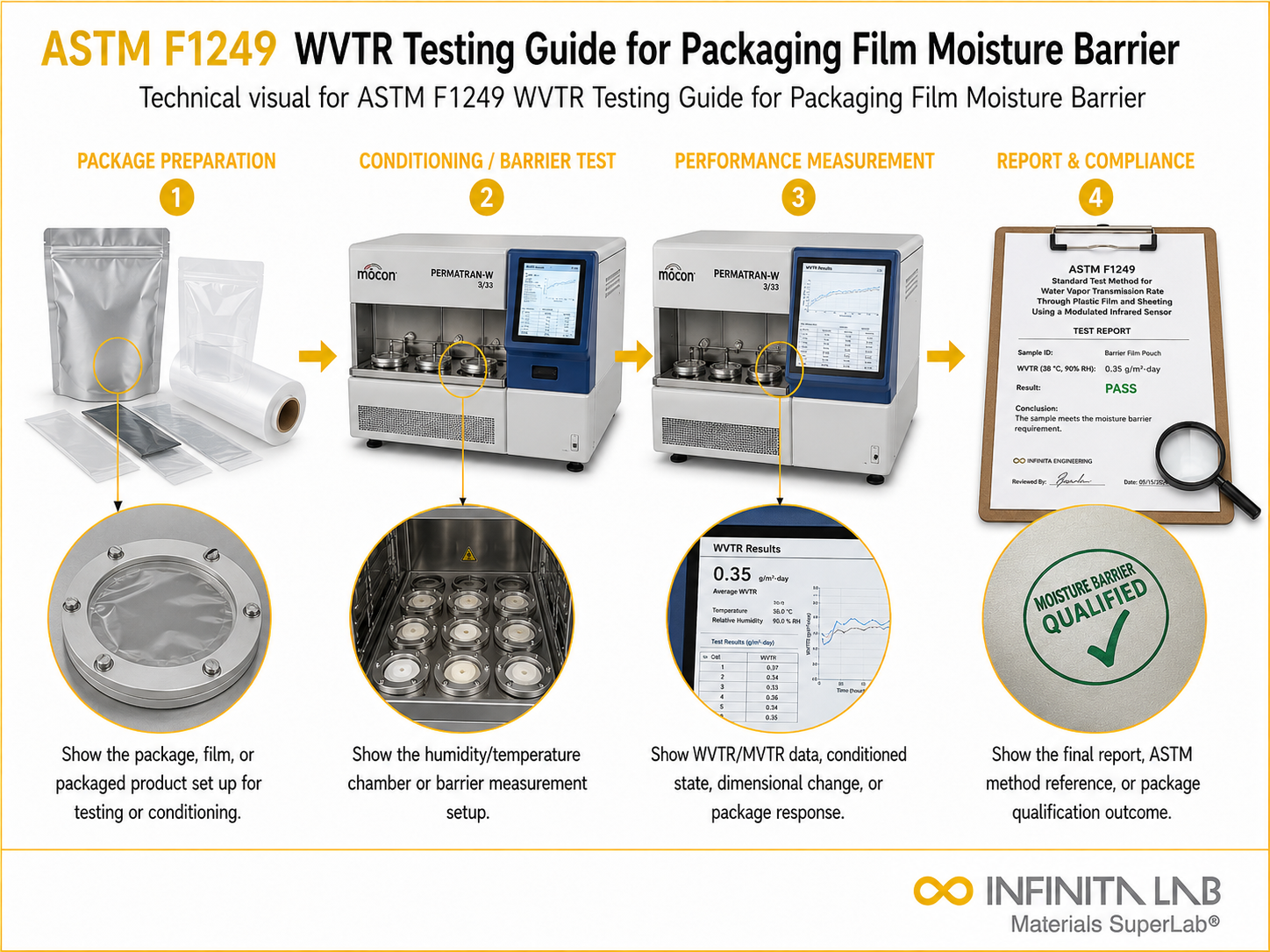
ASTM F1249 is a standardized test method used to measure the Water Vapor Transmission Rate (WVTR) of flexible barrier materials such as plastic films, laminates, and packaging structures. It determines how much moisture passes through a material under controlled temperature and humidity conditions using an infrared detection system.
This test is critical for evaluating moisture barrier performance, especially in packaging where product stability is sensitive to humidity. It helps in material selection, shelf-life prediction, and quality assurance by quantifying moisture permeability and ensuring consistent barrier integrity.

Applications and Benefits of ASTM F1249 WVTR Packaging Film Moisture Barrier Guide Testing
Scope
ASTM F1249 evaluates moisture transmission through films using controlled environmental conditions and infrared detection to quantify barrier performance.
- Measures water vapor transmission through flexible barrier materials
- Applicable to plastic films, multilayer laminates, and coated materials
- Uses controlled humidity gradient across the sample
- Supports permeability and shelf-life studies
- Evaluates effectiveness of barrier layers and coatings
- Ensures consistency in packaging performance
Applications
- Food and beverage packaging films
- Pharmaceutical blister and pouch materials
- Electronics moisture barrier packaging
- Flexible laminates and coatings evaluation
- Shelf-life and stability studies
- Quality control in packaging production
Benefits
- Quantifies moisture barrier performance accurately
- Supports material comparison and optimization
- Enables shelf-life prediction
- Detects defects or inconsistencies in films
- Ensures compliance with packaging standards
- Improves product protection against moisture
Our ASTM F1249 Testing Procedure
Sample Mounting
The film specimen is sealed in a test cell, separating dry and humid chambers to establish a moisture gradient.
1Controlled Exposure
One side is exposed to high humidity while the other side is maintained dry, driving water vapor transmission through the sample.
2Infrared Detection
Transmitted moisture is carried by a carrier gas to an infrared sensor for precise quantification.
3WVTR Calculation
The rate of moisture transmission is calculated based on detected vapor flow under steady-state conditions.
4ASTM F1249 Test Parameters and Requirements
| Parameter | Details |
|---|---|
| Measurement Principle | Infrared detection of water vapor transmission |
| Sample Type | Plastic films and laminates |
| Measurement Parameter | Water Vapor Transmission Rate (WVTR) |
| Test Conditions | Controlled temperature and humidity gradient |
| Detection Method | Infrared sensor-based quantification |
| Output Units | g/m²/day |


- WVTR analyzer (infrared detection type)
- Controlled humidity chamber
- Diffusion test cells
- Carrier gas system
- Temperature control unit
- Data acquisition system
Equipment and Instrumentation Used for ASTM F1249 Testing
What You Receive: Test Report, Data, and Certification
- WVTR value (g/m²/day)
- Barrier performance evaluation report
- Comparative material analysis
- Test condition documentation
- Compliance with ASTM F1249
- Certification and detailed test report
ASTM F1249 WVTR Packaging Film Moisture Barrier Guide FAQs
WVTR directly determines how much moisture can penetrate packaging over time, influencing product stability, shelf life, and degradation, especially for moisture-sensitive goods like pharmaceuticals, food, and electronics.
ASTM F1249 uses infrared detection for real-time, high-sensitivity measurement, while gravimetric methods rely on weight change over time, which is slower and less sensitive for low permeability materials.
The method uses an infrared sensor (modulated infrared detection) to measure the amount of water vapor permeating through the specimen. One side of the film is exposed to high humidity, while the other side is kept dry. The water vapor diffuses through the material and is detected by the instrument.
Steady-state ensures that moisture flow through the material is constant, providing accurate and reproducible transmission rate measurements.
A controlled humidity gradient creates a vapor pressure difference across the film, driving water molecules from the high humidity side to the dry side.
Why Choose Infinita Lab for WVTR Packaging Film Moisture Barrier Guide Testing
At the core of this breadth is our network of 2,000+ accredited laboratories across the USA, offering access to over 10,000 testing methods and analytical services. From advanced materials characterization (SEM, TEM, RBS, XPS) to mechanical, chemical, environmental, biological, and standardized ASTM/ISO-compliant testing, we deliver unmatched flexibility, specialization, and scale. You are never limited by geography, facility, or methodology — Infinita Lab connects you to the right expertise and testing solution, every time.

Need ASTM F1249 WVTR Packaging Film Moisture Barrier Guide Testing You Can Rely On?
Send query us at hello@infinitalab.com or call us at (888) 878-3090 to learn more about our services and how we can support you.



Request a Quote
Submit your material details and receive testing procedures, pricing, and turnaround time within 24 hours.
 Quick Turnaround and Hasslefree process
 Confidentiality Guarantee
 Free, No-obligation Consultation
 100% Customer Satisfaction
