


ASTM E21: Elevated Temperature Mechanical Testing Services
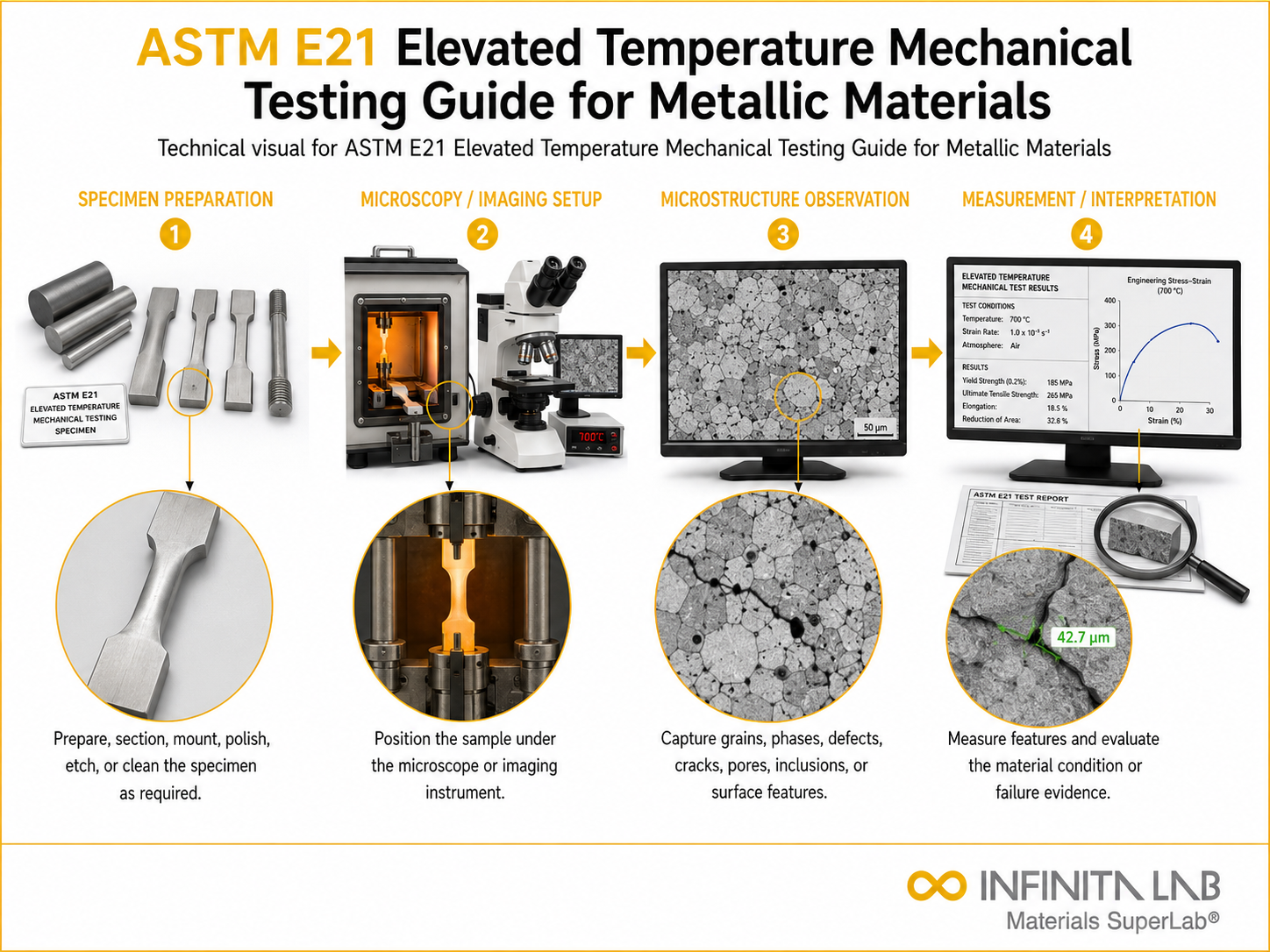
ASTM E21 defines the procedure for tensile testing of metallic materials at temperatures above ambient — measuring how yield strength, ultimate tensile strength, elongation, and reduction of area change as temperature increases. This data is essential for qualifying materials used in gas turbine blades, jet engine components, pressure vessel nozzles, nuclear reactor internals, and heat exchanger tubing where room temperature properties alone are insufficient for design. Infinita Lab performs ASTM E21 testing with temperature accuracy of ±3°C up to 980°C and ±6°C above 980°C, using high-temperature extensometers and calibrated furnaces, delivering full stress-strain curves and property tables at each test temperature.
TRUSTED BY


Get ASTM E21 compliant results — request your elevated temperature mechanical testing quote
- Overview
- Scope, Applications, and Benefits
- Test Process
- Specifications
- Instrumentation
- Results and Deliverables
What Is ASTM E21 Elevated Temperature Mechanical?
ASTM E21 is a standard test method for determining the tensile properties of metallic materials at elevated temperatures. It evaluates how materials behave under uniaxial tensile loading at temperatures above ambient, typically greater than 38°C.
The test provides critical mechanical properties such as tensile strength, yield strength, elongation, and reduction of area. These properties help assess material performance in high-temperature environments, making the method essential for industries where components operate under thermal stress.

Applications and Benefits of ASTM E21 Elevated Temperature Mechanical Testing
Scope
ASTM E21 evaluates:
- Tensile strength at elevated temperatures
- Yield strength and offset yield
- Elongation and ductility
- Reduction of area
- Temperature-dependent mechanical behavior
Applications
- Aerospace and turbine components
- Power generation and energy systems
- Automotive engines and exhaust systems
- Oil & gas high-temperature equipment
- Structural metals and alloys
Benefits
- Determines material performance under thermal stress
- Supports high-temperature material selection
- Helps prevent failure in extreme environments
- Enables accurate design and engineering decisions
- Provides standardized and repeatable results
Our ASTM E21 Testing Procedure
Sample Preparation
Standard tensile specimen (round or flat) is machined as per ASTM E8/E8M.
1Heating
Specimen is placed in a furnace and heated to target temperature (>38°C).
2Tensile Loading
Uniaxial tensile load is applied at controlled strain rate using extensometer.
3Data Analysis
Stress–strain data is recorded to determine strength and ductility properties.
4ASTM E21 Test Parameters and Requirements
| Parameter | Details |
|---|---|
| Test Principle | Tensile testing under elevated temperature |
| Temperature Range | >38°C up to ~1000°C+ (application dependent) |
| Temperature Accuracy | ±3°C (≤980°C), ±6°C (>980°C) |
| Strain Rate | ~0.005 ± 0.002 mm/mm/min (yield region) |
| Specimen Type | Round or flat metallic specimens |
| Measured Outputs | Tensile strength, yield strength, elongation, reduction of area |


- Universal testing machine (UTM) or servo-hydraulic system
- High-temperature furnace (split or chamber type)
- High-temperature extensometer
- Thermocouples (for temperature measurement)
- Grips and load train system
- Data acquisition and control software
Equipment and Instrumentation Used for ASTM E21 Testing
What You Receive: Test Report, Data, and Certification
- Stress–strain curves at elevated temperatures
- Tensile strength and yield strength values
- Elongation and reduction of area
- Temperature-dependent material behavior
- Mechanical performance evaluation report
ASTM E21 Elevated Temperature Mechanical FAQs
ASTM E21 is a standard test method used to determine the tensile properties of metallic materials at elevated temperatures, such as yield strength, ultimate tensile strength, elongation, and reduction in area.
It helps engineers understand how metals perform under high-temperature service conditions, ensuring that components used in turbines, engines, and reactors retain sufficient strength and ductility during operation.
This standard applies to a wide range of metallic materials, including carbon steels, stainless steels, nickel-based alloys, titanium alloys, aluminum alloys, and refractory metals.
The purpose is to measure how mechanical properties such as tensile strength, yield strength, and ductility change when the material is exposed to elevated temperatures.
ASTM E21 is used for elevated temperature tensile testing, while ASTM E8 is used for room temperature testing of metallic materials, making E21 essential for high-temperature applications.
Why Choose Infinita Lab for Elevated Temperature Mechanical Testing
At the core of this breadth is our network of 2,000+ accredited laboratories across the USA, offering access to over 10,000 testing methods and analytical services. From advanced materials characterization (SEM, TEM, RBS, XPS) to mechanical, chemical, environmental, biological, and standardized ASTM/ISO-compliant testing, we deliver unmatched flexibility, specialization, and scale. You are never limited by geography, facility, or methodology — Infinita Lab connects you to the right expertise and testing solution, every time.

Need ASTM E21 Elevated Temperature Mechanical Testing You Can Rely On?
Send query us at hello@infinitalab.com or call us at (888) 878-3090 to learn more about our services and how we can support you.



Request a Quote
Submit your material details and receive testing procedures, pricing, and turnaround time within 24 hours.
 Quick Turnaround and Hasslefree process
 Confidentiality Guarantee
 Free, No-obligation Consultation
 100% Customer Satisfaction
