


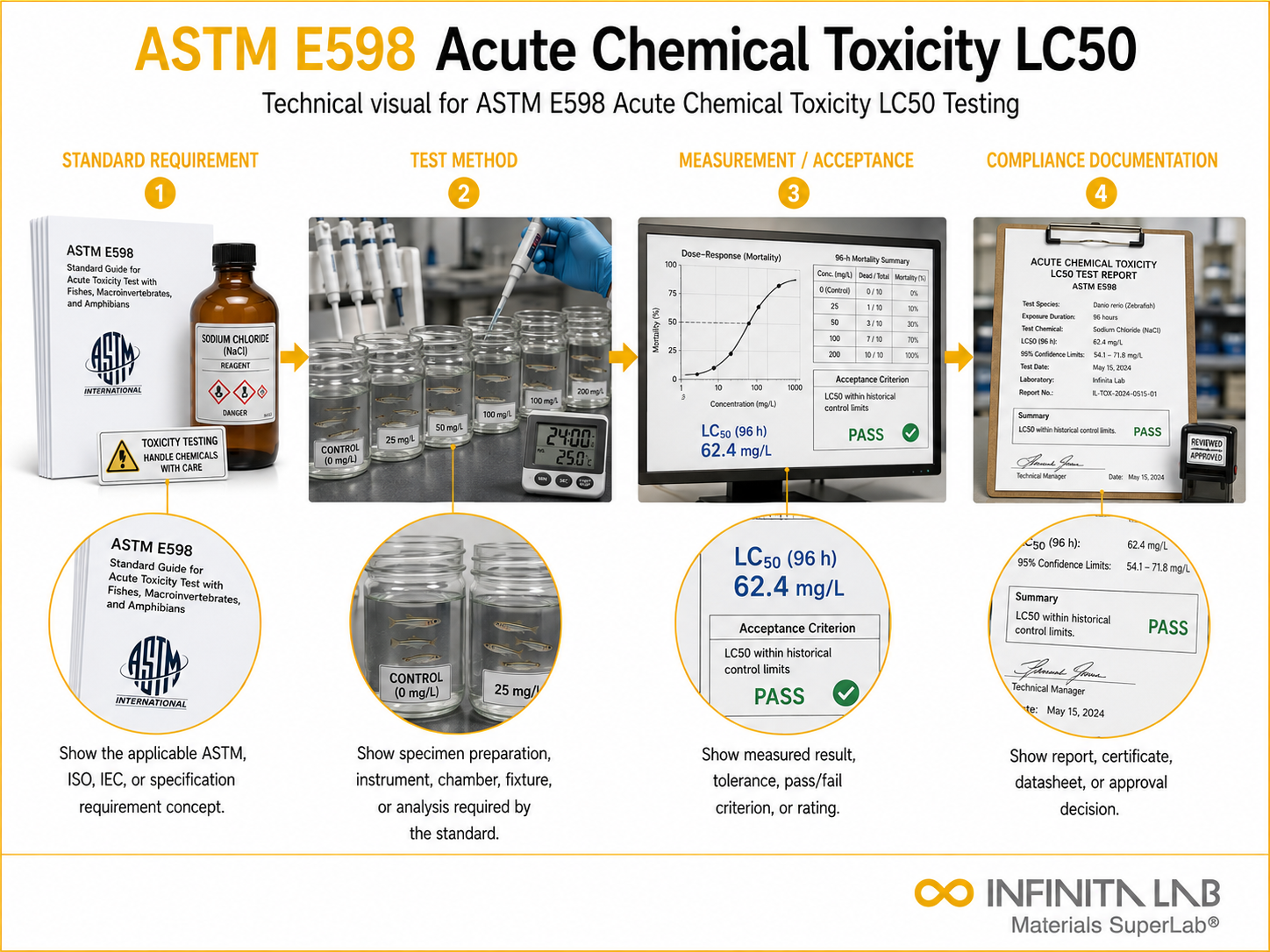
ASTM E598 Acute Chemical Toxicity LC50 Testing
ASTM E598-08 test method determines the heat transfer properties of solids by using a calorimeter. The null point calorimeter used in this method is effective in determining the heat transfer rates of bodies immersed in different gaseous environments. The final results of this method are expressed in SI units.
TRUSTED BY


Precision Testing Solutions for Accurate, Reliable, and Standards-Compliant Results
- Overview
- Scope, Applications, and Benefits
- Test Process
- Specifications
- Instrumentation
- Results and Deliverables
ASTM E598 Extreme Heat Transfer Measurement – Overview
ASTM E598 – 08 defines a method for measuring extreme heat-transfer rates from high-energy environments using specialized heat flux sensors. The standard focuses on quantifying rapid and intense thermal energy transfer typically encountered in fire exposure, aerospace testing, and high-temperature industrial processes.
This method is critical for evaluating material performance under severe thermal conditions. It provides accurate heat flux data essential for thermal protection system design, safety assessment, and failure analysis. By capturing transient and steady-state heat transfer behavior, ASTM E598 supports reliable engineering decisions in extreme environments.

Scope, Applications, and Benefits
Scope
ASTM E598 establishes procedures for measuring high heat-transfer rates using calibrated sensors exposed to intense thermal environments. It ensures accurate and repeatable quantification of heat flux under controlled testing conditions.
The method is applicable to both steady and transient heat exposure scenarios and supports evaluation of materials and systems subjected to rapid thermal loading. Proper calibration and environmental control are essential to minimize measurement uncertainty.
- Applicable to high-energy thermal environments such as flames and radiant heat sources
- Measures extreme heat flux using specialized transducers
- Suitable for transient and steady-state conditions
- Supports evaluation of thermal protection materials and systems
- Ensures controlled experimental setup for reproducibility
- Enables analysis of rapid heat transfer dynamics
Applications
- Fire testing and flame exposure analysis
- Aerospace thermal protection system evaluation
- High-temperature material performance testing
- Industrial furnace and combustion studies
- Safety analysis for extreme heat environments
- Research in heat transfer and thermal dynamics
- Calibration and validation of heat flux sensors
- Engineering design of thermal shielding systems
Benefits
- Provides accurate measurement of extreme heat-transfer rates
- Supports design and validation of thermal protection systems
- Enables understanding of transient heat flux behavior
- Improves safety assessment in high-temperature environments
- Ensures reliable and repeatable thermal data
- Assists in material selection for extreme conditions
- Reduces risk of thermal failure in critical applications
- Enhances predictive modeling of heat transfer phenomena
ASTM E598 Extreme Heat Transfer – Test Process
Sensor Calibration
Calibrate heat flux transducer using traceable standards to ensure accurate response under high-energy conditions.
1Test Setup Preparation
Position sensor within the high-energy environment ensuring proper alignment and thermal exposure conditions.
2Heat Exposure Measurement
Expose sensor to extreme heat source and record heat flux over time under controlled conditions.
3Data Analysis & Calculation
Analyze recorded signals to determine heat-transfer rates and evaluate transient or steady-state behavior.
4ASTM E598 Extreme Heat Transfer – Technical Specification
| Parameter | Details |
|---|---|
| Standard | ASTM E598 – 08 |
| Method | Heat flux measurement using thermal transducers |
| Measurement Type | Extreme heat-transfer rate |
| Sensor Type | Heat flux gauge |
| Environment | High-energy thermal exposure (flame/radiant) |
| Measurement Range | High heat flux levels (kW/m² range) |
| Units | kW/m² |


- Heat flux sensor (Schmidt-Boelter or equivalent)
- High-energy heat source (flame or radiant panel)
- Data acquisition system
- Temperature measurement devices (thermocouples)
- Calibration equipment
Instrumentation Used for Testing
Results and Deliverables
- Heat flux values (kW/m²)
- Time-dependent heat transfer data
- Sensor calibration details
- Test conditions and setup parameters
- Final thermal performance report
Frequently Asked Question
ASTM E598 uses specially designed heat flux gauges with high thermal capacity and calibrated response characteristics, allowing them to withstand and accurately measure intense heat flux without saturation or signal distortion under extreme conditions.
Calibration ensures that the sensor output corresponds accurately to known heat flux values. Without proper calibration, measurement errors increase significantly, especially under high thermal loads where sensor response may drift.
Incorrect placement can expose the sensor to non-uniform heat fields or directional bias, leading to inaccurate readings. Proper alignment ensures representative measurement of the intended heat source.
The method primarily measures total heat flux. Separation of radiative and convective components requires additional instrumentation or analytical modeling beyond the standard procedure.
Steady-state measurements provide constant heat flux values, while transient measurements capture time-dependent changes, both of which are critical for understanding material behavior under varying thermal loads.
Why Choose Infinita Lab for Advanced Materials Testing and Characterization?
At the core of this breadth is our network of 2,000+ accredited laboratories across the USA, offering access to over 10,000 testing methods and analytical services. From advanced materials characterization (SEM, TEM, RBS, XPS) to mechanical, chemical, environmental, biological, and standardized ASTM/ISO-compliant testing, we deliver unmatched flexibility, specialization, and scale. You are never limited by geography, facility, or methodology — Infinita Lab connects you to the right expertise and testing solution, every time.

Looking for a Trusted Partner for Accurate and Reliable Testing Services?
Send query us at hello@infinitalab.com or call us at (888) 878-3090 to learn more about our services and how we can support you.



Request a Quote
Submit your material details and receive testing procedures, pricing, and turnaround time within 24 hours.
 Quick Turnaround and Hasslefree process
 Confidentiality Guarantee
 Free, No-obligation Consultation
 100% Customer Satisfaction
