


Microbiological Testing Services for Packaging Materials
The packaging of consumables must be designed in such a way that it does not alter the quality, identity, safety, and purity of the consumable. Microbiological testing is essential for ensuring the safety and hygiene of the packed consumable.
TRUSTED BY


Precision Testing Solutions for Accurate, Reliable, and Standards-Compliant Results
- Overview
- Scope, Applications, and Benefits
- Test Process
- Specifications
- Instrumentation
- Results and Deliverables
Microbiological Testing of Packaging – Overview
Microbiological Testing of Packaging evaluates the presence, level, and behavior of microorganisms on packaging materials to ensure they do not compromise product safety or quality. It focuses on detecting contamination, verifying cleanliness, and assessing microbial load under controlled laboratory conditions using standardized microbiological techniques.
This testing involves sampling packaging surfaces or materials, culturing microorganisms, and identifying or quantifying them. It helps determine whether packaging meets specified microbial limits and supports hygiene validation. Reliable microbiological testing is essential for maintaining product integrity, preventing contamination risks, and ensuring consistent performance across storage and handling conditions.

Scope, Applications, and Benefits
Scope
Microbiological testing of packaging covers detection, enumeration, and identification of microorganisms present on packaging materials, supporting contamination control and hygiene verification across different packaging types and environments.
- Detection of microbial contamination on packaging surfaces
- Enumeration of total viable microbial count
- Identification of bacteria, fungi, and yeast
- Evaluation of hygienic condition of packaging materials
- Verification of compliance with microbial limits
Applications
- Quality control of packaging materials
- Environmental monitoring in packaging areas
- Validation of cleaning and sanitation processes
- Testing of primary and secondary packaging
- Contamination risk assessment
- Supplier quality evaluation
Benefits
- Ensures packaging hygiene and safety
- Detects contamination at early stages
- Supports regulatory compliance
- Improves product shelf life and stability
- Reduces risk of microbial transfer
- Enhances overall quality assurance
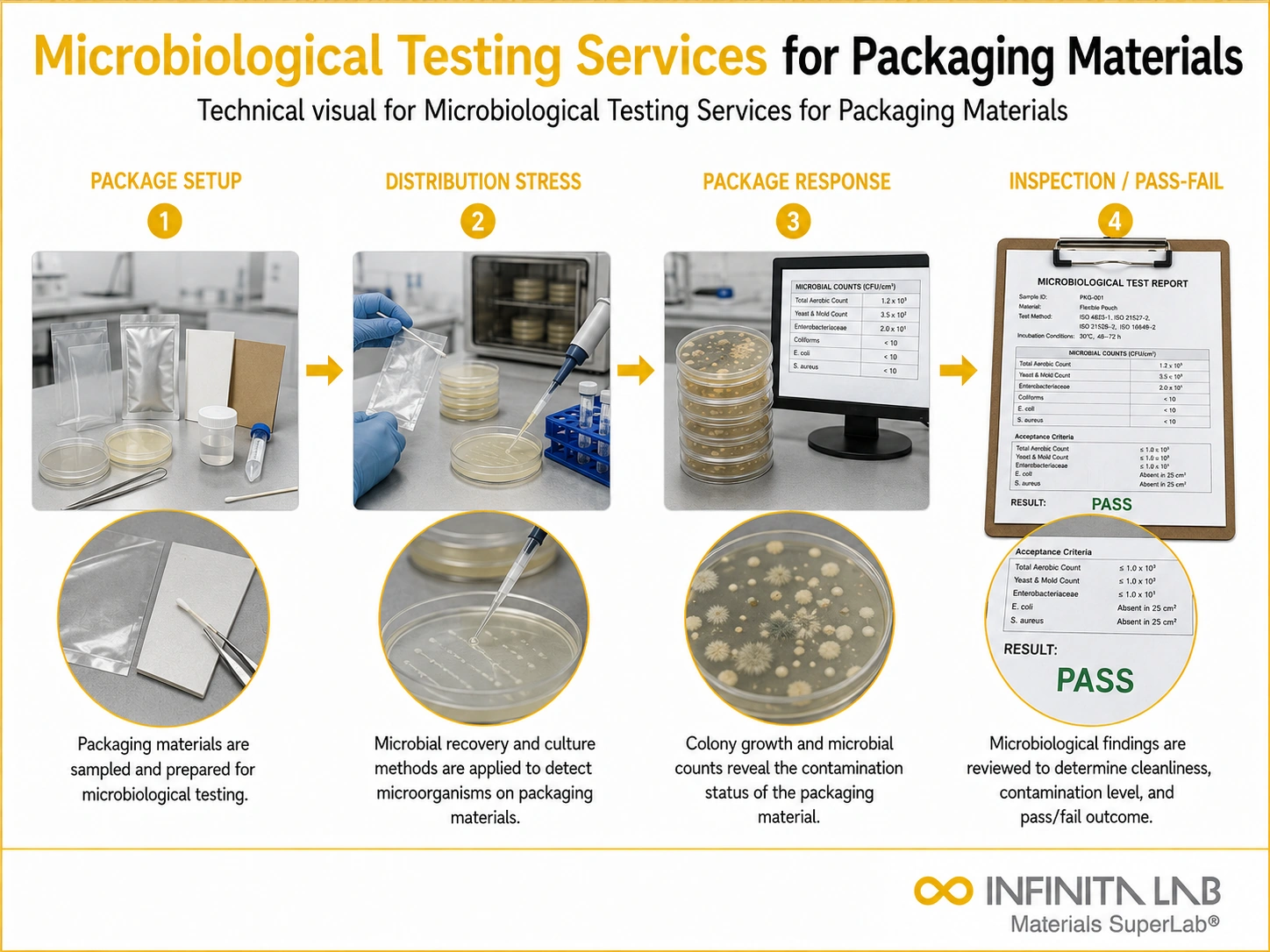
Microbiological Testing of Packaging – Test Process
Sample Collection
Packaging samples are aseptically collected or swabbed to capture microbial presence.
1Sample Preparation
Samples are diluted or extracted into suitable media for analysis.
2Culturing & Incubation
Microorganisms are grown on selective media under controlled conditions.
3Analysis & Reporting
Microbial colonies are counted and identified to generate final results.
4Microbiological Testing of Packaging – Technical Specification
| Parameter | Details |
|---|---|
| Sample Condition | Sterile or as-received packaging under controlled handling |
| Absorption Measurement | Colony growth quantified via culture-based enumeration |
| Environmental Conditions | Controlled temperature (20–37°C) and sterile environment |
| Sample Size | Defined surface area or packaging unit per test |
| Equilibrium Time | Incubation typically 24–72 hours |
| Measurement Units | CFU/cm², CFU/unit, or qualitative presence/absence |


- Incubator
- Autoclave
- Laminar airflow cabinet
- Colony counter
- Microscope
- Sterile swabs and sampling kits
- Petri dishes and culture media
- pH meter
Instrumentation Used for Testing
Results and Deliverables
- Total viable microbial count
- Identification of microbial species (if required)
- Detection of pathogenic organisms
- Compliance status with specified limits
- Detailed analytical test report
- Corrective action recommendations
Frequently Asked Question
Microbiological testing of packaging determines the presence and level of microorganisms on packaging materials. Its primary objective is to ensure packaging does not introduce contamination, thereby maintaining product safety, quality, and compliance with defined microbial specifications.
Packaging can act as a contamination source if not properly controlled. Testing ensures hygiene, verifies cleaning effectiveness, and prevents microbial transfer to products, especially in sensitive applications requiring strict contamination control and safety assurance.
Microbial load is quantified using colony-forming units (CFU) after culturing microorganisms on growth media. Results are expressed per unit area or packaging item, providing measurable contamination levels for evaluation.
Total count measures overall microbial load, while identification determines specific species present. Both are important for assessing contamination severity and understanding potential risks associated with specific microorganisms.
Testing frequency depends on risk assessment, production volume, and regulatory requirements. Regular testing ensures consistent quality and early detection of contamination issues.
Why Choose Infinita Lab for Advanced Materials Testing and Characterization?
At the core of this breadth is our network of 2,000+ accredited laboratories across the USA, offering access to over 10,000 testing methods and analytical services. From advanced materials characterization (SEM, TEM, RBS, XPS) to mechanical, chemical, environmental, biological, and standardized ASTM/ISO-compliant testing, we deliver unmatched flexibility, specialization, and scale. You are never limited by geography, facility, or methodology — Infinita Lab connects you to the right expertise and testing solution, every time.

Looking for a Trusted Partner for Accurate and Reliable Testing Services?
Send query us at hello@infinitalab.com or call us at (888) 878-3090 to learn more about our services and how we can support you.



Request a Quote
Submit your material details and receive testing procedures, pricing, and turnaround time within 24 hours.
 Quick Turnaround and Hasslefree process
 Confidentiality Guarantee
 Free, No-obligation Consultation
 100% Customer Satisfaction
