


NES Toxicity Index Testing Services
The NES 713 standard test is used to determine the toxicity of materials that may emit toxic gases during combustion or high-temperature exposure, such as insulation materials, coatings, and other products used in naval vessels. This test sets out specific criteria for the toxicity index, with lower values indicating lower toxicity and higher values indicating higher toxicity.
TRUSTED BY


Get compliant results — request your NES toxicity index testing quote
- Overview
- Scope, Applications, and Benefits
- Test Process
- Specifications
- Instrumentation
- Results and Deliverables
What Is NES Toxicity Index?
NES 713 is the UK Ministry of Defence Naval Engineering Standard that defines the test method for determining the Toxicity Index (TI) of gases produced when a material is burned or subjected to high-temperature decomposition. The standard was developed specifically to address the hazard posed by toxic combustion products in confined naval environments — particularly warships and submarines — where rapid evacuation during a fire is not possible and personnel must continue to operate in close proximity to burning materials. NES 713 requires the complete combustion of a material sample under controlled conditions, measurement of the resulting toxic gas concentrations, and calculation of a single composite TI value that represents the overall inhalation hazard of the combustion products.
The Toxicity Index is the central output of the test. It accounts for the combined effect of all toxic gases produced — including carbon monoxide, hydrogen cyanide, hydrogen chloride, nitrogen oxides, sulfur dioxide, hydrogen fluoride, and others — by comparing each gas concentration to its respective lethal concentration value and normalizing the result per unit mass of material burned per unit volume of space. A material passes NES 713 if its calculated Toxicity Index does not exceed 5. This threshold is the explicit pass/fail criterion defined in the standard, and it is the figure against which all NES 713 test results are assessed for compliance. Materials that exceed a TI of 5 are not permitted for use in spaces aboard naval vessels where personnel may be present during a fire event.

Applications and Benefits of NES Toxicity Index Testing
Scope
NES 713 applies to all materials intended for use aboard UK Royal Navy vessels where, in the event of a fire, combustion products could accumulate in spaces occupied by personnel. This includes cable sheathings and insulation, structural and interior surface materials, paints, coatings, sealants, foam and textile materials, gaskets, and any polymer or composite used in compartments with limited ventilation. The standard is referenced in UK MoD Defence Standards and procurement specifications, and compliance is a requirement for material approval for naval applications.
NES 713 evaluates the following:
- Total Toxicity Index of combustion gases per gram of material per cubic metre of enclosed space
- Individual concentration of each regulated toxic gas: CO, HCN, HCl, HF, NOₓ, SO₂, NH₃, H₂S, and CO₂
- Individual Cₙ/LCₙ fractional toxicity contribution of each gas to the overall TI
- Complete combustion behavior of the material at temperatures up to approximately 1200°C
- Pass/fail compliance against the NES 713 threshold of TI ≤ 5
- Gas generation profile of novel polymers, composite materials, and cable compounds during material development and qualification
Applications
- Naval cable and wiring systems — Cable sheathings, insulation jackets, and conduit materials for Royal Navy vessels where low-smoke, low-toxicity performance is a procurement requirement
- Ship interior materials — Bulkhead cladding, deckhead linings, flooring compounds, and acoustic insulation used in occupied compartments
- Paints and surface coatings — Naval-grade paints, primers, and protective coatings applied to interior surfaces of vessels and submarines
- Sealants, adhesives, and gaskets — Polymer-based jointing and sealing compounds used in pipework, fittings, and structural connections
- Structural composites — GRP, carbon fibre, and other composite materials used in superstructure, deck, and bulkhead construction
- Foam and textile materials — Upholstery foams, furnishing textiles, and thermal insulation used in accommodation and operational spaces
- Offshore and marine platforms — Fixed and floating offshore installations, where NES 713 compliance is adopted by operators requiring naval-equivalent fire safety standards
- Material development and R&D — Polymer formulators, cable manufacturers, and composite developers screening new material compounds for naval and marine market entry
- Material re-qualification — Existing approved materials undergoing re-qualification following formulation changes, supplier changes, or revised procurement specifications
Benefits
- Evaluates the toxicity hazards of combustion gases
- Supports material safety evaluation for fire conditions
- Helps identify materials with lower toxic gas emissions
- Assists in selecting safer materials for enclosed environments
- Supports regulatory and safety compliance
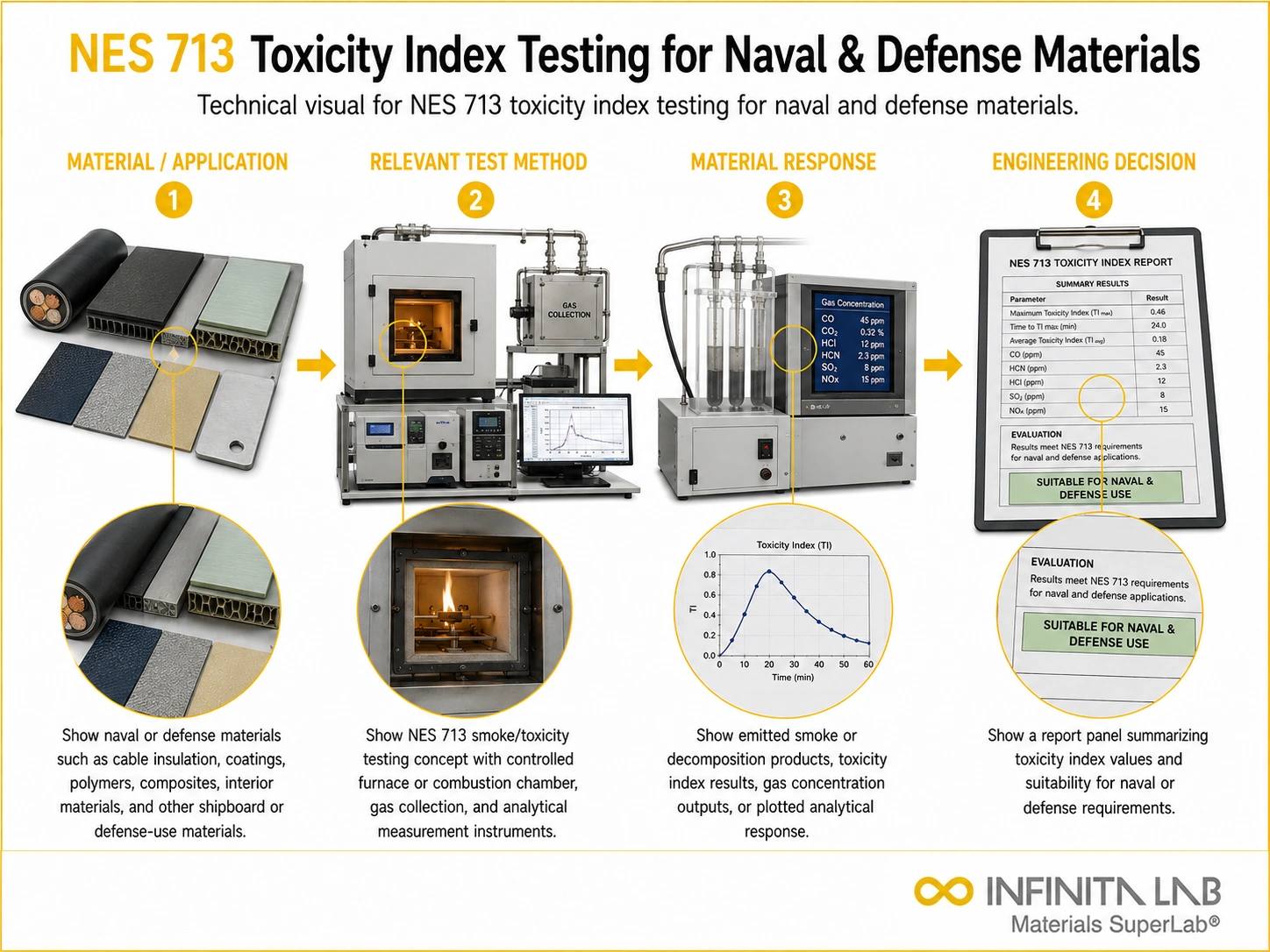
Our Testing Procedure
Sample Preparation
Small material specimens (typically ~100 g basis for calculation) are prepared and conditioned.
1Combustion Exposure
Sample is completely burned in a controlled chamber with excess air at high temperature (~up to 1200°C).
2Gas Collection
Emitted gases are collected and analyzed for toxic components.
3Data Recording & Evaluation
Concentrations of toxic gases are measured and used to calculate the toxicity index.
4Test parameters and requirements
| Parameter | Details |
|---|---|
| Applicable Materials | Insulation materials, coatings, and polymers |
| Chamber Volume | ~0.7 m³ |
| Temperature | Up to ~1200°C |
| Sample Basis | 100 g material equivalent |
| Gas Analysis | Measurement of combustion gas concentrations |
| Evaluation Metric | Toxicity index calculation |
| Measured Gases | CO, CO₂, HCN, HCl, NOx, SO₂, NH₃, H₂S, HF, etc. |
| Pass/Fail Threshold | TI ≤ 5 (materials with TI > 5 do not comply with NES 713) |
| TI Formula | TI = (V/m) × Σ(Cₙ/LCₙ) |


- Combustion test chamber
- Gas sampling and collection system
- Gas analysis instruments
- Temperature monitoring equipment
- Specimen mounting fixtures
- Data acquisition and recording system
Equipment and Instrumentation Used for Testing
What You Receive: Test Report, Data, and Certification
- Toxicity index values
- Toxic gas concentration measurements
- Combustion exposure observations
- Test condition summary
- Compliance report
NES Toxicity Index FAQs
NES 713 tests the toxicity of gases that occur during the burning of materials under controlled conditions. It measures the concentrations of dangerous gases produced during combustion to determine the toxicity index for materials used in confined spaces.
NES 713 helps evaluate fire risk posed by toxic gas emissions. It also helps ensure that materials used in closed spaces emit no hazardous fumes that could harm occupants in the event of a fire.
NES 713 measures gases such as carbon monoxide, hydrogen chloride, hydrogen cyanide, nitrogen oxides, and sulfur dioxide that are produced during combustion. These gases combine to form the combined toxicity index value for the tested materials.
The Toxicity Index formula is the technical core of NES 713, and understanding it is essential for interpreting test results and predicting compliance. The formula calculates TI as follows: TI = (V / m) × Σ (Cₙ / LCₙ)
NES 713 is used for measuring the toxicity of gases under controlled combustion conditions. The results may not reflect the complexity of a fire involving mixed materials, ventilation, fire intensity, and dynamic characteristics of the smoke.
Why Choose Infinita Lab for NES Toxicity Index Testing
At the core of this breadth is our network of 2,000+ accredited laboratories across the USA, offering access to over 10,000 testing methods and analytical services. From advanced materials characterization (SEM, TEM, RBS, XPS) to mechanical, chemical, environmental, biological, and standardized ASTM/ISO-compliant testing, we deliver unmatched flexibility, specialization, and scale. You are never limited by geography, facility, or methodology — Infinita Lab connects you to the right expertise and testing solution, every time.

Looking for an Accredited Partner for NES Toxicity Index Testing?
Send query us at hello@infinitalab.com or call us at (888) 878-3090 to learn more about our services and how we can support you.



Request a Quote
Submit your material details and receive testing procedures, pricing, and turnaround time within 24 hours.
 Quick Turnaround and Hasslefree process
 Confidentiality Guarantee
 Free, No-obligation Consultation
 100% Customer Satisfaction
