


BSS Aerospace Toxicity Testing Services
Accredited BSS aerospace toxicity testing from Infinita Lab, performed to the exact standard requirements - accurate, reproducible results with full documentation for compliance, R&D, and quality control programs.
TRUSTED BY


Get compliant results - request your BSS aerospace toxicity testing quote
- Overview
- Scope, Applications, and Benefits
- Test Process
- Specifications
- Instrumentation
- Results and Deliverables
What Is BSS Aerospace Toxicity?
BSS 7239 is a Boeing Specification Support Standard, and it governs what fire tests often overlook: the toxic gases aircraft interior materials give off when exposed to combustion or thermal decomposition. It isn’t concerned with how easily a material catches fire – that’s a separate question entirely. Instead, BSS 7239 looks at what happens after a fire starts, tracking which harmful gases make it into the cabin atmosphere and at what concentration. Because Boeing doesn’t publish its specifications the way ASTM or ISO does, BSS 7239 circulates as a proprietary, supplier-facing procedure; test labs and material manufacturers work from controlled copies obtained through Boeing’s engineering documentation channels rather than an open catalog.
The test itself builds on the NBS (National Bureau of Standards) smoke density chamber – the same enclosed apparatus used for ASTM E662 smoke testing. Still, here it’s configured to capture and analyze combustion gases instead of just optical smoke density. A specimen is exposed under both flaming and non-flaming (radiant, pyrolytic) conditions, and the gases evolved – typically carbon monoxide, hydrogen cyanide, hydrogen chloride, hydrogen fluoride, nitrogen oxides, and sulfur dioxide – are sampled and quantified over the exposure period.
Why does that matter so much? Because cabin fires are survived or lost within minutes, and toxic smoke is frequently more dangerous to occupants than the flames themselves. By characterizing which gases a candidate material produces under decomposition, engineers can select interior components – seating, panels, adhesives, coatings, insulation – that keep the cabin atmosphere survivable long enough for evacuation. BSS 7239 results feed directly into material qualification packages for Boeing airframe programs, and they’re frequently reviewed alongside smoke density and flammability data as part of a complete fire-safety profile for interior materials.

Applications and Benefits of BSS Aerospace Toxicity Testing
Scope
BSS 7239 defines a controlled laboratory procedure for analyzing toxic gas emissions generated when materials are subjected to elevated temperatures or flame exposure. It quantifies harmful gases to assess toxicity levels under fire conditions.
The method supports evaluation of material safety and compliance with aerospace fire toxicity requirements.
- BSS 7239 is a Boeing-proprietary test procedure covering the generation of toxic gases from materials under thermal decomposition and combustion.
- Non-metallic materials used in aircraft interiors – composites, adhesives, coatings, foams, textiles, and upholstery – fall within its scope.
- Testing takes place in an NBS-type smoke density chamber, the same enclosure configuration used for ASTM E662 smoke measurement.
- Two distinct exposure conditions are used to evaluate specimens: flaming combustion and non-flaming, radiant-heat pyrolytic decomposition.
- Among the gases typically quantified are carbon monoxide, hydrogen cyanide, hydrogen chloride, hydrogen fluoride, nitrogen oxides, and sulfur dioxide.
- Carbon monoxide gets continuous monitoring throughout the exposure period, usually via a non-dispersive infrared analyzer.
- Because it’s a test method rather than a stand-alone specification, BSS 7239 doesn’t carry pass/fail limits of its own.
- Acceptance criteria for toxicity results come from the material or process specification that invokes BSS 7239, and they often echo the toxicity limits used across other OEM and industry frameworks.
- It’s common practice to run the test alongside BSS 7238, Boeing’s companion smoke density standard, since the two together give a fuller picture of fire-generated hazards.
- Since Boeing doesn’t publish BSS 7239 openly, testing is typically performed by accredited labs that maintain controlled copies of the procedure through supplier or licensing arrangements.
Applications
- Qualifying seat cushions, seat covers, and upholstery materials for commercial and business aircraft interiors.
- Evaluating interior panels, sidewalls, and ceiling materials for cabin fire-safety compliance.
- Screening structural and decorative adhesives used in interior assembly.
- Assessing thermal and acoustic insulation blankets against toxic off-gassing under fire exposure.
- Verifying coatings and decorative laminates applied to interior surfaces.
- Supporting new-material development programs that are seeking approval for Boeing interior applications.
- Backing supplier qualification files and material substitution requests within Boeing’s approved-materials process.
Benefits
- Objective, repeatable toxicity data support material selection decisions early in the design process.
- A solid BSS 7239 result strengthens a supplier’s qualification package when seeking approval onto Boeing interior programs.
- Testing early reduces the downstream risk of a material getting rejected late in a certification program.
- Toxicity data complements flammability and smoke density results, rounding out a complete fire-hazard profile.
- Manufacturers can use the results to benchmark materials against comparable OEM toxicity expectations, including Airbus’s ABD0031 framework.
- Engineering teams come away with defensible documentation for responding to airworthiness or customer audits.
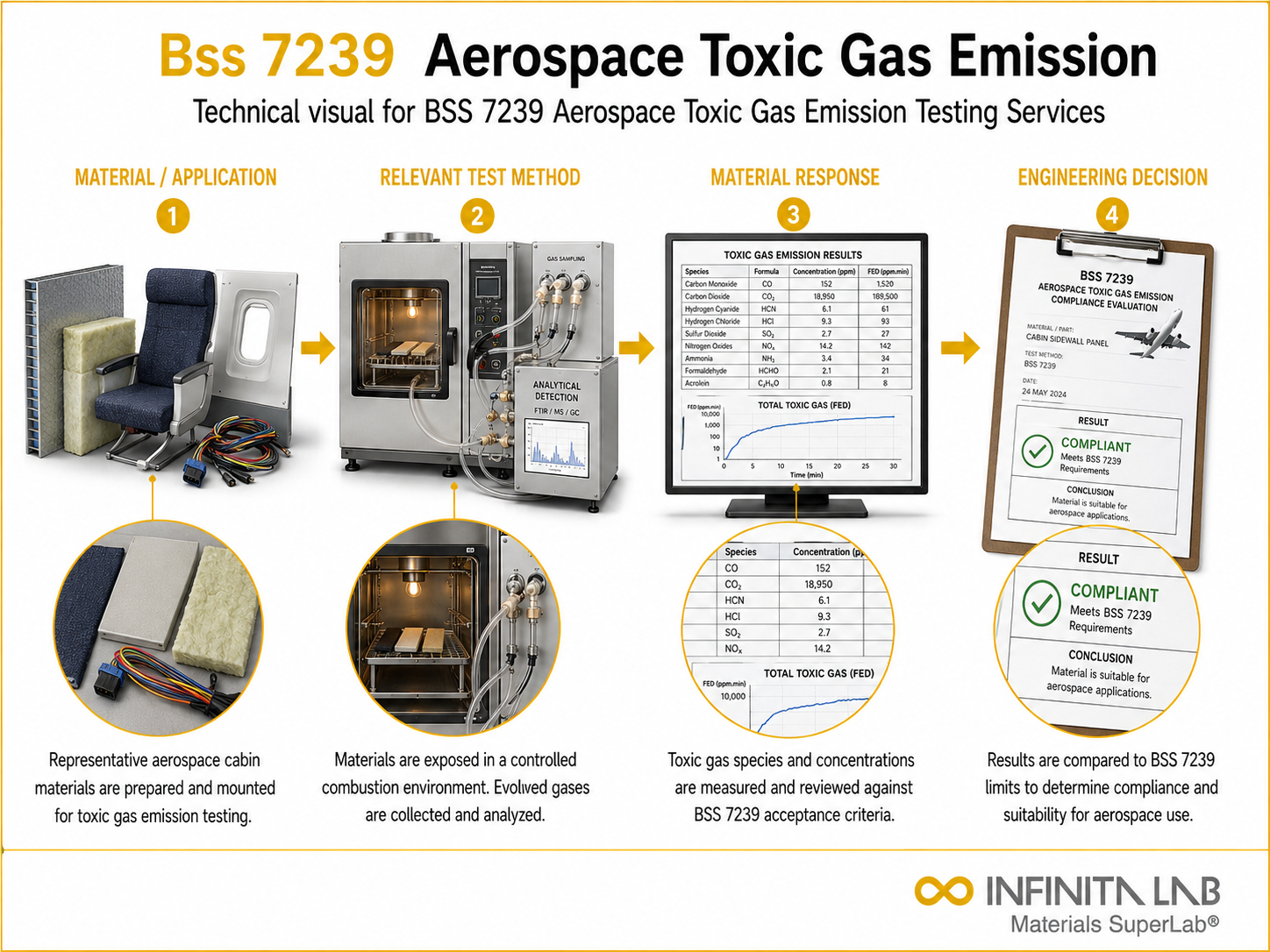
BSS 7239 Toxic Gas Test – Test Process
Sample Preparation
Specimens are cut and conditioned to ensure consistent properties before exposure.
1Chamber Setup
The sample is placed in a controlled combustion chamber equipped with gas collection and analysis systems.
2Thermal Exposure
The material is exposed to defined heat or flame conditions to generate decomposition gases.
3Gas Analysis
Emitted gases are collected and analyzed using analytical instruments to quantify toxic species.
4Test parameters and requirements
| Parameter | Details |
|---|---|
| Standard | BSS 7239 toxic gas emission testing |
| Applicable Materials | Composites, polymers, foams, textiles, adhesives, and coatings for aircraft interiors |
| Target Gases | CO, HCN, SO₂, NOx, HF, HCl |
| Sample Conditioning | 23 °C / 50 % RH |
| Typical Conditioning Duration | 24–48 hours |
| Test Environment | Controlled combustion chamber |
| Replicate Testing | Typically minimum 3 specimens |
| Sample Type | Polymers, composites, textiles, insulation materials |
| Specimen Conditioning | Pre-test temperature and humidity conditioning |
| Measured Outputs | Individual gas concentrations, toxic gas profile, pass/fail result |
| Loading Type | Heat or flame exposure |


- NBS Smoke Density Chamber – the enclosed test cell where specimens are combusted or pyrolyzed under controlled, repeatable conditions.
- Non-Dispersive Infrared (NDIR) Analyzer – keeps a continuous reading of carbon monoxide concentration throughout each exposure run.
- Gas Detection Instruments – colorimetric, electrochemical, or spectrophotometric equipment used to quantify HCN, HCl, HF, NOx, and SO2 in the sampled atmosphere.
- Calibrated Radiant Heat Source – delivers a consistent, measured heat flux to the specimen for the non-flaming exposure mode.
- Pilot Flame Assembly – supplies the ignition source used during the flaming-combustion exposure.
- Data Acquisition System – logs gas concentration readings in real time for later reduction and reporting.
- Calibration Gas Standards – reference gases that verify analyzer accuracy before and during testing.
Equipment and Instrumentation Used for Testing
What You Receive: Test Report, Data, and Certification
- Peak and time-weighted concentration values for each toxic gas species measured during both exposure modes.
- A pass/fail evaluation weighed against the toxicity limits specified in the governing material or engineering specification.
- A formal test report suitable for inclusion in supplier qualification files and certification packages.
- Comparative data that can be referenced alongside BSS 7238 smoke density and flammability results for the same material.
- Raw chart or trace data showing gas evolution over the exposure period, useful for engineering review.
- Guidance on retesting or material reformulation for cases where results fall outside the applicable acceptance criteria.
BSS Aerospace Toxicity FAQs
BSS 7239 is used to evaluate the toxicity of gases generated when materials burn. This test is used to determine the concentration of hazardous gases generated and to calculate the toxicity index value for the safety of passengers in the event of a fire in an aircraft.
BSS 7239 checks that interior aircraft materials do not emit excessive amounts of toxic gases during fire exposure. This protects the people on board from excessive levels of noxious components in the smoke produced by burning aircraft materials.
Carbon monoxide is highly toxic and produced in incomplete combustion. Even low concentrations can impair oxygen transport in the bloodstream, making it a key indicator of fire toxicity risk.
BSS 7239 focuses on chemical toxicity of emitted gases, while BSS 7238 evaluates optical smoke density. Together, they provide a comprehensive understanding of fire hazards.
BSS 7239 tests for toxic gases in a controlled combustion test and may not accurately simulate the various fire scenarios that occur during an aircraft fire, depending on ventilation conditions, mixed materials, and fire intensity.
BSS 7239 evaluates toxic gases released when materials undergo combustion. Samples are exposed to controlled heat in a smoke chamber, and gases such as CO, HCN, HF, HCl, SO₂, and NOₓ are collected and measured.
BSS 7239 testing exposes material specimens to controlled flaming or non-flaming conditions and analyzes the resulting combustion gases. Gas concentrations are measured using appropriate analytical methods and compared with applicable limits.
SMP 800-C evaluates toxic gases generated during material combustion using controlled smoke-generation conditions. It measures gases including CO, CO₂, HCN, HF, HCl, HBr, NOₓ, and SO₂ using specified sampling and analytical procedures.
Why Choose Infinita Lab for BSS Aerospace Toxicity Testing
When your BSS Aerospace Toxicity results have to hold up - for compliance, a customer audit, or an engineering decision - accuracy and an unbiased third-party report matter more than price. Infinita Lab routes your BSS aerospace toxicity testing to ISO/IEC 17025-accredited U.S. partner labs with hands-on method experience, so you get defensible data, transparent reporting, and turnaround times built around your project deadline - not ours.

Looking for an Accredited Partner for BSS Aerospace Toxicity Testing?
Send query us at hello@infinitalab.com or call us at (888) 878-3090 to learn more about our services and how we can support you.



Request a Quote
Submit your material details and receive testing procedures, pricing, and turnaround time within 24 hours.
 Quick Turnaround and Hasslefree process
 Confidentiality Guarantee
 Free, No-obligation Consultation
 100% Customer Satisfaction
