


Systemic Toxicity Testing Services
Systemic toxicology is the study of the effects of chemical substances and medical devices on the body. Acute Systemic Injection Tests (ASIT) and Material Mediated Pyrogen Tests (MMPT) are conducted to assess the potential health risks posed by acute exposure. Animals are monitored for changes in temperature and other indicators of toxicity. These tests must comply with ISO 10993-11 and ISO 10993-12 standards to ensure patient safety.
TRUSTED BY


Get compliant results — request your systemic toxicity testing quote
- Overview
- Scope, Applications, and Benefits
- Test Process
- Specifications
- Instrumentation
- Results and Deliverables
What Is Systemic Toxicity?
Systemic toxicity testing evaluates the potential adverse effects of a material or chemical substance on the body as a whole – not just at the site of contact. For medical devices and biomaterials, this means assessing whether leachable or extractable substances from the test material, when introduced into the body, cause toxic responses in organs or tissues beyond the point of exposure. The two primary test types are the Acute Systemic Injection Test (ASIT) and the Material-Mediated Pyrogenicity Test (MMPT).
In the ASIT, extracts of the test material prepared in saline and cottonseed oil are administered to mice by intravenous and intraperitoneal injection. Animals are observed over 72 hours for signs of systemic toxicity, including changes in body weight, posture, motor activity, and mortality. In the MMPT, extracts are administered intravenously to rabbits, and body temperature is monitored over a defined period to detect pyrogenic (fever-inducing) responses caused by material-derived contaminants.
These tests are part of the broader biocompatibility evaluation framework for medical devices under ISO 10993. They address the systemic toxicity endpoint defined in ISO 10993-11 and are conducted using extraction vehicles and conditions specified in ISO 10993-12.

Applications and Benefits of Systemic Toxicity Testing
Scope
Systemic toxicity testing covers in vivo evaluation of material extracts for acute systemic and pyrogenic effects. The tests are conducted on animal models using extracts prepared from the test material under conditions intended to simulate worst-case clinical exposure. Both tests are governed by the ISO 10993 series, and the extraction conditions – solvent, temperature, duration, and surface area to volume ratio – are defined per ISO 10993-12.
The testing scope includes:
- Acute Systemic Injection Test (ASIT) – mouse model; extracts in saline (IV route) and cottonseed oil (IP route) administered simultaneously; animals observed at 4, 24, 48, and 72 hours for clinical signs of toxicity; governed by ISO 10993-11 and USP <88> Biological Reactivity Tests, In Vivo
- Material-Mediated Pyrogenicity Test (MMPT) – rabbit model; saline extract administered IV; rectal temperature monitored before and at 1, 2, and 3 hours post-injection; pyrogenic response assessed against defined threshold; governed by ISO 10993-11 and USP <151> Pyrogen Test
- Extraction conditions – defined per ISO 10993-12; standard extraction vehicles include 0.9% saline and cottonseed oil; temperature typically 37°C for 24 hours or 70°C for 24 hours, depending on material and intended use
Applications
- Medical device biocompatibility – systemic toxicity and pyrogenicity are required endpoints in the ISO 10993-1 biocompatibility evaluation matrix for devices with prolonged or permanent contact with the body; ASIT and MMPT are commonly needed for implants, catheters, tubing, and fluid-contact components
- New material qualification – when a new polymer, coating, or adhesive is introduced into a medical device, systemic toxicity testing establishes that leachables from the material do not produce adverse systemic effects
- Change control and material substitution – changes in raw material supplier, processing aids, or sterilization method can alter the extractable profile; retesting confirms the updated material remains within acceptable limits
- Combination products and drug-device interfaces – components that contact drug solutions or are used in drug delivery systems require systemic toxicity data covering both the material itself and its potential interactions with the drug vehicle
- Veterinary devices and implants – systemic toxicity evaluation for materials used in veterinary medical devices where similar biocompatibility endpoints are applicable
Benefits
- Addresses the systemic endpoint that local biocompatibility tests cannot – cytotoxicity, sensitization, and irritation tests evaluate localized responses; ASIT and MMPT are the only in vivo tests that detect body-wide toxic effects from material extracts
- Both routes of exposure covered in ASIT – IV and IP injection in the same study cover both direct vascular exposure and peritoneal absorption, providing broader coverage of potential clinical exposure scenarios
- MMPT distinguishes material-mediated pyrogenicity from endotoxin – a LAL test detects endotoxin but not non-endotoxin pyrogens; MMPT detects both, making it relevant for materials where chemical pyrogens are a concern
- Internationally recognized test methods – ISO 10993-11, USP 88, and USP 151 are accepted by FDA, EMA, and other major health authorities for device submissions; data generated under these methods does not need to be repeated for different market submissions
- Supports a risk-based biocompatibility strategy – when chemical characterization data alone is insufficient to rule out systemic risk, in vivo systemic toxicity data provides the biological evidence needed to support a safety conclusion
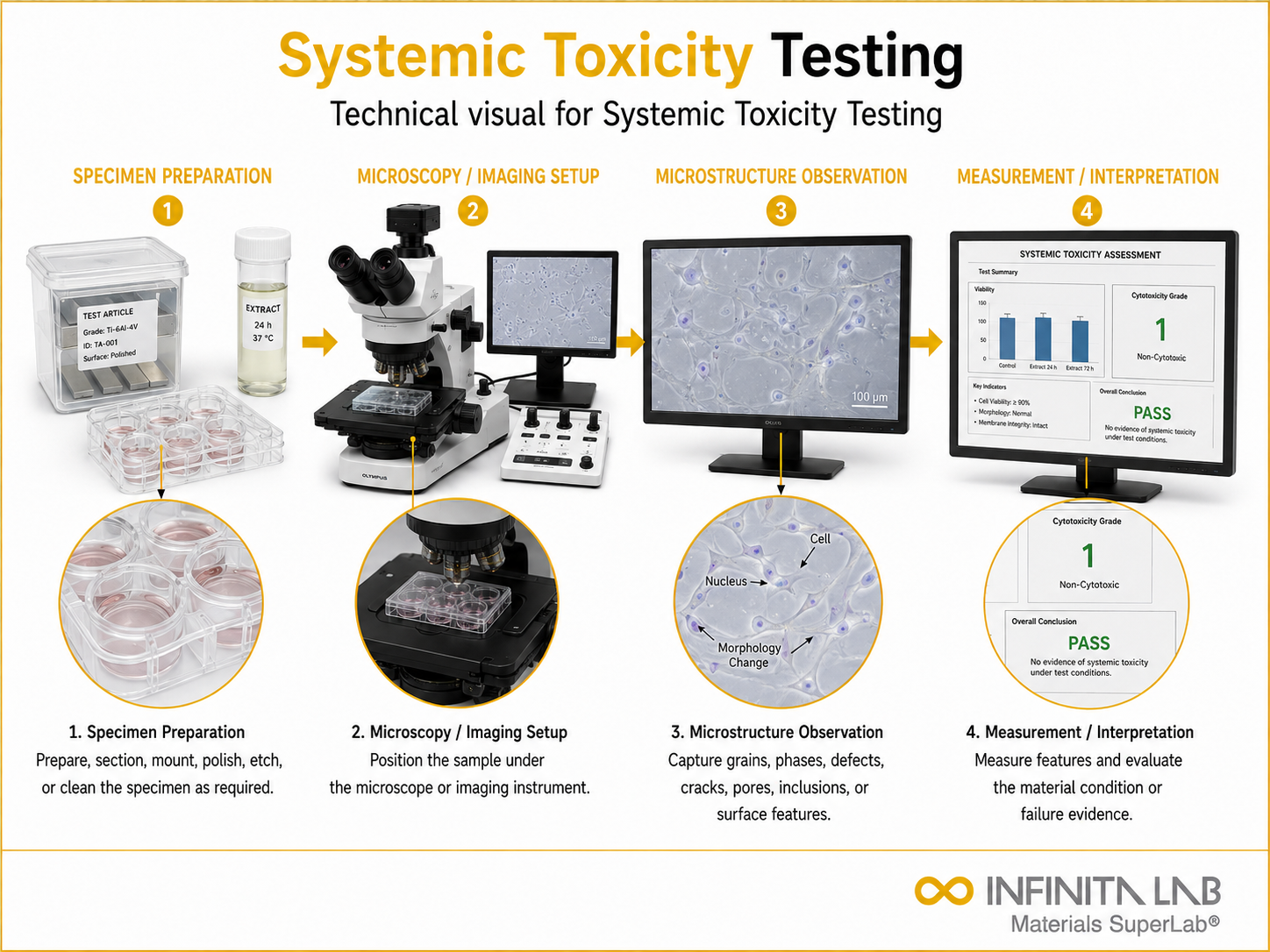
Our Testing Procedure
Extract Preparation
Test material extracts are prepared in saline and cottonseed oil as per ISO 10993-12, with blank extracts used as controls.
1Animal Dosing
For ASIT, mice are injected with saline and oil extracts. For MMPT, rabbits receive the saline extract intravenously.
2Observation
Animals are monitored for toxicity signs, body weight changes, mortality, or temperature rise at specified time points.
3Evaluation and Reporting
Results are compared with control groups and acceptance limits. Pass/fail conclusions are documented in the test report.
4Test parameters and requirements
| Parameter | Details |
|---|---|
| Applicable Standards | ISO 10993-11, ISO 10993-12, USP <88>, USP <151> |
| Test Types | Acute Systemic Injection Test (ASIT); Material-Mediated Pyrogenicity Test (MMPT) |
| Animal Models | Mice (ASIT); Rabbits (MMPT) |
| Extraction Vehicles | 0.9% Saline; Cottonseed oil |
| Extraction Conditions | Typically 37°C/24h or 70°C/24h per ISO 10993-12 |
| ASIT Routes | IV (saline extract); IP (cottonseed oil extract) |
| MMPT Route | IV (saline extract) |
| Observation Period | ASIT: 72 hours; MMPT: 3 hours post-injection |
| ASIT Endpoint | Clinical signs of toxicity, body weight change, and mortality |
| MMPT Endpoint | Individual and cumulative temperature rise vs. defined threshold |
| Minimum Group Size | ASIT: 5 mice per group; MMPT: 3 rabbits per group |


- Autoclave and extraction equipment for extract preparation
- Analytical balance for sample and dose preparation
- Rectal thermometer or telemetry system for rabbit temperature monitoring
- Animal observation facilities (mice and rabbit housing)
- Syringes and injection equipment for IV and IP dosing
- Timers and data recording systems for observation schedules
Equipment and Instrumentation Used for Testing
What You Receive: Test Report, Data, and Certification
- Test report – test material description, extraction conditions, vehicle used, animal group assignments, dose volumes, and observation schedule
- ASIT results – individual animal observations at each time point, body weight data, and group summary with pass/fail conclusion
- MMPT results – individual rabbit temperature readings at baseline and each post-injection time point, temperature rise calculations, and pass/fail conclusion against the pyrogenicity threshold
- Control group data – blank extract results confirming the solvent vehicle itself does not produce a response
- Extraction records – preparation conditions, lot numbers, and any observations noted during extract preparation
- Raw data tables – complete individual animal data for all observations and measurements
Systemic Toxicity FAQs
It helps assess the biological safety of medical devices, biomaterials, and other patient-contacting products.
Finished devices, raw materials, polymers, coatings, metals, elastomers, and other biomaterials can be tested.
Material extracts are prepared and administered to test animals through defined routes such as intravenous, intraperitoneal, or oral exposure.
Acute Systemic Injection Testing assesses short-term toxic effects after injection of material extracts.
The Material-Mediated Pyrogen Test evaluates whether a material extract causes a fever response.
Why Choose Infinita Lab for Systemic Toxicity Testing
At the core of this breadth is our network of 2,000+ accredited laboratories across the USA, offering access to over 10,000 testing methods and analytical services. From advanced materials characterization (SEM, TEM, RBS, XPS) to mechanical, chemical, environmental, biological, and standardized ASTM/ISO-compliant testing, we deliver unmatched flexibility, specialization, and scale. You are never limited by geography, facility, or methodology — Infinita Lab connects you to the right expertise and testing solution, every time.

Looking for an Accredited Partner for Systemic Toxicity Testing?
Send query us at hello@infinitalab.com or call us at (888) 878-3090 to learn more about our services and how we can support you.



Request a Quote
Submit your material details and receive testing procedures, pricing, and turnaround time within 24 hours.
 Quick Turnaround and Hasslefree process
 Confidentiality Guarantee
 Free, No-obligation Consultation
 100% Customer Satisfaction
