


ASTM F963: Toy Safety Testing Services
ASTM F963-17 test method determines the techniques that can be applied to minimize the hazards posed by toys and contribute towards toy safety. The age range and the safe usage of toys are focused on in this approach. The final results of this method are displayed keeping in view the international standards.
TRUSTED BY


Get ASTM F963 compliant results — request your toy safety testing quote
- Overview
- Scope, Applications, and Benefits
- Test Process
- Specifications
- Instrumentation
- Results and Deliverables
Applications and Benefits of ASTM F963 Toy Safety Testing
ASTM F963-17 is a comprehensive consumer safety standard developed by ASTM International that establishes minimum safety requirements for toys intended for use by children under 14 years of age. The standard addresses a broad range of hazards — mechanical, chemical, electrical, thermal, and acoustic — that can arise from toy design, materials, and construction. Testing to ASTM F963-17 verifies that a toy will not pose an unreasonable risk of injury during normal use or reasonably foreseeable misuse.
Manufacturers, importers, and private-label brands are all responsible for ensuring their products meet the specifications before entering the market. Third-party testing by a CPSC-accepted laboratory is required for children’s toys, and a Children’s Product Certificate (CPC) must be issued and maintained.
Compliance with ASTM F963-17 is the baseline expectation for any toy product entering the U.S. market, and alignment with it also significantly supports regulatory submissions in international markets.

Applications and Benefits of ASTM F963 Toy Safety Testing
Scope
ASTM F963-17 covers toys and other articles intended for use in play by children under 14 years of age. The standard specifies requirements for materials, design, construction, and labeling, and prescribes test methods to evaluate compliance in each area.
Key hazard categories addressed include:
- Mechanical and physical hazards — sharp edges, sharp points, small parts, protrusions, and accessible openings that could cause cuts, punctures, or choking
- Flammability — the ignition resistance of materials used in toy construction
- Chemical hazards — limits on heavy metals, restricted substances in surface coatings, and migration limits for materials in contact with children
- Electrical hazards — requirements for battery-operated and electrically powered toys
- Thermal hazards — surface temperature limits for toys with heating elements
- Acoustic hazards — sound pressure level limits to protect against hearing damage
- Age-grading and labeling — requirements for warning labels, choking hazard notifications, and age-appropriateness marking
The standard also includes provisions for specific toy categories such as stuffed and plush toys, toys with projectiles, ride-on toys, art materials, and toys intended for children under 36 months.
Applications
- Toy manufacturers and OEMs — domestic producers and overseas manufacturers supplying to U.S. retailers
- Importers and brand owners — parties legally responsible for CPSIA compliance when bringing toys into the U.S. market
- Retailers and private-label brands — companies marketing toys under their own name, regardless of where the product is manufactured
- Product developers — design and engineering teams assessing safety requirements early in the development cycle
- Testing laboratories — CPSC-accepted third-party labs conducting conformity assessments
- Certification and regulatory consultants — professionals supporting compliance documentation and market access
Benefits
- Mandatory market access — ASTM F963-17 compliance is legally required for U.S. toy sales; testing resolves this obligation and enables lawful distribution.
- Hazard identification before market entry — structured testing surfaces design deficiencies, material failures, and labeling gaps while correction is still practical
- Consumer and brand protection — demonstrated compliance reduces liability exposure and supports consumer confidence in product safety.
- International alignment — ASTM F963-17 overlaps significantly with EN 71 and ISO 8124, meaning test data can support multiple market submissions while efficiently using resources.
- Audit and retail readiness — major U.S. retailers require valid test reports and CPCs as a condition of listing; compliance documentation satisfies this requirement upfront
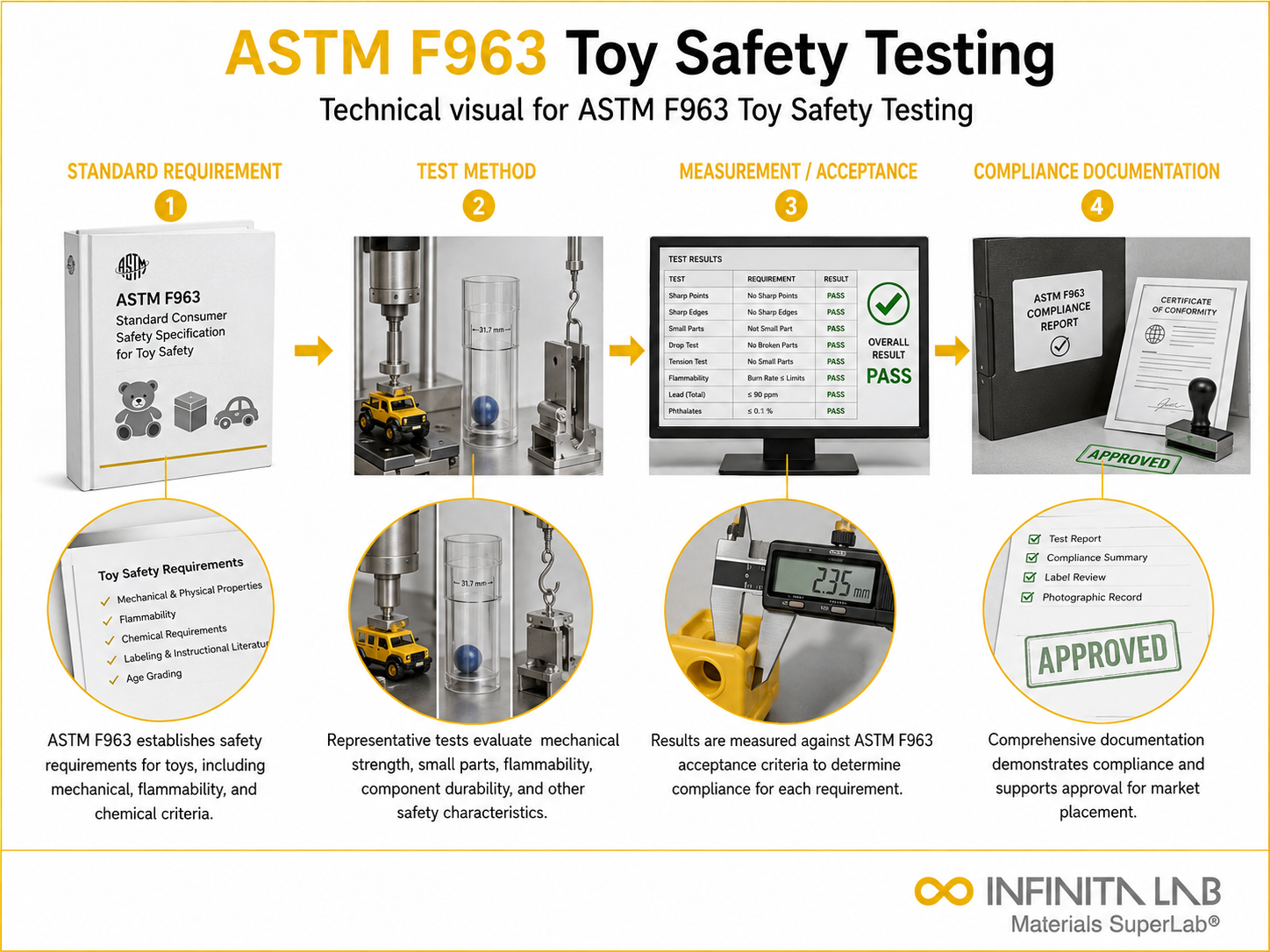
Our ASTM F963 Testing Procedure
Review & Sample Assessment
Verify applicable ASTM F963-17 requirements and evaluate product construction, age grading, and labeling.
1Safety Testing
Perform mechanical, physical, and flammability tests to assess product safety and durability.
2Chemical & Electrical Testing
Test for regulated substances, electrical safety, temperature limits, and sound levels as applicable.
3Reporting & Compliance
Review labelling compliance and issue a test report to support CPC certification.
4ASTM F963 Test Parameters and Requirements
| Parameter | Details |
|---|---|
| Mechanical Tests | Sharp edges, sharp points, small parts, torque, tension, impact, bite force, projectile, ride-on stability |
| Flammability Tests | Ignition resistance, flame propagation per applicable material categories |
| Chemical Tests | Heavy metals (soluble and total), phthalates, and restricted substances in coatings |
| Electrical Tests | Accessible voltage, insulation, thermal cut-off, and battery compartment requirements |
| Acoustic Tests | Sound pressure level limits (continuous and impulsive) |
| Labelling Requirements | Age grading, choking hazard warnings, manufacturer/importer identification |


- Sharp edge and sharp point probes
- Small parts cylinder (per 16 CFR Part 1501)
- Torque and tension test apparatus
- Drop and impact test equipment
- Flammability test chamber
- ICP-MS and AAS systems for heavy metal analysis
- GC-MS for phthalate and restricted substance analysis
- Electrical safety test equipment (hi-pot, leakage current measurement)
- Calibrated sound level meter and acoustic measurement system
- Calibrated thermocouples and surface temperature measurement equipment
Equipment and Instrumentation Used for ASTM F963 Testing
What You Receive: Test Report, Data, and Certification
- Test report — full documentation of all clauses evaluated, methods applied, specimen descriptions, and pass/fail results for each requirement
- Pass/fail determination — clear compliance status against each applicable section of ASTM F963-17.
- Failure and nonconformance summary — identification of any failed clauses with the specific requirement not met, supporting corrective action
- Chemical analysis data — quantitative results for heavy metals, phthalates, and other restricted substances with comparison to applicable limits
- Children’s Product Certificate support data — test report structured to meet CPSC documentation requirements for CPC issuance
- Labeling review findings — documented assessment of warning statements and age-grade markings against standard requirements
- Photographic documentation — visual records of specimen condition, test setup, and any identified nonconformances
ASTM F963 Toy Safety FAQs
The standard covers many products designed primarily for play, including dolls, games, rattles, projectile toys, battery-operated toys and ride-on toys. Some products, such as bicycles, playground equipment and non-powered scooters, are excluded.
Mechanical tests evaluate small parts, sharp points, sharp edges, projections, cords, hinges, wheels and accessible mechanisms. These tests help identify choking, cutting, pinching, strangulation and entrapment hazards.
Yes. The standard evaluates lead and soluble heavy elements such as antimony, arsenic, barium, cadmium, chromium, mercury and selenium in applicable coatings and substrates.
Toys intended for young children are assessed using a small-parts cylinder and age-appropriate use-and-abuse tests. Components that fit completely inside the cylinder may present a choking hazard.
Battery-operated toys are evaluated for overheating, short circuits, battery accessibility, polarity and secure battery-compartment construction. Testing helps reduce electrical, thermal, fire and ingestion hazards.
Why Choose Infinita Lab for Toy Safety Testing
At the core of this breadth is our network of 2,000+ accredited laboratories across the USA, offering access to over 10,000 testing methods and analytical services. From advanced materials characterization (SEM, TEM, RBS, XPS) to mechanical, chemical, environmental, biological, and standardized ASTM/ISO-compliant testing, we deliver unmatched flexibility, specialization, and scale. You are never limited by geography, facility, or methodology — Infinita Lab connects you to the right expertise and testing solution, every time.

Looking for an Accredited Partner for ASTM F963 Toy Safety Testing?
Send query us at hello@infinitalab.com or call us at (888) 878-3090 to learn more about our services and how we can support you.



Request a Quote
Submit your material details and receive testing procedures, pricing, and turnaround time within 24 hours.
 Quick Turnaround and Hasslefree process
 Confidentiality Guarantee
 Free, No-obligation Consultation
 100% Customer Satisfaction
