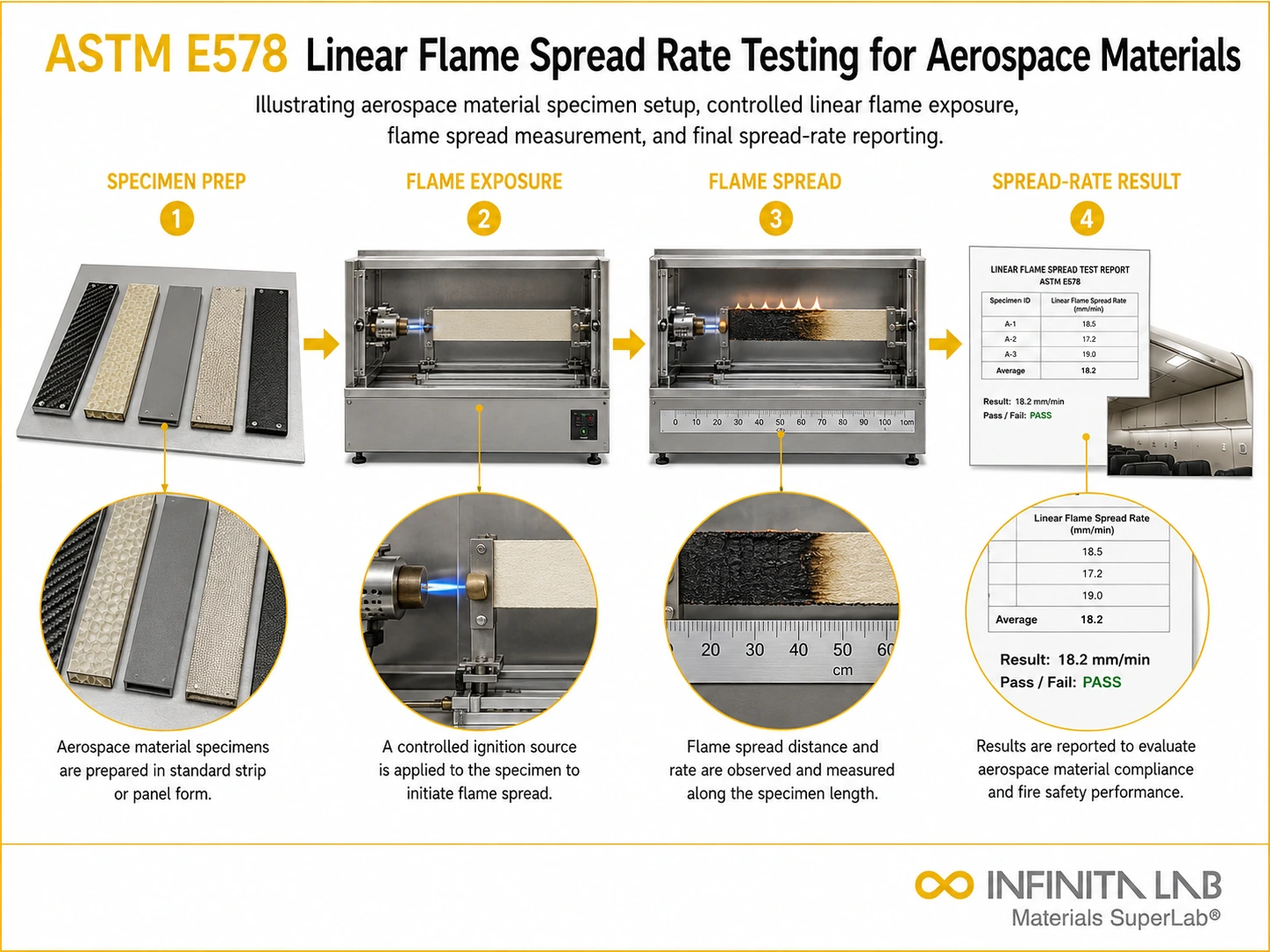


What Is ASTM E578 Linear Flame Spread Aerospace?
ASTM E578 – 07 defines procedures for evaluating the linearity of fluorescence measuring systems. The method determines how accurately the instrument response correlates with known concentrations of fluorescent materials over a defined measurement range.
This standard is essential for ensuring reliable quantitative fluorescence measurements in analytical applications. By verifying linear response behavior, ASTM E578 helps identify instrument limitations, improves calibration accuracy, and ensures consistency in results across different concentration levels.

Applications and Benefits of ASTM E578 Linear Flame Spread Aerospace Testing
Scope
ASTM E578 establishes a method to assess the linearity of fluorescence measurement systems using calibrated standards. It ensures accurate response across a defined concentration range.
- Applicable to fluorescence spectrometers and detectors
- Evaluates instrument response versus concentration
- Suitable for calibration verification and performance testing
- Ensures reliable quantitative fluorescence analysis
Applications
- Calibration of fluorescence instruments
- Analytical chemistry measurements
- Environmental and trace analysis
- Pharmaceutical and material testing
- Research and laboratory validation
Benefits
- Ensures accurate quantitative fluorescence data
- Identifies non-linear instrument behavior
- Improves calibration reliability
- Enhances measurement confidence
- Supports quality assurance processes
Our ASTM E578 Testing Procedure
Standard Preparation
Prepare a series of fluorescent standards with known increasing concentrations.
1Instrument Calibration
Set up and stabilize the fluorescence system under defined operating conditions.
2Fluorescence Measurement
Measure fluorescence intensity for each standard under identical conditions.
3Linearity Evaluation
Plot intensity versus concentration and assess deviation from linear response.
4ASTM E578 Test Parameters and Requirements
| Parameter | Details |
|---|---|
| Standard | ASTM E578 – 07 |
| Method | Fluorescence response linearity evaluation |
| Measurement Type | Fluorescence intensity vs concentration |
| Sample Type | Fluorescent standard solutions |
| Concentration Range | Defined calibration range |
| Measurement Basis | Emission intensity proportionality |
| Units | Relative fluorescence units (RFU) |


- Fluorescence spectrometer
- Light source (UV/visible excitation)
- Photodetector (PMT or photodiode)
- Calibration standards
- Data acquisition system
Equipment and Instrumentation Used for ASTM E578 Testing
What You Receive: Test Report, Data, and Certification
- Calibration curve (intensity vs concentration)
- Linearity range and correlation coefficient
- Deviation from linearity data
- Instrument performance evaluation
- Final calibration and validation report
ASTM E578 Linear Flame Spread Aerospace FAQs
Linearity is defined as the proportional relationship between fluorescence intensity and analyte concentration. ASTM E578 evaluates this by comparing measured responses to expected values across a calibration range and quantifying deviations from ideal linear behavior.
Accurate quantification depends on predictable signal response. Non-linearity leads to systematic errors, especially at high or low concentrations, compromising analytical reliability and requiring correction or range limitation.
At elevated concentrations, analyte absorbs excitation and emission light internally, reducing effective fluorescence output. This leads to signal suppression and deviation from linear proportionality, limiting the usable analytical range.
Detector saturation at high intensities compresses signal response, while low-end noise limits sensitivity. These boundaries define the true linear dynamic range and must be carefully identified during evaluation.
It establishes the reliable working range of the instrument, ensuring that quantitative measurements are performed only within regions where proportional response is scientifically valid and reproducible.
Why Choose Infinita Lab for Linear Flame Spread Aerospace Testing?
At the core of this breadth is our network of 2,000+ accredited laboratories across the USA, offering access to over 10,000 testing methods and analytical services. From advanced materials characterization (SEM, TEM, RBS, XPS) to mechanical, chemical, environmental, biological, and standardized ASTM/ISO-compliant testing, we deliver unmatched flexibility, specialization, and scale. You are never limited by geography, facility, or methodology — Infinita Lab connects you to the right expertise and testing solution, every time.

Looking for an Accredited Partner for ASTM E578 Linear Flame Spread Aerospace Testing?
Send query us at hello@infinitalab.com or call us at (888) 878-3090 to learn more about our services and how we can support you.





