


ASTM D6671: Composite Mixed Mode Fracture Toughness Testing Services
ASTM D6671 is a standard test method that establishes the short-term hydraulic failure pressure of thermoplastic pipe, tubing, and fittings, reinforced thermosetting pipe, and reinforced thermoplastic pipe.
TRUSTED BY


Get ASTM D6671 compliant results — request your composite mixed mode fracture toughness testing quote
- Overview
- Scope, Applications, and Benefits
- Test Process
- Specifications
- Instrumentation
- Results and Deliverables
What Is ASTM D6671 Composite Mixed Mode Fracture Toughness?
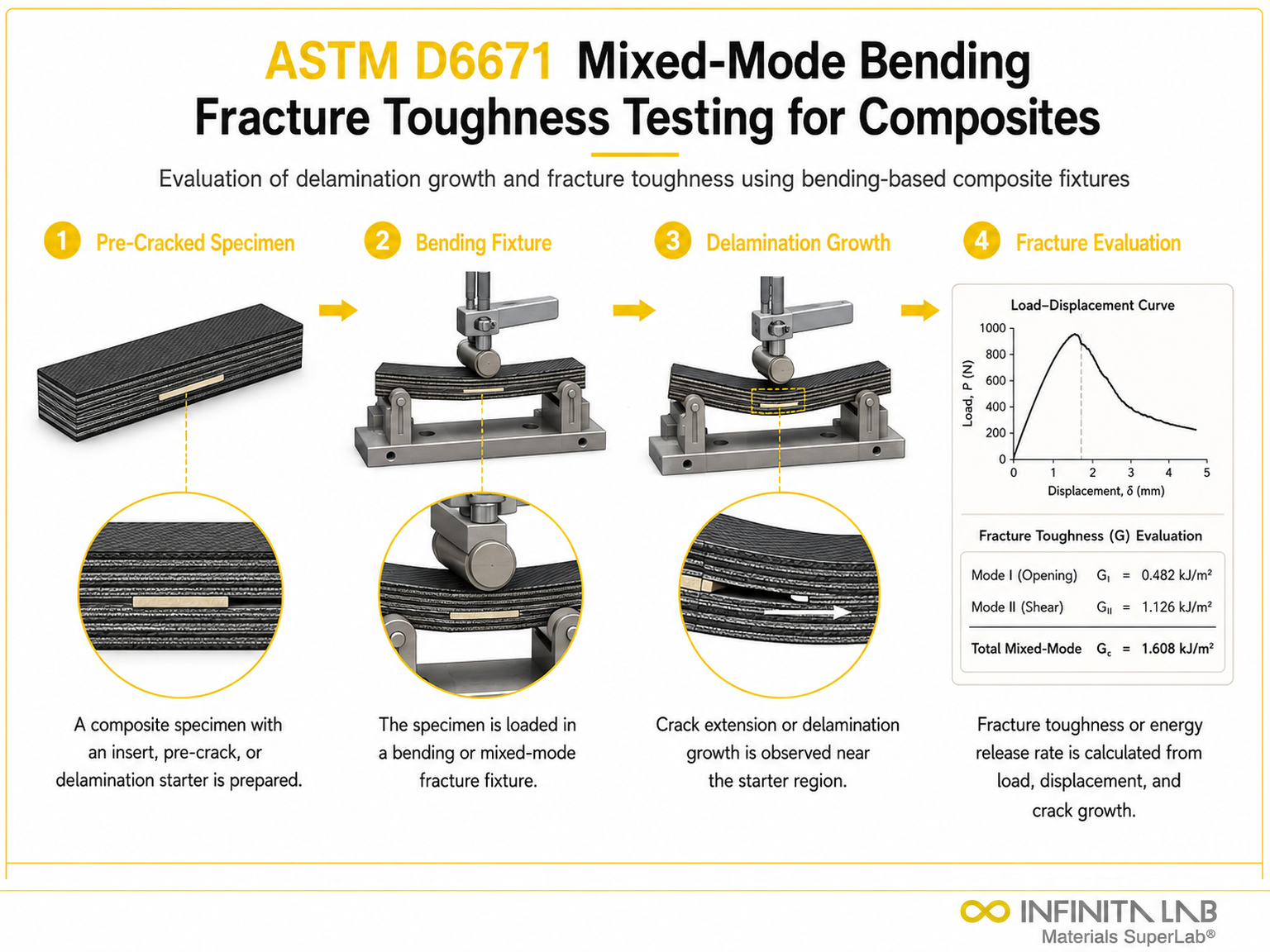
ASTM D6671 is a standard test method for measuring the mixed-mode (Mode I and Mode II) interlaminar fracture toughness of unidirectional fiber-reinforced polymer matrix composites using the Mixed Mode Bending (MMB) test fixture. Delamination is a primary failure mode in composite structures, and understanding fracture behavior under combined opening and shearing loads is critical for structural design and damage tolerance assessment.
This method allows the user to independently vary the ratio of Mode I (opening) to Mode II (shearing) loading by adjusting the lever arm of the MMB fixture, making it uniquely versatile for characterizing the complete mixed-mode fracture behavior of composite laminates.

Applications and Benefits of ASTM D6671 Composite Mixed Mode Fracture Toughness Testing
Scope
ASTM D6671 evaluates:
- Mixed-mode interlaminar fracture toughness (G_c)
- Mode I and Mode II component contributions at defined mode mixity ratios
- Crack initiation and propagation resistance
- Applicability to unidirectional composite laminates with a pre-implanted delamination
Applications
- Aerospace composite structural design and damage tolerance
- Automotive composite component delamination resistance
- Wind turbine blade composite evaluation
- Marine composite structural qualification
- Research and development of composite matrices and interfaces
Benefits
- Enables testing across a range of Mode I/Mode II ratios in one fixture
- Provides critical fracture toughness data for structural failure models
- Supports progressive damage modeling and finite element analysis (FEA)
- Enables comparison of toughened and untoughened matrix systems
- Standardized data accepted by aerospace and structural design communities
Our ASTM D6671 Testing Procedure
Specimen Preparation
Unidirectional composite specimens with a pre-implanted PTFE film delamination are cut, measured, and piano-hinged for loading.
1MMB Fixture Setup
The specimen is mounted in the MMB fixture; lever arm length is adjusted to achieve the target Mode I/Mode II mixity ratio.
2Fracture Testing
Load is applied at a controlled rate, recording load–displacement and crack length during initiation and propagation.
3G_c Calculation
Mixed-mode fracture toughness (G_c) is calculated from load, displacement, and crack length data per ASTM D6671.
4ASTM D6671 Test Parameters and Requirements
| Parameter | Details |
|---|---|
| Standard | ASTM D6671 |
| Test Principle | Mixed Mode Bending (MMB) with adjustable lever arm |
| Applicable Materials | Unidirectional CFRP and GFRP composite laminates |
| Measured Output | Mixed-mode fracture toughness G_c (J/m²) |
| Mode Mixity | Variable G_IIc/G_c ratio adjustable via lever arm |
| Pre-crack | PTFE film insert at mid-plane |


- Mixed Mode Bending (MMB) test fixture
- Servo-hydraulic or electromechanical universal testing machine
- Optical microscope or traveling microscope for crack length measurement
- Piano hinges for specimen loading
- Data acquisition system for load and displacement
- Digital image correlation (DIC) system
Equipment and Instrumentation Used for ASTM D6671 Testing
What You Receive: Test Report, Data, and Certification
- Mixed-mode fracture toughness G_c at multiple mode mixity ratios
- G_I and G_II component values
- Load-displacement curves and crack growth data
- Mixed-mode fracture envelope (G_I vs. G_II)
- Material design allowable and qualification data
ASTM D6671 Composite Mixed Mode Fracture Toughness FAQs
Mixed-mode fracture occurs when a delamination propagates under simultaneous Mode I (crack opening, peel) and Mode II (in-plane shear, sliding) loading, which is common in real structural loading scenarios.
Real delaminations experience varying ratios of opening and shearing loads depending on structure geometry and load case. Testing across a range of mixities maps the full fracture envelope needed for accurate failure prediction.
Mode mixity is controlled by adjusting the lever arm length of the MMB fixture. A shorter lever arm increases Mode II contribution; a longer arm increases Mode I dominance.
Carbon fiber/epoxy (CFRP) and glass fiber/epoxy (GFRP) unidirectional laminates are the most common systems, though any unidirectional composite system can be evaluated.
ASTM D5528 measures pure Mode I fracture toughness and D7905 measures pure Mode II. ASTM D6671 bridges these by measuring fracture toughness under combined loading, completing the interlaminar fracture characterization.
Why Choose Infinita Lab for Composite Mixed Mode Fracture Toughness Testing?
At the core of this breadth is our network of 2,000+ accredited laboratories across the USA, offering access to over 10,000 testing methods and analytical services. From advanced materials characterization (SEM, TEM, RBS, XPS) to mechanical, chemical, environmental, biological, and standardized ASTM/ISO-compliant testing, we deliver unmatched flexibility, specialization, and scale. You are never limited by geography, facility, or methodology — Infinita Lab connects you to the right expertise and testing solution, every time.

Need ASTM D6671 Composite Mixed Mode Fracture Toughness Testing You Can Rely On?
Send query us at hello@infinitalab.com or call us at (888) 878-3090 to learn more about our services and how we can support you.



Request a Quote
Submit your material details and receive testing procedures, pricing, and turnaround time within 24 hours.
 Quick Turnaround and Hasslefree process
 Confidentiality Guarantee
 Free, No-obligation Consultation
 100% Customer Satisfaction
