

What Is ASTM E2899 Surface Crack Initiation Toughness?
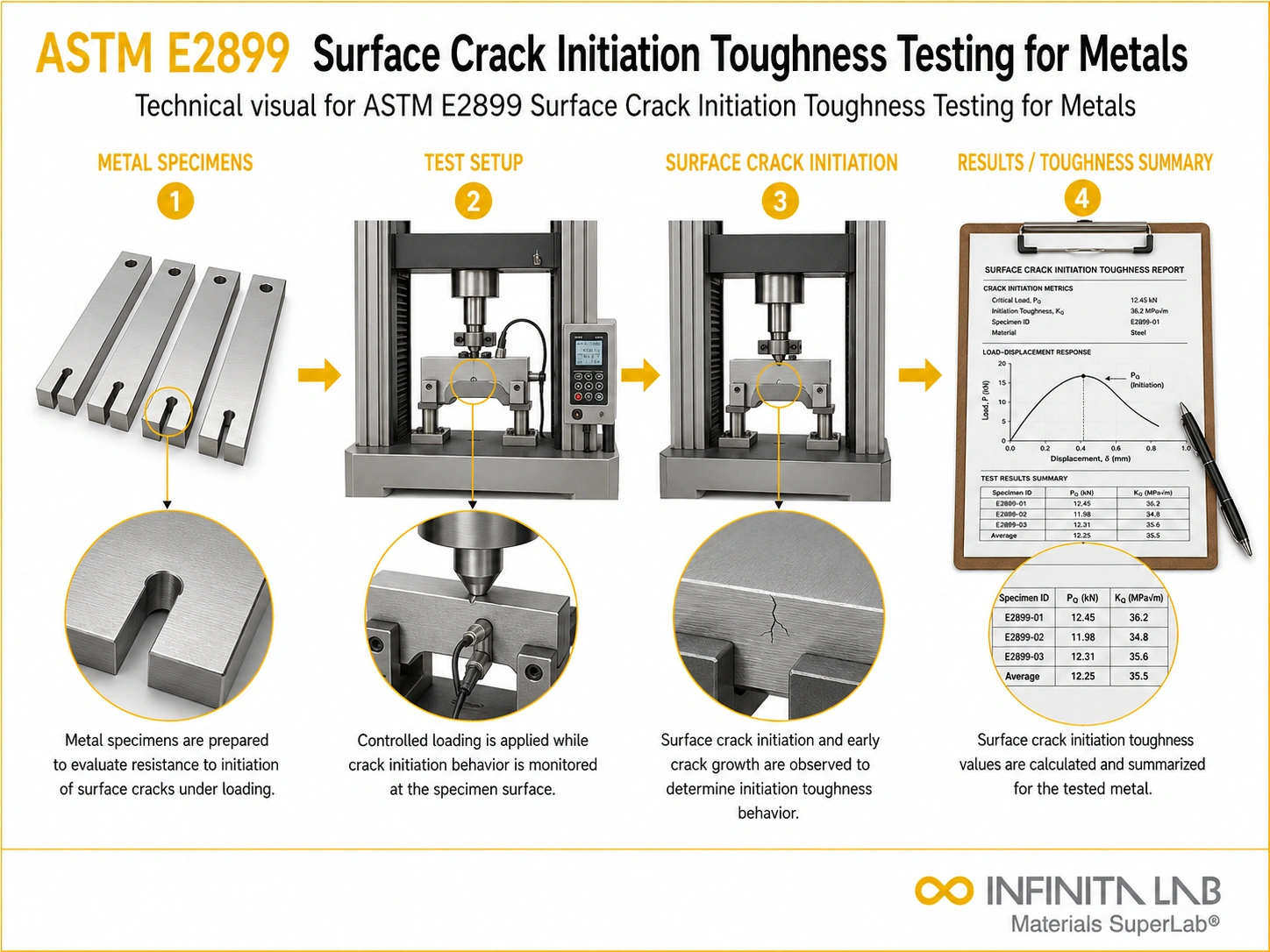
ASTM E2899 provides a test method for determining the initiation fracture toughness of materials containing surface cracks. It evaluates a material’s resistance to crack initiation from surface flaws under applied loading.
This standard is widely used in structural integrity assessments, especially for components where surface defects can significantly affect performance and safety.

Applications and Benefits of ASTM E2899 Surface Crack Initiation Toughness Testing
Scope
ASTM E2899 focuses on measuring the fracture toughness at the point of crack initiation for surface-cracked specimens. It ensures accurate evaluation of material resistance to crack growth.
The test evaluates:
- Initiation fracture toughness
- Crack initiation behavior
- Surface flaw sensitivity
- Stress intensity conditions
- Material reliability
Applications
- Structural components and pressure vessels
- Aerospace and automotive parts
- Pipeline and welded structures
- Failure analysis
- Research and quality control
Benefits
- Provides accurate toughness evaluation
- Improves safety and reliability
- Supports damage tolerance analysis
- Enables material comparison
- Helps predict failure behavior
Our ASTM E2899 Testing Procedure
Sample Preparation
Specimen with controlled surface crack is prepared.
1Loading
Sample is subjected to controlled mechanical loading.
2Crack Monitoring
Crack initiation is detected using suitable methods.
3Data Recording & Evaluation
Toughness is calculated at crack initiation.
4ASTM E2899 Test Parameters and Requirements
| Parameter | Details |
|---|---|
| Applicable Materials | Metals and structural materials |
| Specimen Type | Surface-cracked specimens |
| Loading Mode | Typically Mode I |
| Test Temperature | Ambient or controlled conditions |
| Measured Outputs | Initiation toughness (K or J values) |


- Universal testing machine
- Fracture mechanics fixtures
- Crack detection system (e.g., compliance or optical)
- Extensometer
- Data acquisition system
Equipment and Instrumentation Used for ASTM E2899 Testing
What You Receive: Test Report, Data, and Certification
- Initiation fracture toughness values
- Crack initiation data
- Material performance evaluation
- Test condition summary
- ASTM compliance report
ASTM E2899 Surface Crack Initiation Toughness FAQs
ASTM E2899 is a standard test method used to measure initiation toughness of materials containing surface cracks, evaluating resistance to crack initiation under applied loading conditions.
ASTM E2899 is important because it helps predict failure behavior and ensures structural integrity of components with surface flaws in engineering and critical applications.
ASTM E2899 involves loading a specimen with a surface crack and measuring the stress intensity at which crack initiation occurs.
ASTM E2899 requires a fracture mechanics testing machine, crack measurement tools, and loading fixtures for accurate evaluation.
ASTM E2899 results are reported as initiation toughness values, indicating resistance to crack initiation from surface defects.
Why Choose Infinita Lab for Surface Crack Initiation Toughness Testing?
When your Surface Crack Initiation Toughness results have to hold up - for compliance, a customer audit, or an engineering decision - ASTM E2899 accuracy and an unbiased third-party report matter more than price. Infinita Lab routes your ASTM E2899 surface crack initiation toughness testing to ISO/IEC 17025-accredited U.S. partner labs with hands-on method experience, so you get defensible data, transparent reporting, and turnaround times built around your project deadline - not ours.

Looking for an Accredited Partner for ASTM E2899 Surface Crack Initiation Toughness Testing?
Send query us at hello@infinitalab.com or call us at (888) 878-3090 to learn more about our services and how we can support you.