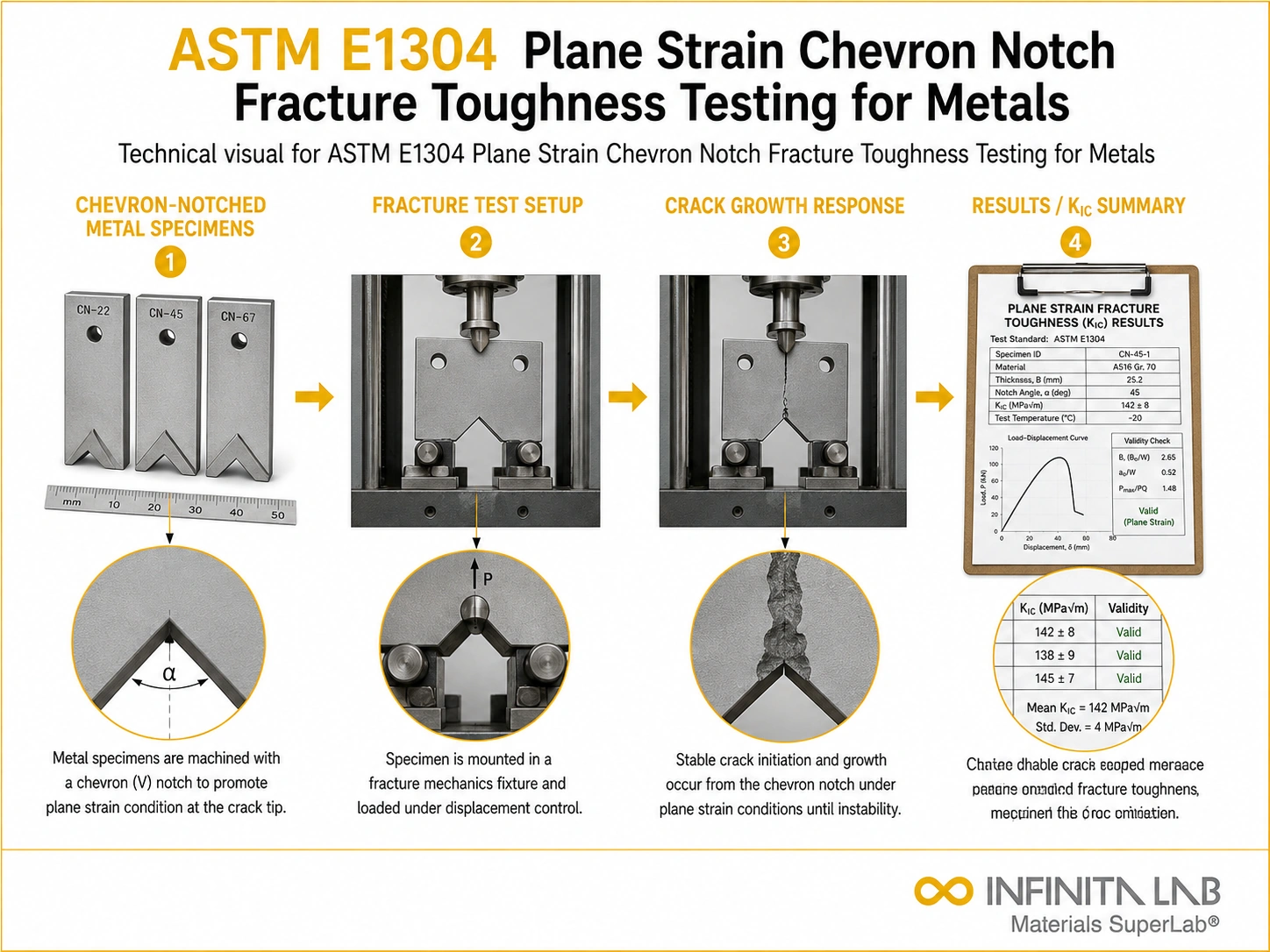


What Is ASTM E1304 Chevron Notch Fracture Toughness?
ASTM E1304 defines a standardized method to determine the plane-strain fracture toughness of metals using chevron-notched specimens. The test evaluates a material’s resistance to crack initiation and propagation under plane-strain conditions, where deformation is highly constrained.
The chevron-notch geometry promotes stable crack initiation, allowing precise identification of the critical load at which fracture occurs. The method is particularly useful for materials with limited ductility and provides a reliable measure of fracture toughness, which is essential for structural integrity assessment, failure analysis, and material selection in engineering applications.

Applications and Benefits of ASTM E1304 Chevron Notch Fracture Toughness Testing
Scope
ASTM E1304 establishes procedures for determining plane-strain fracture toughness using chevron-notched specimens under controlled loading conditions. It applies to metallic materials where linear-elastic fracture mechanics assumptions are valid.
- Determination of plane-strain fracture toughness (K_IC)
- Use of chevron-notched compact or bend specimens
- Applicable to metals with limited plastic deformation
- Controlled loading using fracture testing machines
- Crack initiation and propagation analysis under plane-strain conditions
Applications
- Fracture toughness evaluation of structural metals
- Material selection for aerospace and automotive components
- Failure analysis and crack propagation studies
- Quality control in metal manufacturing
- Research in fracture mechanics and material behavior
- Assessment of brittle and high-strength alloys
Benefits
- Provides accurate fracture toughness under plane-strain conditions
- Ensures reproducible and standardized fracture testing
- Reduces uncertainty in crack initiation measurements
- Applicable to a wide range of metallic materials
- Enhances reliability in structural design and safety assessment
- Supports predictive failure analysis and life estimation
Our ASTM E1304 Testing Procedure
Specimen Preparation
Machine chevron-notched specimens to precise dimensions with a pre-defined notch geometry.
1Pre-Cracking Setup
Install the specimen in the test fixture and align it properly in the loading apparatus.
2Controlled Loading
Apply increasing load at a constant rate until crack initiation and propagation occur.
3Fracture Analysis
Record critical load and analyze fracture surface to calculate fracture toughness.
4ASTM E1304 Test Parameters and Requirements
| Parameter | Details |
|---|---|
| Test Parameter | Plane-strain fracture toughness (K_IC) |
| Specimen Type | Chevron-notched compact or bend specimen |
| Loading Mode | Static monotonic loading |
| Stress Condition | Plane-strain (high constraint condition) |
| Crack Initiation | Induced by notch geometry |
| Material Types | Metals and high-strength alloys |
| Temperature | Ambient or controlled as required |
| Loading Rate | Controlled to ensure quasi-static conditions |


- Universal testing machine (UTM)
- Load cell with high precision
- Displacement measuring device (extensometer)
- Chevron-notched specimen fixture
- Data acquisition system
- Micrometer or precision measuring tools
- Fracture surface analysis tools (optical or SEM)
Equipment and Instrumentation Used for ASTM E1304 Testing
What You Receive: Test Report, Data, and Certification
- Fracture toughness value (K_IC)
- Load-displacement curve
- Critical load at crack initiation
- Fracture surface characterization
- Compliance with material specifications
- Test report with analysis and calculations
ASTM E1304 Chevron Notch Fracture Toughness FAQs
The chevron notch promotes stable crack initiation by concentrating stress at the notch tip and guiding crack growth. This eliminates the need for fatigue pre-cracking and allows more controlled, repeatable determination of fracture toughness in materials with limited ductility.
Plane-strain conditions create a highly constrained stress state that minimizes plastic deformation at the crack tip. This results in a conservative and material-specific fracture toughness value, which is critical for assessing worst-case failure scenarios in structural applications.
Unlike fatigue pre-crack methods such as ASTM E399, ASTM E1304 uses a chevron notch to initiate cracking. This reduces specimen preparation complexity and is particularly useful for materials where fatigue pre-cracking is difficult or unreliable.
Specimen geometry directly influences stress distribution and crack behavior. Precise chevron-notch dimensions ensure consistent crack initiation and valid fracture mechanics calculations.
It provides reliable fracture toughness data essential for predicting failure, enabling engineers to design safer structures and select materials that can withstand critical stress conditions without catastrophic failure.
Chevron fracture testing evaluates the fracture toughness of advanced ceramics using a beam specimen with a V-shaped notch. The specimen is loaded in bending, allowing a crack to grow stably from the notch; the applied force is measured and used to calculate fracture toughness. ASTM C1421 covers the chevron-notched beam method for advanced ceramics at ambient temperature.
Why Choose Infinita Lab for Chevron Notch Fracture Toughness Testing?
When your Chevron Notch Fracture Toughness results have to hold up - for compliance, a customer audit, or an engineering decision - ASTM E1304 accuracy and an unbiased third-party report matter more than price. Infinita Lab routes your ASTM E1304 chevron notch fracture toughness testing to ISO/IEC 17025-accredited U.S. partner labs with hands-on method experience, so you get defensible data, transparent reporting, and turnaround times built around your project deadline - not ours.

Looking for an Accredited Partner for ASTM E1304 Chevron Notch Fracture Toughness Testing?
Send query us at hello@infinitalab.com or call us at (888) 878-3090 to learn more about our services and how we can support you.





