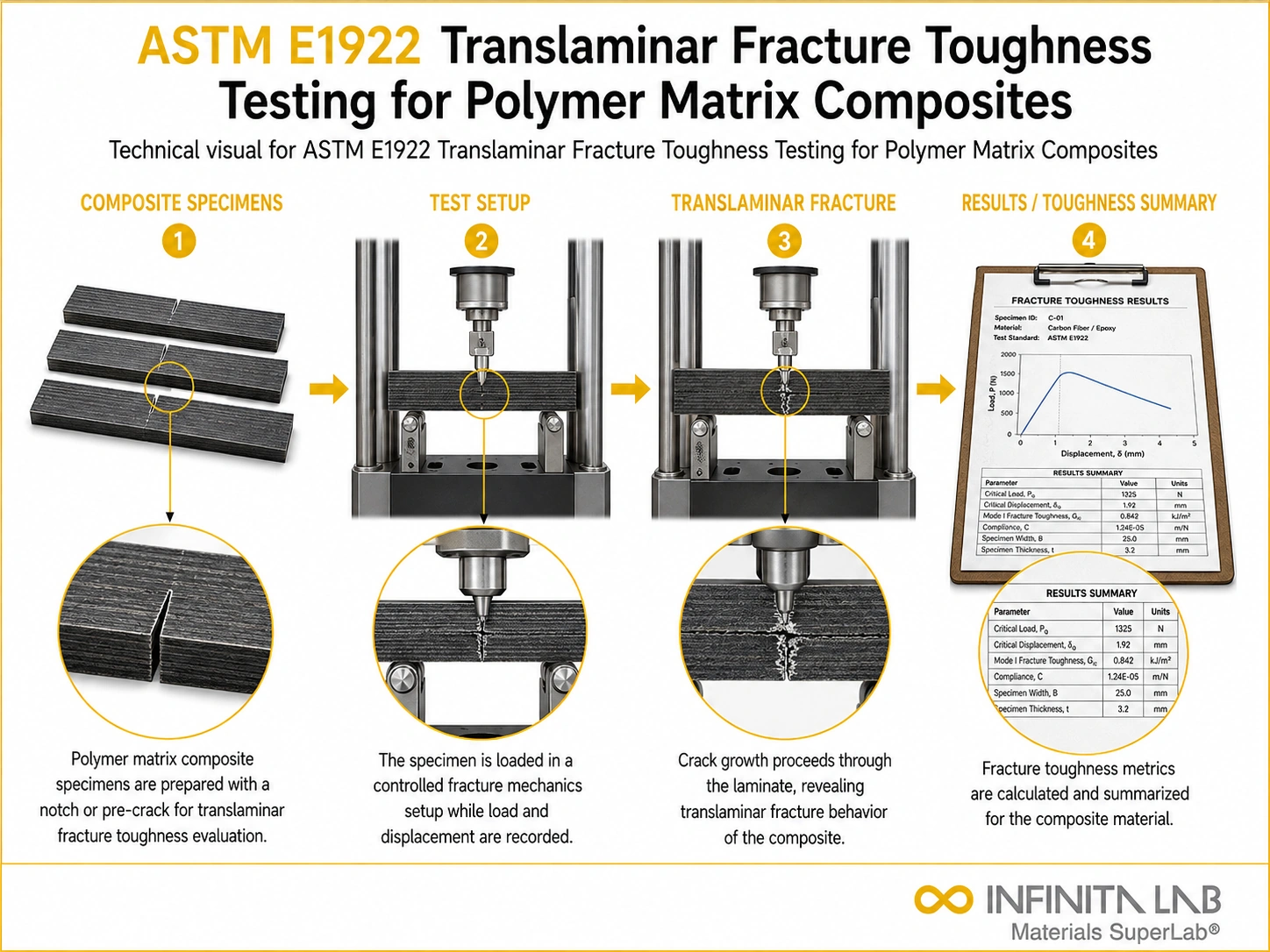


What Is ASTM E1922 Polymer Matrix Composite Translaminar Fracture Toughness?
ASTM E1922 provides a test method for determining the translaminar fracture toughness of polymer materials. This property represents the resistance of a polymer to crack propagation through the material thickness (in the transverse direction).
This standard is widely used to evaluate structural polymers and composites, where resistance to crack growth is critical to performance and durability.

Applications and Benefits of ASTM E1922 Polymer Matrix Composite Translaminar Fracture Toughness Testing
Scope
ASTM E1922 focuses on measuring fracture toughness under controlled loading conditions to assess crack initiation and propagation in polymers. It ensures the accurate characterization of a material’s resistance to fracture.
The test evaluates:
- Fracture toughness (K or G values)
- Crack initiation resistance
- Crack propagation behavior
- Material toughness
- Structural reliability
Applications
- Polymer and plastic materials
- Fiber-reinforced composites
- Structural components
- Aerospace and automotive parts
- Research and quality control
Benefits
- Provides accurate fracture toughness data
- Supports material selection and design
- Improves product durability
- Enables comparison of materials
- Enhances structural safety
Our ASTM E1922 Testing Procedure
Sample Preparation
Notched polymer specimen is prepared.
1Loading
Specimen is subjected to controlled loading.
2Crack Monitoring
Crack initiation and growth are observed.
3Data Recording & Evaluation
Fracture toughness is calculated.
4ASTM E1922 Test Parameters and Requirements
| Parameter | Details |
|---|---|
| Applicable Materials | Polymers and composites |
| Specimen Type | Notched specimens (e.g., compact tension) |
| Loading Mode | Mode I (opening mode) |
| Test Temperature | Ambient or controlled conditions |
| Measured Outputs | Fracture toughness (K_IC or G_IC) |


- Universal testing machine
- Fracture mechanics fixtures
- Crack measurement tools
- Extensometer
- Data acquisition system
Equipment and Instrumentation Used for ASTM E1922 Testing
What You Receive: Test Report, Data, and Certification
- Fracture toughness values (K_IC or G_IC)
- Crack growth analysis
- Material performance evaluation
- Test condition summary
- ASTM compliance report
ASTM E1922 Polymer Matrix Composite Translaminar Fracture Toughness FAQs
ASTM E1922 is a standard test method used to determine translaminar fracture toughness of polymer materials, evaluating resistance to crack propagation through thickness under controlled loading conditions.
ASTM E1922 is important because it helps assess durability and failure resistance of polymers, ensuring reliable performance in structural, aerospace, and engineering applications.
ASTM E1922 involves loading a notched polymer specimen to initiate and propagate a crack, measuring energy required for crack growth through the material thickness.
ASTM E1922 requires a universal testing machine, fracture mechanics fixtures, and crack measurement tools to evaluate toughness accurately.
ASTM E1922 results are reported as fracture toughness values, indicating resistance to crack growth and helping determine material performance and suitability.
Why Choose Infinita Lab for Polymer Matrix Composite Translaminar Fracture Toughness Testing?
When your Polymer Matrix Composite Translaminar Fracture Toughness results have to hold up - for compliance, a customer audit, or an engineering decision - ASTM E1922 accuracy and an unbiased third-party report matter more than price. Infinita Lab routes your ASTM E1922 polymer matrix composite translaminar fracture toughness testing to ISO/IEC 17025-accredited U.S. partner labs with hands-on method experience, so you get defensible data, transparent reporting, and turnaround times built around your project deadline - not ours.

Need ASTM E1922 Polymer Matrix Composite Translaminar Fracture Toughness Testing You Can Rely On?
Send query us at hello@infinitalab.com or call us at (888) 878-3090 to learn more about our services and how we can support you.





